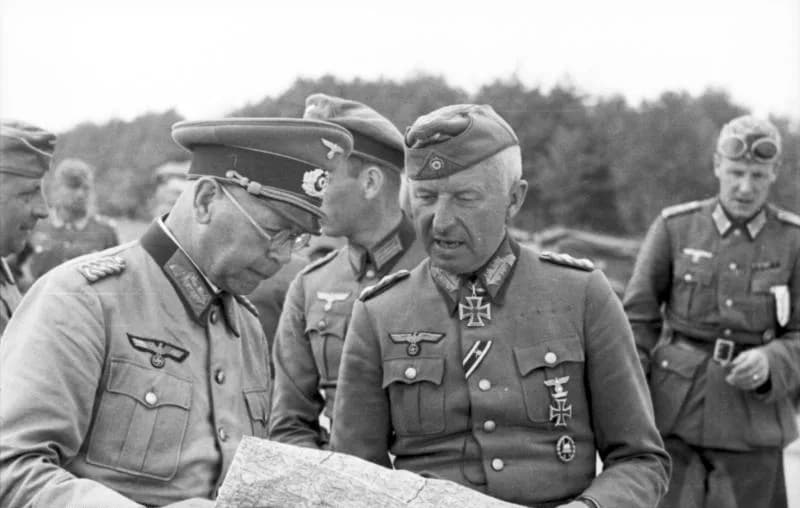
Considered one of the Wehrmacht's most brilliant strategists, Erich von Manstein was the architect of the Sichelschnitt plan that enabled the lightning victory over France in 1940. Commanding on the Eastern Front, he led the conquest of Sevastopol and the Kharkov counteroffensive before being dismissed by Hitler in 1944.
Erich von Lewinski, the future Erich von Manstein, was born on November 24, 1887 in Berlin into a family deeply rooted in Prussian military tradition. The tenth child of artillery General Eduard von Lewinski, he was adopted at birth by General Georg von Manstein, his mother's brother, in accordance with a predetermined family arrangement. This adoption placed him at the heart of the Prussian military aristocracy: his adoptive father, his biological father, and his uncle Hindenburg (future president of the Reich) were all generals. Raised in an environment where military service was considered the natural vocation of a Prussian gentleman, young Erich entered the cadet corps at Plön at age twelve, then Berlin-Lichterfelde, the prestigious Prussian military academy. He was commissioned as a lieutenant in the 3rd Foot Guards Regiment in 1906. During World War I, he served as a staff officer on both the Western and Eastern Fronts, participating in the battles of the Marne, Verdun, and the Brusilov Offensive. Seriously wounded in November 1914, he returned to service after convalescence and ended the war as a staff captain, having acquired solid operational experience. During the Weimar Republic, he continued his career in the Reichswehr, reduced to 100,000 men by the Treaty of Versailles, holding various staff positions that refined his skills in strategic and operational planning.
Manstein's career experienced rapid ascension in the 1930s, driven by his recognized talents as a strategist and planner. Appointed chief of staff of Army Group South in 1938, he participated in planning the Anschluss and the invasion of the Sudetenland. However, it was as chief of staff of Army Group A, under Gerd von Rundstedt's command, that he conceived the plan that would change the course of the war. The initial plan for invading France, Fall Gelb, envisioned a main advance through Belgium and the Netherlands, a repetition of the 1914 Schlieffen Plan that the French had anticipated. Manstein proposed a bold alternative: the Sichelschnitt (sickle cut), concentrating armored forces for a breakthrough through the Ardennes, considered impassable for tanks, then a race to the Channel to cut off Allied armies in Belgium. This plan, initially rejected by the conservative general staff, was presented to Hitler at a dinner in February 1940 and enthusiastically adopted. The spectacular success of May-June 1940 brilliantly validated Manstein's vision. Promoted to General of Infantry, he commanded a corps during the invasion of France, then the LVI Panzer Corps at the start of Operation Barbarossa. His lightning advance toward Leningrad, where his corps covered over 300 kilometers in four days, confirmed his qualities as an offensive commander. In September 1941, he received command of the 11th Army in Crimea, a mission that would establish his reputation as one of the war's greatest tacticians.
The period 1941-1944 constituted the peak and decline of Manstein's military career. In Crimea, he led the 11th Army in a brilliant campaign that culminated in the capture of Sevastopol in July 1942, after a 250-day siege and one of the most intense artillery bombardments of the war. The use of the giant Schwerer Gustav cannon, 800mm caliber, symbolized the firepower deployed against this fortress. For this victory, Manstein was promoted to Field Marshal. Transferred to the Leningrad front in autumn 1942, he was abruptly redirected south after the Stalingrad disaster. Appointed commander of the new Army Group Don in November 1942, he attempted in vain to break the encirclement of Paulus's 6th Army during Operation Winter Storm. The failure of this rescue attempt, due partly to Paulus's refusal to attempt a breakout southward, marked a bitter moment. However, it was in the Kharkov counteroffensive of February-March 1943 that Manstein demonstrated his purest tactical genius. As the front seemed about to collapse, he deliberately allowed the Soviets to advance then struck their exposed flanks with his panzer divisions, recapturing Kharkov and stabilizing the entire southern front. This victory, achieved with greatly outnumbered forces, is considered by many historians as the tactical masterpiece of the Eastern Front war. At Kursk in July 1943, he commanded the southern prong of the offensive but was unable to break through Soviet defenses in depth. Subsequently, he conducted a series of skillful retreats against the growing superiority of the Red Army, advocating elastic defense that Hitler systematically refused.
Manstein's decisions reflect the contradictions of a brilliant military mind operating within a morally condemnable context. His most consequential decision was the conception of the Sichelschnitt plan, which transformed a potentially long war into a lightning six-week victory. Without this strategic audacity, the fall of France and German domination of Western Europe might not have occurred, or would have taken a very different form. His stubborn insistence to Hitler for the plan's adoption, going over the general staff hierarchy, demonstrated rare intellectual courage. In Crimea, his decision to concentrate overwhelming firepower on Sevastopol rather than attempting an early direct assault enabled a decisive victory at lower human cost than other approaches would have entailed. His Kharkov counteroffensive illustrated his ability to make bold decisions under pressure: rather than yielding to ambient panic, he coolly assessed the situation and identified the precise moment when the enemy would be vulnerable. His relationship with Hitler was marked by unusual frankness. He did not hesitate to contradict the Führer on strategic questions, constantly advocating for elastic defense allowing tactical retreats followed by counterattacks, rather than Hitler's 'not one step back' doctrine. This courage ultimately cost him his command on March 30, 1944. However, Manstein refused to participate in the July 20, 1944 plot, considering that a military coup would be catastrophic for Germany. This decision considerably tarnished his moral legacy.
Erich von Manstein's legacy is one of the most debated among World War II commanders. Militarily, he is widely considered the Wehrmacht's most gifted strategist, surpassing even Guderian and Rommel in operational art. His Sichelschnitt plan remains studied in military academies worldwide as a model of strategic audacity. His memoirs, 'Lost Victories' (Verlorene Siege), published in 1955, became a bestseller and helped shape the 'clean Wehrmacht' myth, according to which professional soldiers fought honorably while only the SS and Nazi regime committed atrocities. This thesis is now largely refuted by historians. At his trial by a British military tribunal in 1949, Manstein was found guilty of negligence regarding war crimes committed in his command zone, notably the execution of prisoners of war and Jewish civilians by the Einsatzgruppen in Crimea. Sentenced to 18 years in prison, his sentence was reduced to 12 years, and he was released in 1953. He subsequently served as an advisor for the creation of the Bundeswehr, the new West German army, influencing its structure and doctrine. The debate over Manstein crystallizes the broader question of the responsibility of professional officers serving a criminal regime. His undeniable military genius coexists with his passivity in the face of war crimes and his refusal to actively oppose the Nazi regime, illustrating the moral complexity of this generation of German officers caught between military duty and ethical conscience.
The Sichelschnitt (sickle cut) was Manstein's plan for invading France: concentrate armored forces for a breakthrough through the Ardennes, deemed impassable for tanks, then race to the Channel to cut off Allied armies in Belgium. Rejected by the conservative general staff, Manstein presented his plan directly to Hitler at a dinner in February 1940. The six-week victory (May-June 1940) brilliantly validated this strategic audacity.
With the front seemingly about to collapse after Stalingrad, Manstein refused to panic. He deliberately allowed the Soviets to advance into an exposed salient, then struck their flanks with his panzer divisions, recapturing Kharkov and stabilizing the entire southern front. This victory was achieved with greatly outnumbered forces against a confident Soviet army on the move. Historians cite it as the purest example of Manstein's operational art.
Manstein refused to join the July 20, 1944 plot, believing a military coup would be catastrophic for Germany at war. He preferred to exercise influence through direct confrontation with Hitler on strategic matters, constantly advocating for elastic defense that the Führer refused. This refusal constitutes the most controversial aspect of his moral legacy, alongside his passivity toward Einsatzgruppen crimes in his command zone in Crimea.
Information cross-checked against Wikipedia and reference historical works.
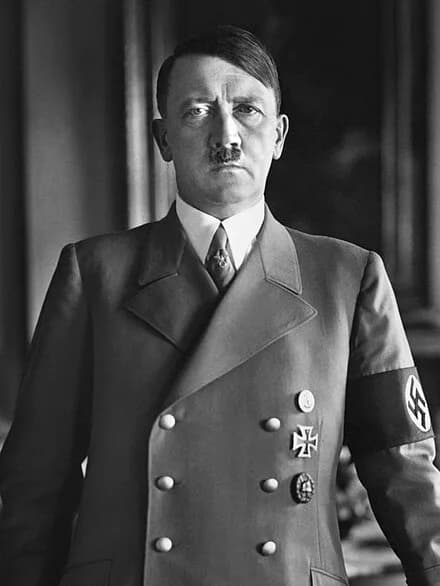
Adolf Hitler
Dictator of Nazi Germany from 1933 to 1945, Adolf Hitler was the primary instigator of World War II and the Holocaust. His racist and expansionist ideology caused the deaths of tens of millions of people worldwide. Appointed chancellor on 30 January 1933, he had dismantled the Weimar Republic within eighteen months and taken absolute power.
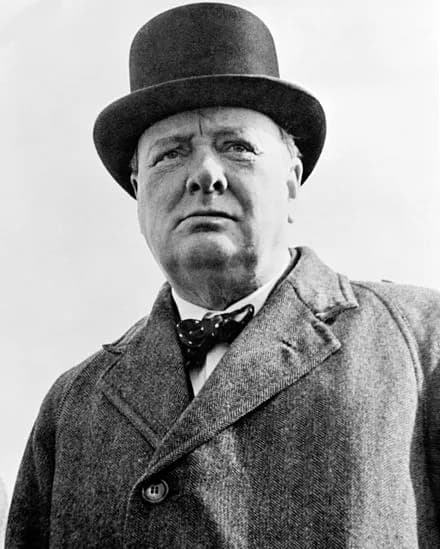
Winston Churchill
Prime Minister of the United Kingdom from 1940 to 1945, Winston Churchill embodied British resistance to Nazi Germany. His rousing speeches and unwavering leadership were instrumental in sustaining British morale through the darkest hours of the war. He refused any negotiated peace after the fall of France.
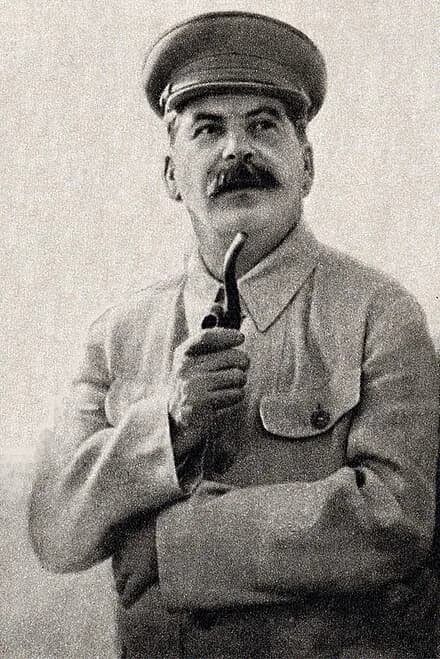
Joseph Stalin
Leader of the Soviet Union from 1924 to 1953, Joseph Stalin transformed the USSR into an industrial and military superpower. His leadership during the Great Patriotic War was decisive in defeating Nazi Germany, but his totalitarian regime caused millions of deaths among his own people.
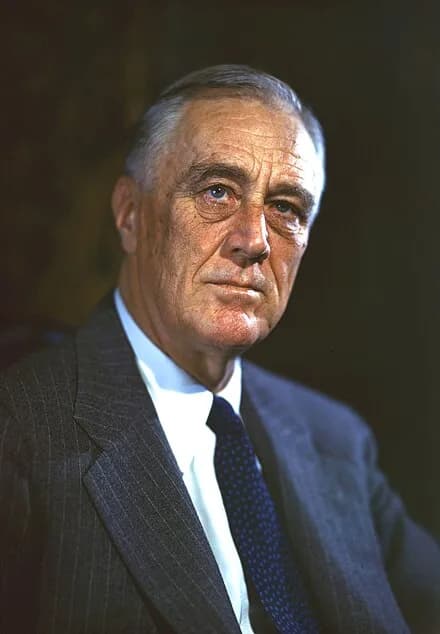
Franklin D. Roosevelt
32nd President of the United States, Franklin D. Roosevelt led the country through the Great Depression and most of World War II. His Lend-Lease program and diplomacy with Churchill and Stalin were decisive in the Allied victory, though he died just weeks before Germany's surrender.
