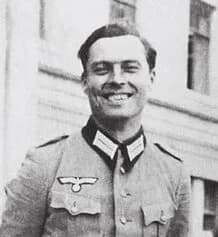
Colonel Claus von Stauffenberg was the driving force behind the July 20, 1944 plot, the most famous assassination attempt against Adolf Hitler. Severely wounded in North Africa, he planted a bomb at the Führer's headquarters at the Wolf's Lair, but Hitler survived. Stauffenberg was executed that same evening.
Claus Philipp Maria Schenk Graf von Stauffenberg was born on November 15, 1907 at Jettingen Castle in Bavaria, into one of the oldest and most prestigious families of the Catholic nobility of southern Germany. The Stauffenbergs, whose title of count dated back to the eighteenth century, belonged to the social and cultural elite of Swabia. His father, Alfred Schenk Graf von Stauffenberg, was chamberlain to the last king of Württemberg, and his mother, Caroline, Countess von Üxküll-Gyllenband, was lady-in-waiting to the queen. Claus and his twin brothers, Berthold and Alexander, grew up in an aristocratic environment steeped in Catholicism, classical culture, and chivalric ideals. Young Claus was a sensitive and intellectually brilliant child, passionate about poetry, architecture, and horsemanship. In the 1920s, the three brothers joined the circle of the mystic poet Stefan George, whose spiritual and aesthetic influence profoundly marked Stauffenberg. George preached a renewal of Germany founded on beauty, nobility of soul, and personal sacrifice, ideals that shaped the young aristocrat's worldview. In 1926, Stauffenberg enlisted in the Reichswehr, joining the 17th Cavalry Regiment at Bamberg, a natural choice for a young Bavarian nobleman. An accomplished horseman and promising officer, he was admitted to the War Academy in Berlin in 1936, where he distinguished himself with exceptional results in strategy and tactics. Unlike many of his contemporaries, Stauffenberg initially welcomed the Nazi regime with some enthusiasm, seeing in Hitler a leader capable of restoring Germany's greatness after the humiliation of Versailles.
Stauffenberg's military career was marked by exceptional competence and profound moral transformation. A brilliant staff officer, he served during the invasion of Poland in 1939 and the French campaign in 1940, acquiring a reputation as an officer both courageous and intellectually remarkable. Assigned to the Army General Staff, he participated in planning Operation Barbarossa in 1941. It was on the Eastern Front that his convictions began to shift. Witnessing atrocities committed against Soviet prisoners of war and civilian populations, and increasingly aware of the ongoing genocide against the Jews, Stauffenberg experienced a crisis of conscience that transformed the conservative patriot into a resolute conspirator. The Einsatzgruppen massacres, the inhuman conditions of prisoner camps, and Hitler's growing strategic incompetence convinced him that the Nazi regime was leading Germany toward moral and military catastrophe. In 1942, transferred to North Africa with the 10th Panzer Division, he was severely wounded on April 7, 1943 during an Allied air attack in Tunisia. He lost his left eye, right hand, and two fingers of his left hand. During his long convalescence, his resolve to overthrow Hitler crystallized. Despite his severe physical handicaps, he returned to active service and was appointed chief of staff of the Reserve Army in June 1944, a position that gave him access to military conferences at Hitler's headquarters and placed him at the heart of the apparatus needed for a coup d'état. He joined the circle of conspirators gathered around General Ludwig Beck and politician Carl Goerdeler, and quickly became the driving force of the plot.
Operation Valkyrie, the July 20, 1944 coup plan, was the masterwork of Stauffenberg and his co-conspirators. The plan was remarkably audacious: Stauffenberg was to assassinate Hitler during a military conference at the Wolfsschanze (Wolf's Lair), the Führer's headquarters in East Prussia, then the conspirators in Berlin would trigger the Walküre plan — a legitimate emergency plan designed to mobilize the reserve army in case of internal disturbances — to seize control of power centers. A provisional government, led by General Beck as head of state and Goerdeler as chancellor, would then negotiate peace with the Allies. On July 20, 1944, Stauffenberg traveled to the Wolf's Lair with two bombs concealed in his briefcase. Pressed for time and hampered by his injuries — he had only three functional fingers to arm the devices — he managed to arm only one of the two bombs. He placed the briefcase under the conference table, as close to Hitler as possible, then left the room on the pretext of a telephone call. The explosion at 12:42 devastated the wooden barracks but Hitler survived, protected by the massive oak tabletop. An officer had fortuitously moved the briefcase behind a thick table leg, deflecting the blast. Four people were killed and several severely wounded, but Hitler escaped with minor injuries: perforated eardrums, temporarily paralyzed right arm, and shredded trousers. Stauffenberg, convinced Hitler was dead after seeing the explosion from outside, flew to Berlin to trigger the coup.
Stauffenberg's decisions in the final months of his life reflect the courage of a man who knew that failure meant certain death. His fundamental decision to move from passive dissent to violent action was matured over more than a year of convalescence and moral reflection. Unlike other conspirators who still hoped for peaceful political change, Stauffenberg concluded by 1943 that only Hitler's assassination could save Germany and stop the slaughter. This conviction distinguished him from the hesitant and the wait-and-see faction and made him the engine of the plot. His decision to personally assume the role of assassin, despite his severe physical handicaps, demonstrated exceptional courage. Several other conspirators had failed to act at the last moment, paralyzed by fear or scruples. Stauffenberg, with one eye, three fingers, and inflexible determination, took this mortal responsibility upon himself. The choice to arm only one bomb, though dictated by circumstances, proved fatal: the explosive power of two bombs would likely have killed Hitler despite the table's protection. Similarly, the decision to leave the Wolf's Lair before verifying Hitler's death, understandable given the need to reach Berlin quickly, created the uncertainty that paralyzed the Berlin conspirators during crucial hours. The decisions taken after the explosion in Berlin, where Stauffenberg attempted to keep the coup going despite news of Hitler's survival, reveal a man of desperate energy yet lucid about the declining chances of success.
Stauffenberg's fate was sealed in the chaotic hours following the explosion. In Berlin, the conspirators, hesitating in the face of contradictory information about Hitler's death, lost precious time. When Hitler appeared live on the radio that night, confirming his survival, the coup collapsed. Loyalist officers regained control of the Bendlerblock, the Reserve Army headquarters in Berlin. Stauffenberg, his adjutant Werner von Haeften, General Friedrich Olbricht, and Colonel Albrecht Mertz von Quirnheim were arrested and shot in the Bendlerblock courtyard shortly after midnight on July 21, 1944. According to witnesses, Stauffenberg shouted 'Long live sacred Germany!' before being shot. He was thirty-six years old. The repression that followed was of unprecedented ferocity. Hitler ordered a massive purge that led to the arrest of more than 7,000 people and the execution of approximately 5,000, including many innocents connected directly or indirectly to the conspirators. The principal plotters were tried by the Volksgerichtshof (People's Court) under Judge Roland Freisler and executed by hanging with piano wire at Plötzensee prison, their agonies filmed on Hitler's orders. Stauffenberg's legacy evolved considerably over the decades. Long regarded with ambivalence by postwar Germany — some viewing him as a traitor, others as a hero — he is today unanimously recognized as a symbol of German resistance to Nazism. The Bendlerblock memorial in Berlin, inaugurated in 1953, honors his memory and that of his companions. July 20 has become an official commemoration date in Germany, and numerous Bundeswehr barracks bear Stauffenberg's name. His story inspired the film 'Valkyrie' (2008) starring Tom Cruise, helping to make the July 20 plot internationally known. Stauffenberg's moral legacy lies in the demonstration that even at the heart of a totalitarian regime, individual courage and moral conscience can lead to action, even if doomed to failure.
Stauffenberg placed a bomb in his briefcase under the conference table at the Wolf's Lair (Wolfsschanze) in East Prussia, then left the room. The explosion at 12:42 devastated the barracks and killed four people, but Hitler survived: an officer had moved the briefcase behind a thick table leg. Stauffenberg had only managed to arm one of the two planned bombs due to his injuries — missing one eye and three fingers.
Claus Philipp Maria Schenk Graf von Stauffenberg was born on November 15, 1907, in Jettingen, Bavaria, into a family of high Catholic Swabian nobility. Son of the chamberlain to the last king of Württemberg, he grew up in an aristocratic milieu marked by the poet Stefan George's influence. A brilliant staff officer, he served in Poland, France, and North Africa, where he was severely wounded in 1943 in Tunisia.
Stauffenberg, his adjutant Werner von Haeften, General Friedrich Olbricht, and Colonel Mertz von Quirnheim were shot in the Bendlerblock courtyard in Berlin shortly after midnight on July 21, 1944. Witnesses reported Stauffenberg shouted 'Long live sacred Germany!' Hitler ordered a massive purge: over 7,000 arrests and approximately 5,000 executions. The principal plotters were hanged with piano wire at Plötzensee prison.
Information cross-checked against Wikipedia and reference historical works.
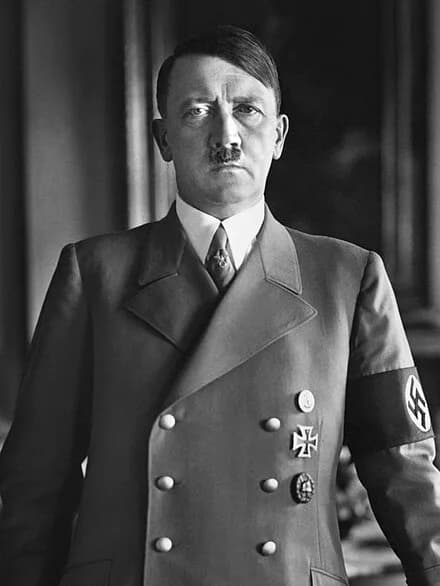
Adolf Hitler
Dictator of Nazi Germany from 1933 to 1945, Adolf Hitler was the primary instigator of World War II and the Holocaust. His racist and expansionist ideology caused the deaths of tens of millions of people worldwide. Appointed chancellor on 30 January 1933, he had dismantled the Weimar Republic within eighteen months and taken absolute power.
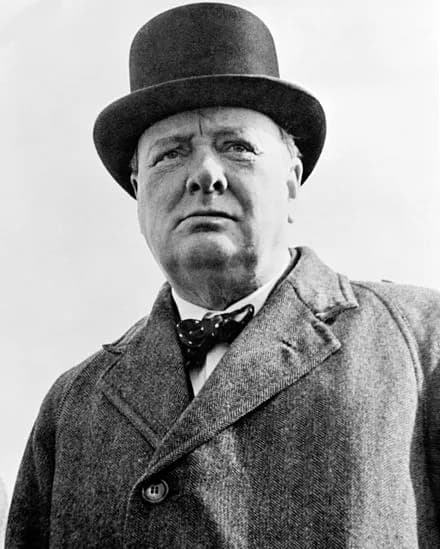
Winston Churchill
Prime Minister of the United Kingdom from 1940 to 1945, Winston Churchill embodied British resistance to Nazi Germany. His rousing speeches and unwavering leadership were instrumental in sustaining British morale through the darkest hours of the war. He refused any negotiated peace after the fall of France.
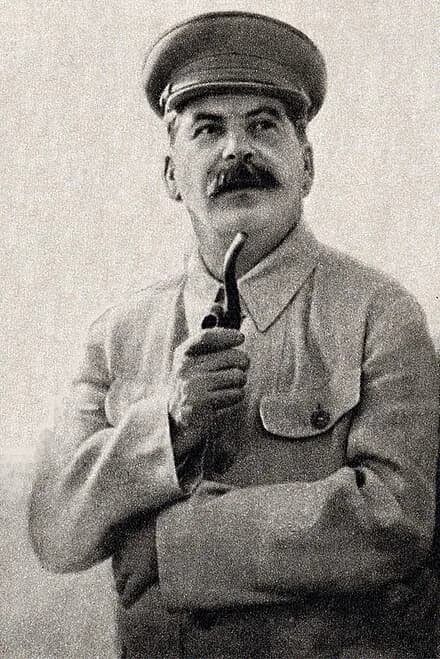
Joseph Stalin
Leader of the Soviet Union from 1924 to 1953, Joseph Stalin transformed the USSR into an industrial and military superpower. His leadership during the Great Patriotic War was decisive in defeating Nazi Germany, but his totalitarian regime caused millions of deaths among his own people.
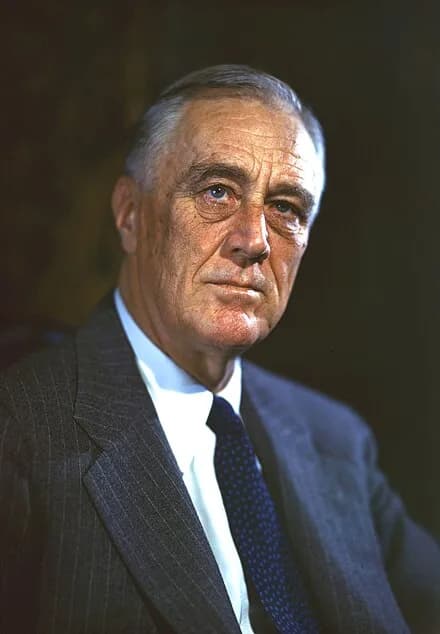
Franklin D. Roosevelt
32nd President of the United States, Franklin D. Roosevelt led the country through the Great Depression and most of World War II. His Lend-Lease program and diplomacy with Churchill and Stalin were decisive in the Allied victory, though he died just weeks before Germany's surrender.
