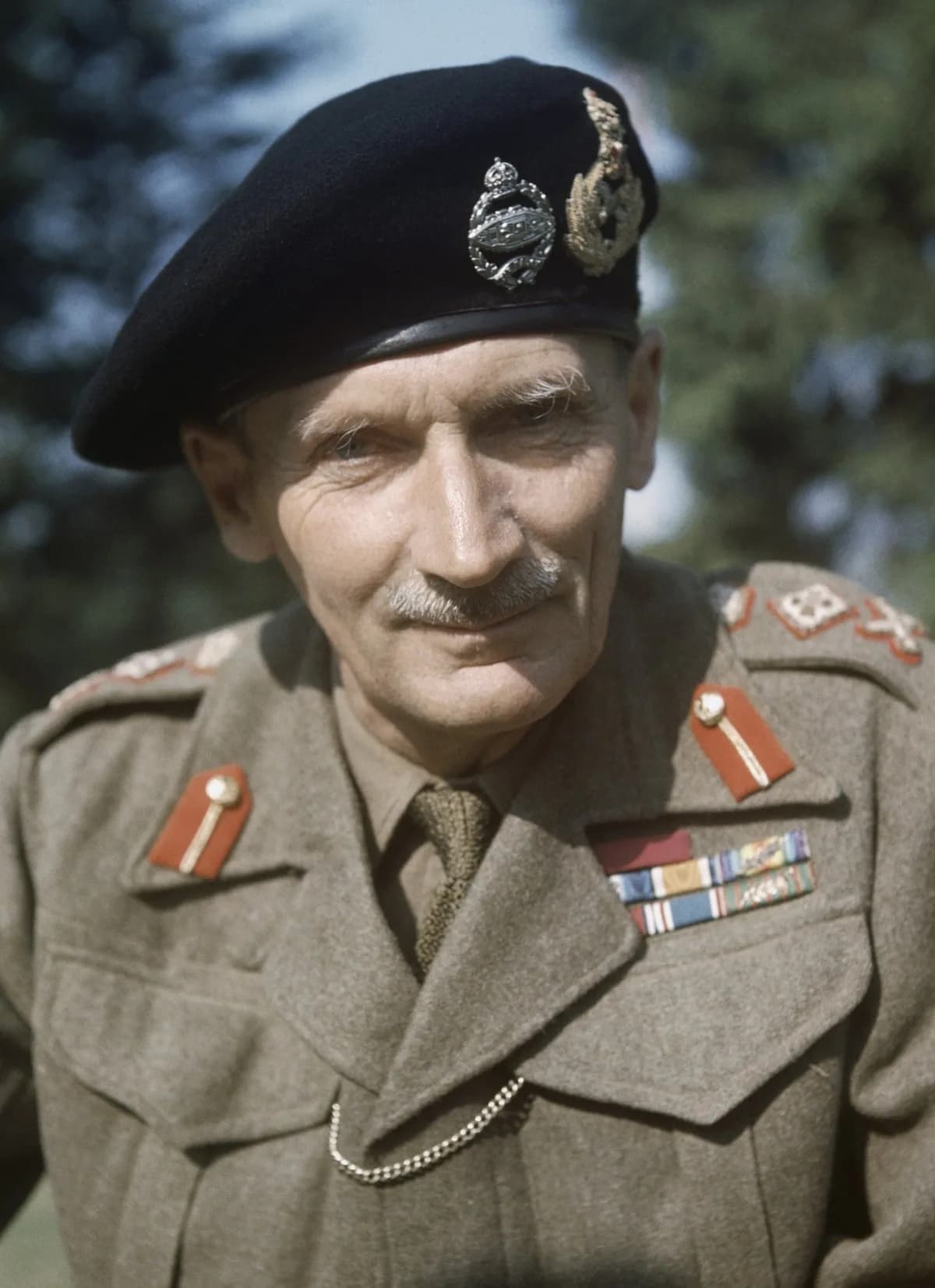
Field Marshal Bernard Law Montgomery, nicknamed Monty, was one of the most famous British commanders of World War II. His decisive victory at El Alamein in 1942 marked the turning point of the war in North Africa and made him a British national hero.
Bernard Law Montgomery was born on November 17, 1887, in Kennington, south London, into an Anglo-Irish family connected to the Anglican Church. His father Henry, a vicar and later bishop in Tasmania, took the family to Australia where young Bernard grew up from 1889 to 1901. Returning to England, he entered the Royal Military Academy Sandhurst in 1907 and joined the Royal Warwickshire Regiment in 1908. During World War I, he served on the Western Front and was severely wounded at Meteren in October 1914 by a bullet that pierced his lung. This traumatic experience forged his conviction that human losses must be minimized through meticulous planning. Between the wars, he rose through the military ranks, developing a methodical and cautious approach to command. He married Betty Carver in 1927, who died tragically in 1937 from an infected insect bite, leaving him a widower with a young son. This event made him even more austere and entirely devoted to his military career.
At the start of World War II, Montgomery commanded the 3rd Infantry Division during the 1940 French campaign and organized an exemplary retreat to Dunkirk. Back in England, he spent two years training troops for a potential invasion, perfecting his command methods based on clarity of orders, intensive training, and direct communication with soldiers. His career took a decisive turn in August 1942 when Churchill appointed him commander of the British 8th Army in Egypt, replacing General Auchinleck. In six weeks, Montgomery transformed the morale of the 8th Army through his constant presence at the front, his iconic beret, and his inspiring speeches. The victory at El Alamein in October-November 1942, where he definitively repelled Rommel's Afrikakorps, was the first major British land success of the war. Churchill declared it was the end of the beginning. Montgomery pursued Rommel across Libya and Tunisia, culminating in the surrender of Axis forces in North Africa in May 1943.
After North Africa, Montgomery commanded Allied ground forces during the landings in Sicily (July 1943) and then on the Italian mainland. Appointed commander of the 21st Army Group for Operation Overlord, he played a central role in planning D-Day on June 6, 1944. He commanded all Allied ground forces during the Battle of Normandy, applying his characteristic strategy: drawing German Panzers around Caen in the east to enable the American breakout in the west with Operation Cobra. After the liberation of Paris, his bold Market Garden plan (September 1944) aiming to cross the Rhine in the Netherlands failed at Arnhem, his most controversial setback. During the Battle of the Bulge (December 1944), Eisenhower placed him in command of Allied forces in the northern sector, which he managed effectively. In March 1945, he organized the Rhine crossing with characteristic meticulous preparation, and his forces advanced through northern Germany to the Baltic Sea. On May 4, 1945, he accepted the surrender of all German forces in northwestern Europe on Luneburg Heath.
Montgomery's strategic decisions remain among the most debated of the war. His methodical caution at El Alamein, where he refused to attack before achieving overwhelming material superiority, earned him criticism for slowness but ensured a decisive victory with minimal casualties. In Normandy, his attrition strategy around Caen is considered by some historians as brilliant and by others as an initial failure repackaged as success after the fact. Operation Market Garden, the most ambitious airborne operation in history, failed partly due to overly optimistic planning and the disregard of intelligence indicating the presence of Panzer divisions at Arnhem. His personal rivalry with American General George Patton and constant friction with Eisenhower over the question of a single thrust toward Berlin versus a broad front poisoned inter-allied relations. Montgomery demanded supreme ground command, a position Eisenhower refused to grant him. Despite these controversies, his ability to inspire his troops and his mastery of planned defensive battle remain undisputed.
After the war, Montgomery became Chief of the Imperial General Staff (1946-1948) and then first Deputy Supreme Allied Commander Europe at NATO (1951-1958), helping to structure Western defense during the Cold War. Elevated to Viscount Montgomery of Alamein in 1946, he published his controversial memoirs in 1958, openly criticizing Eisenhower and several former colleagues. His command style, based on meticulous planning, guaranteed material superiority before any offensive, and direct communication with rank-and-file soldiers, profoundly influenced British military doctrine. His victory at El Alamein remains a foundational moment in British national memory, proving that Britain could defeat Axis forces on the ground. A complex character, vain and difficult but of undeniable military competence, Montgomery died on March 24, 1976, at Isington Mill in Hampshire. His legacy still divides historians between admirers of his defensive tactical genius and critics of his excessive caution and outsized ego.
Field Marshal Bernard Montgomery systematically refused to attack before guaranteeing material superiority: at El Alamein in October 1942, he waited until he had 195,000 men and 1,029 tanks against 116,000 and 547 on the opposing side. His method rested on meticulous planning, concentration of firepower, and direct communication with soldiers. Severely wounded in the lung in 1914, he had understood that needless casualties result from improvisation.
Operation Market Garden (September 1944), planned by Field Marshal Bernard Montgomery, was the largest airborne operation in history. It aimed to cross the Rhine in the Netherlands via a series of bridges, including the one at Arnhem. The operation failed partly due to overly optimistic planning and the dismissal of intelligence reports indicating two SS Panzer divisions near Arnhem. British paratroopers of the 1st Airborne Division were encircled and most were captured or killed.
Appointed commander of the 21st Army Group for Operation Overlord, Bernard Montgomery played a central role in planning D-Day on June 6, 1944. During the Battle of Normandy, he commanded all Allied ground forces, applying an attrition strategy: drawing German Panzers around Caen in the east to enable the American breakout in the west with Operation Cobra. On May 4, 1945, he accepted the surrender of all German forces in northwestern Europe on Luneburg Heath.
Information cross-checked against Wikipedia and reference historical works.
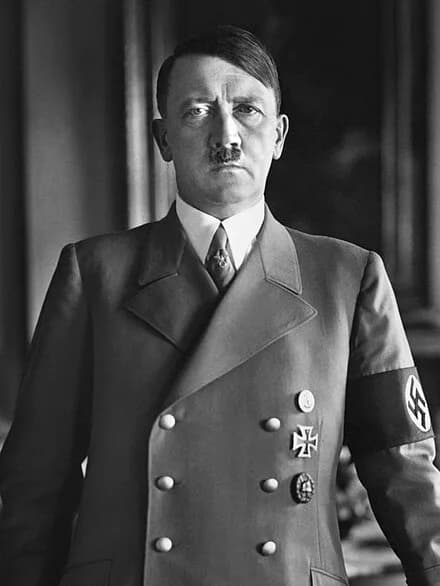
Adolf Hitler
Dictator of Nazi Germany from 1933 to 1945, Adolf Hitler was the primary instigator of World War II and the Holocaust. His racist and expansionist ideology caused the deaths of tens of millions of people worldwide. Appointed chancellor on 30 January 1933, he had dismantled the Weimar Republic within eighteen months and taken absolute power.
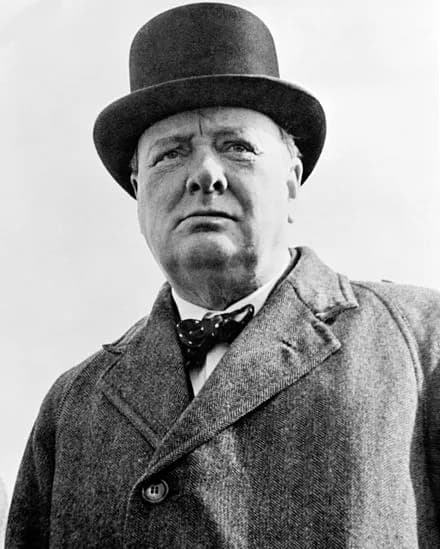
Winston Churchill
Prime Minister of the United Kingdom from 1940 to 1945, Winston Churchill embodied British resistance to Nazi Germany. His rousing speeches and unwavering leadership were instrumental in sustaining British morale through the darkest hours of the war. He refused any negotiated peace after the fall of France.
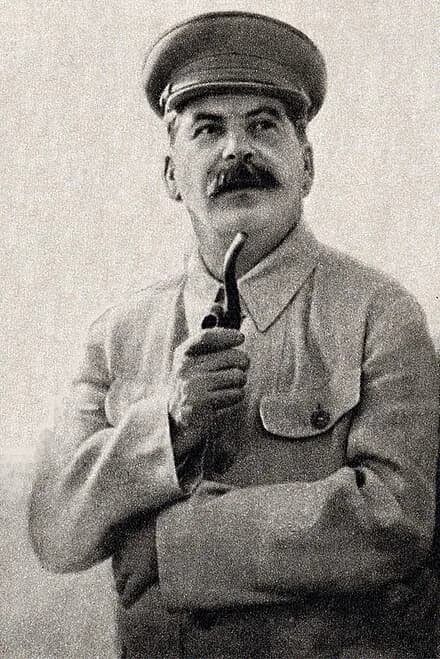
Joseph Stalin
Leader of the Soviet Union from 1924 to 1953, Joseph Stalin transformed the USSR into an industrial and military superpower. His leadership during the Great Patriotic War was decisive in defeating Nazi Germany, but his totalitarian regime caused millions of deaths among his own people.
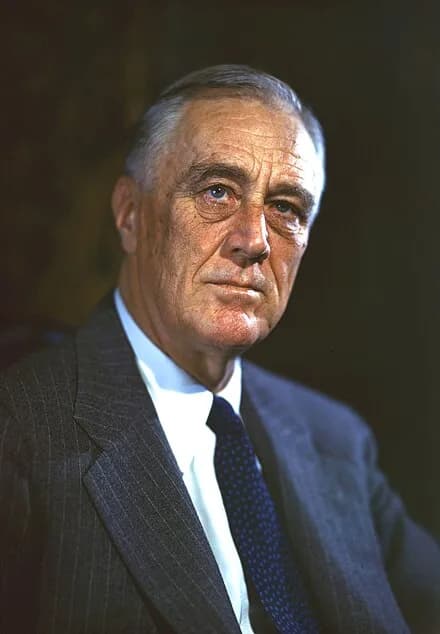
Franklin D. Roosevelt
32nd President of the United States, Franklin D. Roosevelt led the country through the Great Depression and most of World War II. His Lend-Lease program and diplomacy with Churchill and Stalin were decisive in the Allied victory, though he died just weeks before Germany's surrender.
