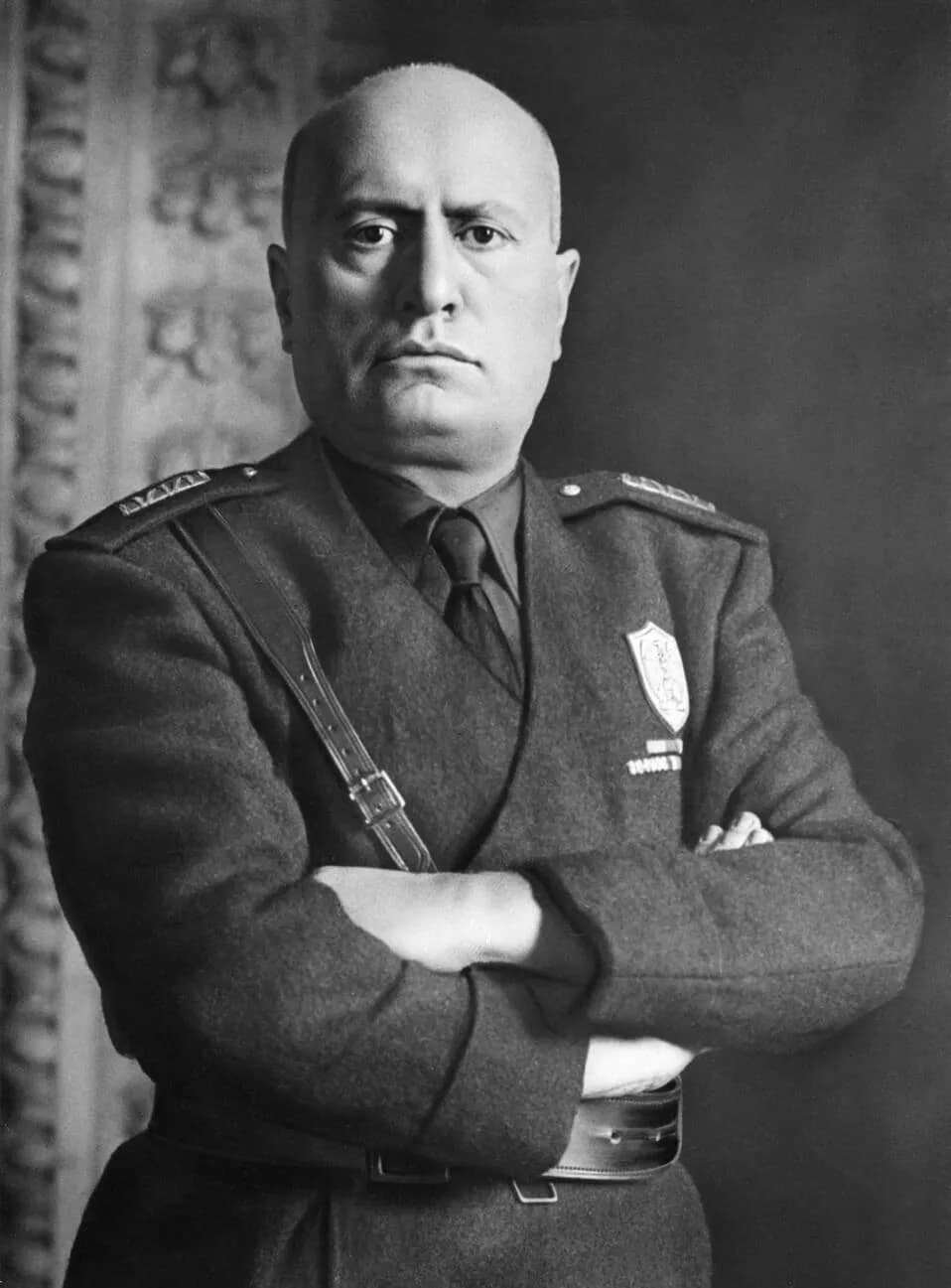
Fascist dictator of Italy from 1922 to 1943, Benito Mussolini was the founder of fascism and Adolf Hitler's ally during World War II. His totalitarian regime led Italy into a disastrous war that resulted in his downfall and execution by Italian partisans.
Benito Amilcare Andrea Mussolini was born on July 29, 1883, in Predappio, Romagna, into a modest family. His father Alessandro, a blacksmith and committed socialist, profoundly influenced his early political orientation. His mother Rosa, a devout schoolteacher, provided his basic education. The young Benito proved turbulent and rebellious, expelled from several schools for violent behavior. He nonetheless obtained his teaching diploma in 1901 and taught briefly before fleeing to Switzerland in 1902 to avoid military service. In Switzerland, he lived in poverty, worked as a bricklayer and laborer, and immersed himself in revolutionary socialism. He was arrested several times for political agitation. Returning to Italy in 1904, he completed his military service then resumed teaching and militant journalism. His talent as an orator and polemicist brought him to the attention of socialist circles. In 1912, he became editor of Avanti!, the main newspaper of the Italian Socialist Party, a position that gave him considerable national prominence.
Mussolini's break with socialism came in 1914 when he advocated Italy's entry into the war on the Allied side, resulting in his expulsion from the Socialist Party. After serving and being wounded at the front, he founded the Italian Fasces of Combat in March 1919, a nationalist and anti-socialist movement that attracted disillusioned veterans, arditi, and the petty bourgeoisie frightened by the revolutionary threat. Mussolini's Blackshirts terrorized socialists and trade unionists through systematic violence. The movement structured itself as the National Fascist Party in 1921. On October 28, 1922, the March on Rome — an orchestrated show of force by thousands of fascist militiamen — compelled King Victor Emmanuel III to appoint Mussolini as Prime Minister. Within a few years, he dismantled parliamentary democracy, muzzled the press, banned opposition parties, and established a personal dictatorship by proclaiming himself Duce. He signed the Lateran Accords with the Vatican in 1929, consolidating his power by reconciling the Italian state with the Catholic Church.
Mussolini brought Italy into World War II on June 10, 1940, convinced that German victory was imminent after the fall of France. But the Italian army, poorly equipped and poorly led, accumulated military disasters. The invasion of Greece in October 1940 turned into a humiliation, requiring German intervention. In North Africa, Italian forces were driven back by the British in Libya and Ethiopia, again forcing Hitler to send Rommel's Afrikakorps. The Italian navy suffered heavy losses, notably at Taranto and Cape Matapan. The deployment of the ARMIR to the Eastern Front ended with the destruction of eight Italian divisions at Stalingrad. Italy became the weak link of the Axis, increasingly dependent on Germany. Allied bombing devastated Italian cities and popular morale collapsed. In July 1943, following the Allied landing in Sicily, the Grand Council of Fascism voted to depose Mussolini. The king had him arrested on July 25, 1943.
Mussolini's strategic decisions were almost uniformly disastrous for Italy. His entry into the war in 1940 was motivated by opportunism rather than a realistic assessment of Italian military capabilities. The attack on Greece, launched without adequate preparation and without consulting his generals, humiliated Italy and dispersed its forces. His decision to send troops to the Eastern Front deprived North Africa of crucial reinforcements. After his arrest in July 1943, he was rescued by a German commando during the spectacular Gran Sasso raid in September 1943 and installed as head of the Italian Social Republic at Salò, a puppet state under German control in northern Italy. This republic, supported by the last fascist loyalists and German troops, waged a brutal civil war against the partisans of the Italian Resistance, committing massive reprisals against the civilian population. Mussolini was a shadow of his former self, manipulated by the Germans and despised by the majority of Italians.
Benito Mussolini was captured by Italian partisans on April 27, 1945, while attempting to flee to Switzerland with his mistress Clara Petacci. He was executed the following day near the village of Giulino di Mezzegra, on the shores of Lake Como. Their bodies were hung upside down at Piazzale Loreto in Milan, where fascists had previously displayed executed partisans. Mussolini's legacy is one of the destruction of Italian democracy and the invention of fascism as a totalitarian political model that inspired Hitler and other dictators. Italy paid a terrible price: over 450,000 dead, devastated cities, a fratricidal civil war, and the loss of its colonial empire. The Republican Constitution of 1948, which abolished the monarchy complicit in fascism, and the national purification trials marked the Italian people's desire to turn the page. Italian neo-fascism persists as a marginal current, but anti-fascism remains a fundamental pillar of Italian political identity. Mussolini's story illustrates the dangers of nationalist demagoguery and authoritarianism.
Benito Mussolini, founder of the National Fascist Party, came to power on October 28, 1922, through the March on Rome: thousands of fascist militiamen marched on the capital, compelling King Victor Emmanuel III to appoint him Prime Minister. He then dismantled democracy and proclaimed himself Duce. On April 27, 1945, Italian partisans captured him while he fled toward Switzerland; he was executed the following day near Lake Como, and his body was displayed hung upside down in Milan.
Mussolini brought Italy into the war on June 10, 1940, expecting quick victory. But the Italian army accumulated failures: disastrous invasion of Greece in October 1940 (requiring German intervention), defeats in North Africa and Ethiopia, destruction of the ARMIR on the Eastern Front with eight Italian divisions lost at Stalingrad. After the Allied landing in Sicily, the Grand Council of Fascism voted to depose him on July 25, 1943; the king had him arrested the same day.
In September 1943, a German commando unit freed Mussolini from captivity during the spectacular Gran Sasso raid. The Germans installed him as head of the Italian Social Republic at Salò, in German-occupied northern Italy. This puppet state, supported by the last fascist loyalists and German troops, waged a brutal civil war against Italian Resistance partisans until its collapse in April 1945. Mussolini was no more than a German puppet throughout this period.
Information cross-checked against Wikipedia and reference historical works.
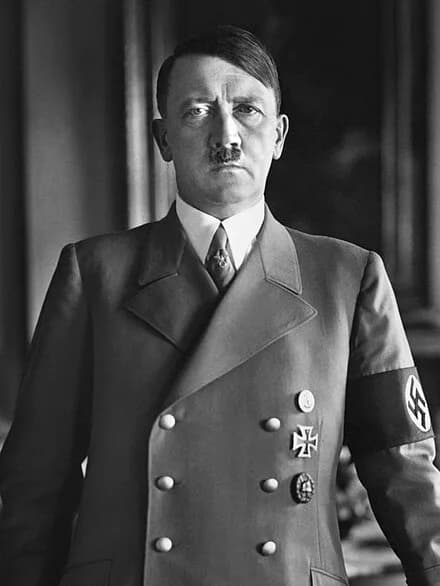
Adolf Hitler
Dictator of Nazi Germany from 1933 to 1945, Adolf Hitler was the primary instigator of World War II and the Holocaust. His racist and expansionist ideology caused the deaths of tens of millions of people worldwide. Appointed chancellor on 30 January 1933, he had dismantled the Weimar Republic within eighteen months and taken absolute power.
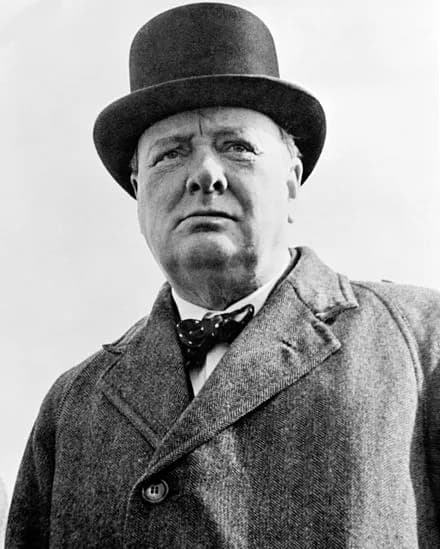
Winston Churchill
Prime Minister of the United Kingdom from 1940 to 1945, Winston Churchill embodied British resistance to Nazi Germany. His rousing speeches and unwavering leadership were instrumental in sustaining British morale through the darkest hours of the war. He refused any negotiated peace after the fall of France.
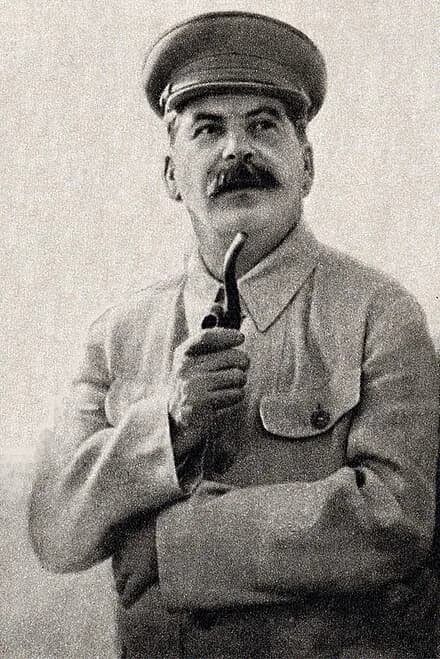
Joseph Stalin
Leader of the Soviet Union from 1924 to 1953, Joseph Stalin transformed the USSR into an industrial and military superpower. His leadership during the Great Patriotic War was decisive in defeating Nazi Germany, but his totalitarian regime caused millions of deaths among his own people.
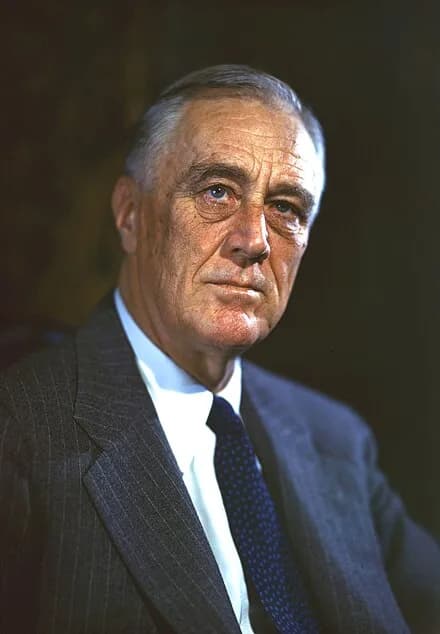
Franklin D. Roosevelt
32nd President of the United States, Franklin D. Roosevelt led the country through the Great Depression and most of World War II. His Lend-Lease program and diplomacy with Churchill and Stalin were decisive in the Allied victory, though he died just weeks before Germany's surrender.
