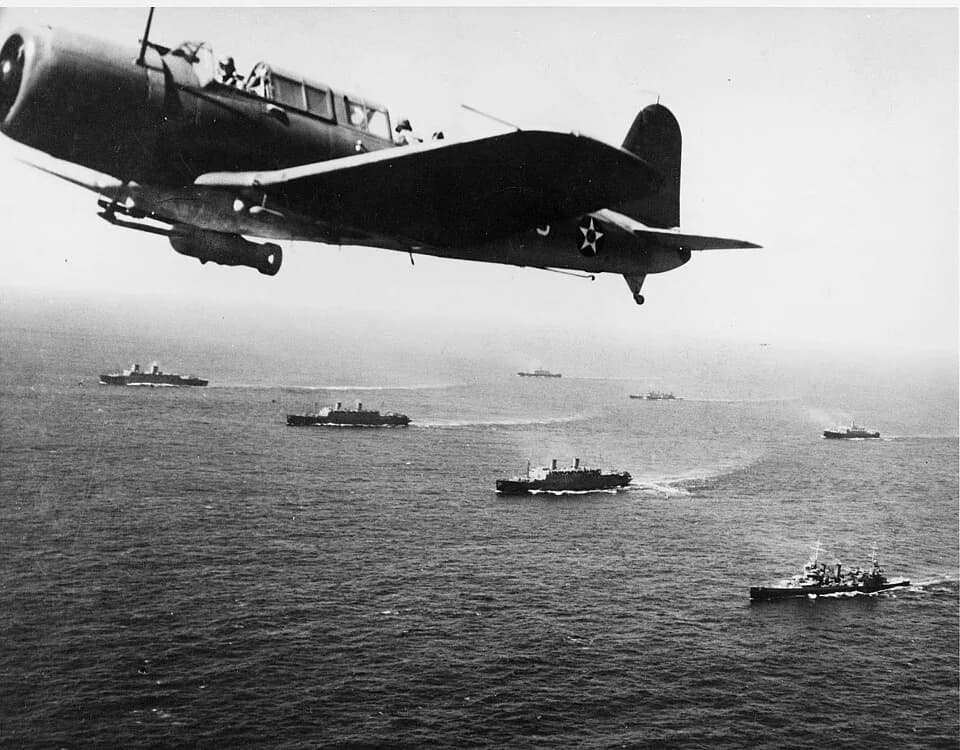
The Battle of the Atlantic was the longest continuous campaign of World War II, pitting German U-boats against Allied convoys for six years. This struggle for control of sea lanes determined Britain's ability to survive and the Allies' capacity to wage war in Europe.
The Battle of the Atlantic took place across the entire Atlantic Ocean, from the Arctic to the coasts of Brazil, from American ports to the approaches of the British Isles. The main convoy routes linked East Coast American and Canadian ports (New York, Halifax, Sydney) to British ports (Liverpool, Glasgow). The Mid-Atlantic Gap, the zone in the middle of the ocean beyond the range of land-based aircraft, was the U-boats' favorite hunting ground until 1943. The Arctic waters, through which convoys to Murmansk and Arkhangelsk passed to supply the USSR (PQ/QP then JW/RA convoys), were among the most dangerous: icebergs, storms, air attacks from occupied Norway, and U-boats. The English Channel, Irish Sea, and Western Approaches were concentration zones where convoys converged. The U-boat bases on the French Atlantic coast (Lorient, Saint-Nazaire, Brest, La Rochelle, Bordeaux), housed in massive concrete bunkers, gave German submarines direct access to the Atlantic.
The Kriegsmarine deployed a total of 1,162 U-boats during the war, of which approximately 830 were Type VII. Admiral Karl Donitz commanded the submarine fleet with an aggressive offensive doctrine based on wolf packs (Rudeltaktik). On the Allied side, the Royal Navy and the Royal Canadian Navy formed the bulk of escort forces, joined by the US Navy after December 1941. Escorts included destroyers, Flower-class corvettes (small, uncomfortable but effective), frigates, and from 1943 onward, escort carriers (CVEs) that closed the Mid-Atlantic Gap. RAF Coastal Command and naval aviation deployed long-range bombers — the Consolidated B-24 Liberator was the key aircraft in winning the Atlantic. Allied merchant marines, which carried the vital supplies, lost 30,000 sailors — a sacrifice often forgotten. American Liberty ships, mass-produced (2,710 vessels), replaced losses at a rate the U-boats could no longer match.
The Battle of the Atlantic is divided into several phases. From 1939 to 1941, the U-boats enjoyed the 'Happy Times': few in number but highly effective, they sank 1,500 ships. Aces like Otto Kretschmer (47 ships sunk) and Gunther Prien (who penetrated Scapa Flow and sank the battleship Royal Oak) became heroes in Germany. In 1941-1942, the introduction of radar, improved ASDIC (sonar), and the breaking of Enigma by Bletchley Park improved the Allied situation, but the U-boats adapted their tactics. Operation Drumbeat (January-June 1942) devastated the unprepared American coast. March 1943 was the most critical month: 627,000 tons sunk, with convoys SC-122 and HX-229 losing 22 ships. But May 1943 ('Black May' for the submariners) brutally reversed the situation: 43 U-boats sunk, forcing Donitz to withdraw his forces from the North Atlantic. After May 1943, the U-boats returned with snorkels and acoustic torpedoes, but never regained their former effectiveness.
The turning point of the Battle of the Atlantic occurred between March and May 1943. Several factors converged to reverse the situation. The continuous breaking of the Enigma codes by Ultra allowed convoys to be rerouted away from wolf packs — but the Germans changed their codes regularly, creating 'blackouts' during which Allied losses soared. The introduction of the centimetric ASV Mark III radar, which U-boats could not detect, was a game-changer: submarines on the surface were spotted at night and in bad weather. Escort carriers and VLR (Very Long Range) Liberator bombers closed the Mid-Atlantic Gap, eliminating the U-boats' last refuge. Hunter-killer groups, combining a CVE with escort destroyers, actively hunted submarines. The combination of all these technologies with improved escort tactics created a lethal environment for U-boats. In May 1943, Donitz lost one U-boat for every merchant ship sunk — an unsustainable ratio that forced a temporary withdrawal from the North Atlantic.
The Battle of the Atlantic was the longest and one of the costliest campaigns of the war. U-boats sank 3,500 merchant ships (14.7 million tons) and 175 Allied warships. In return, 783 U-boats were destroyed and 30,000 submariners killed out of 40,000 — a mortality rate of 75%, the highest of any armed force in the conflict. Allied merchant marines lost 36,000 sailors. Churchill considered the Battle of the Atlantic the dominant factor of the war: 'The only thing that ever really frightened me.' Victory in the Atlantic was indispensable to everything else: without it, no supply of Britain, no American buildup in England, no D-Day. The lessons of the Battle of the Atlantic profoundly influenced postwar naval warfare: the primacy of anti-submarine warfare, the importance of electronic intelligence, and the crucial role of aviation in maritime conflict. The nuclear submarines of the Cold War are the direct heirs of the innovations pioneered by the Type XXI U-boats.
German U-boats sank 3,500 merchant ships totaling 14.7 million tons, as well as 175 Allied warships during the Battle of the Atlantic (1939-1945). In return, 783 U-boats were destroyed and 30,000 submariners killed out of 40,000 — a mortality rate of 75%, the highest of any armed force in the conflict. Allied merchant marines lost 36,000 sailors.
In May 1943, several combined technologies reversed the situation: Enigma decryption by Bletchley Park (Ultra), the centimetric ASV Mark III radar (undetectable by U-boats), escort carriers, and VLR Liberator bombers that closed the Mid-Atlantic Gap. In May 1943 alone, 43 U-boats were sunk, forcing Admiral Dönitz to withdraw his forces from the North Atlantic.
Churchill declared the Battle of the Atlantic was 'the only thing that ever really frightened me' because defeat would have meant the end of British resistance. Without victory in the Atlantic, the United Kingdom could neither resupply itself nor build up the American forces needed for the June 1944 Normandy landings. Control of transatlantic sea lanes was the prerequisite for any land operation in Europe.
Information cross-checked against Wikipedia and reference historical works.
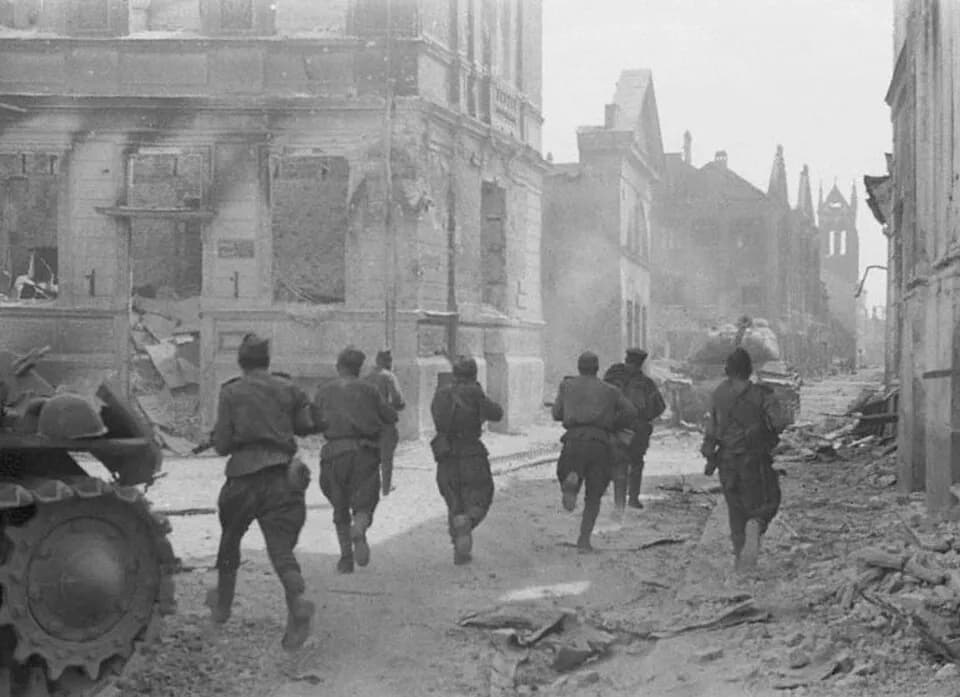
Eastern Front
The Eastern Front was the largest and deadliest theatre of operations in World War II. The clash between Nazi Germany and the Soviet Union caused over 30 million deaths and decided the outcome of the war in Europe. Four out of five German soldiers killed in the conflict fell there.
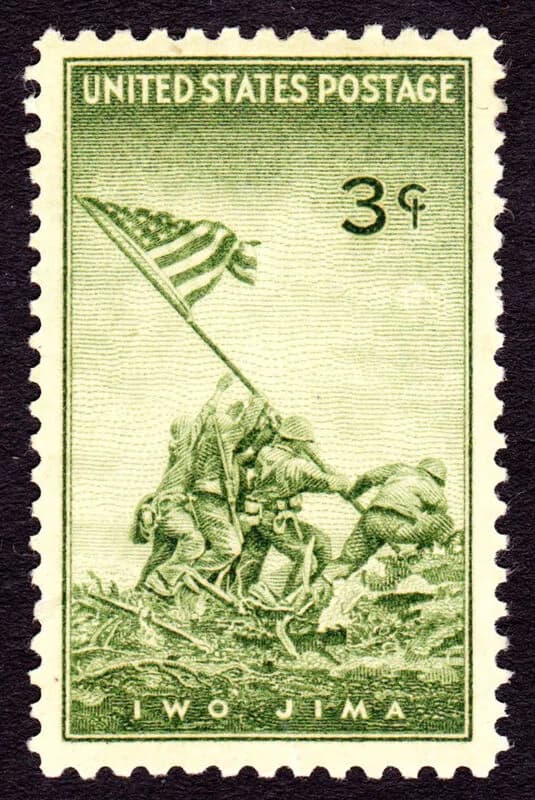
Pacific Theater
The Pacific Theater primarily pitted the United States against Imperial Japan in a naval and amphibious war spanning thousands of kilometers of ocean. From Pearl Harbor to Hiroshima, this fierce campaign concluded with the use of the first atomic bombs in history.
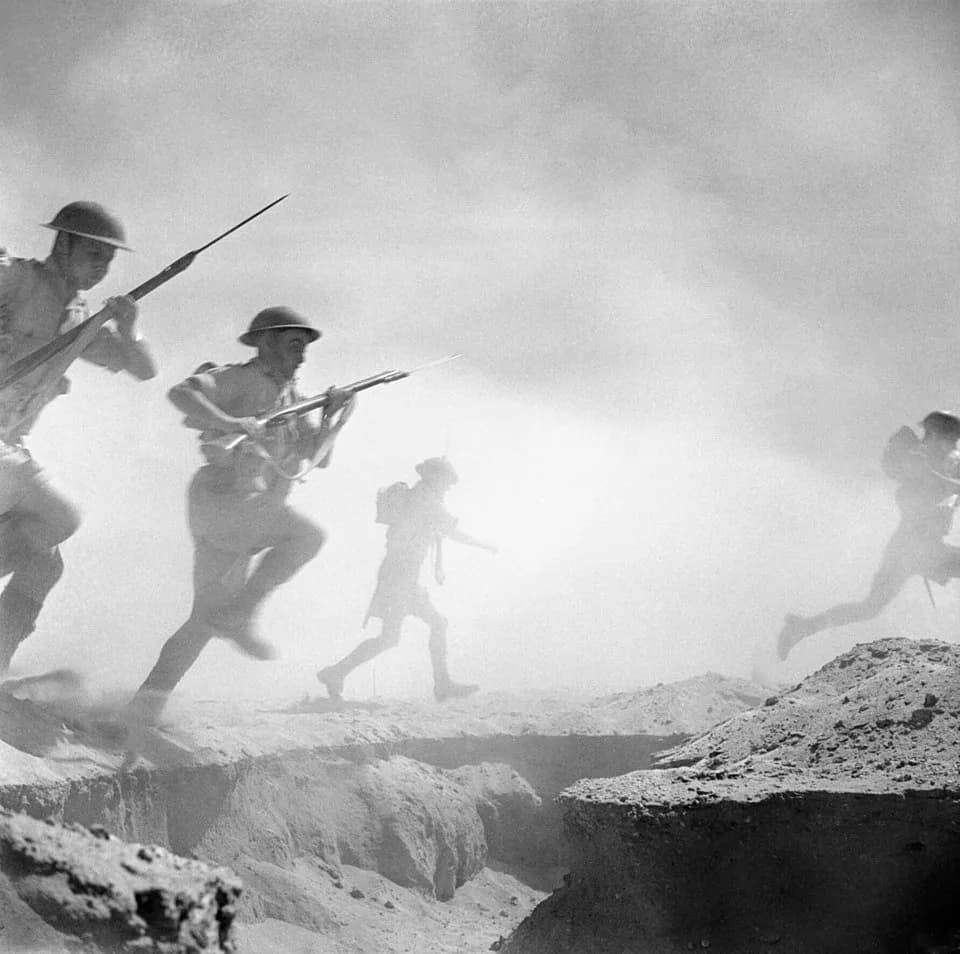
North African Campaign
The North African Campaign saw Axis and Allied forces clash in the deserts of Libya, Egypt and Tunisia. Theater of Rommel's desert war and Montgomery's decisive victory at El Alamein, it concluded with the surrender of 250,000 Axis soldiers in May 1943.
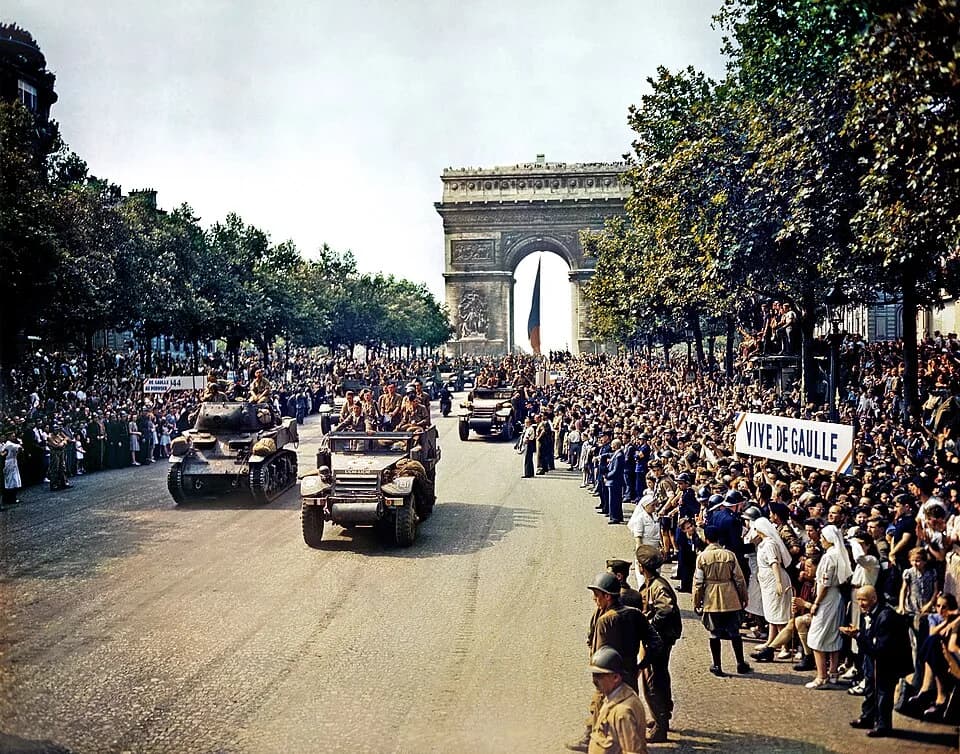
Western Front (1944-1945)
The Western Front, opened by the Normandy landings on June 6, 1944, saw Allied forces liberate France, Belgium and the Netherlands before invading Germany. From the Avranches breakthrough to the Rhine crossing, this eleven-month campaign ended the Third Reich from the west.
