Ptérygotus
Pterygotus anglicus is a sea scorpion 1.6 to 2.3 metres long and around twenty kilograms, described in 1839 and found in Scotland, England, the United States and Australia. It ruled the seas 428 to 420 million years ago, before jawed fishes even appeared. Its claws crushed the bony armour of plated fishes.
Pterygotus lived during the Late Silurian, approximately 428 to 420 million years ago (Ludlow-Pridoli). This giant eurypterid inhabited the shallow seas and estuaries of what is now Europe, North America, and Australia. The Silurian was a period of recovery after the Ordovician extinction, with warm seas and thriving coral reefs. Pterygotus was the apex predator of its time, ruling the seas even before jawed fish became dominant.
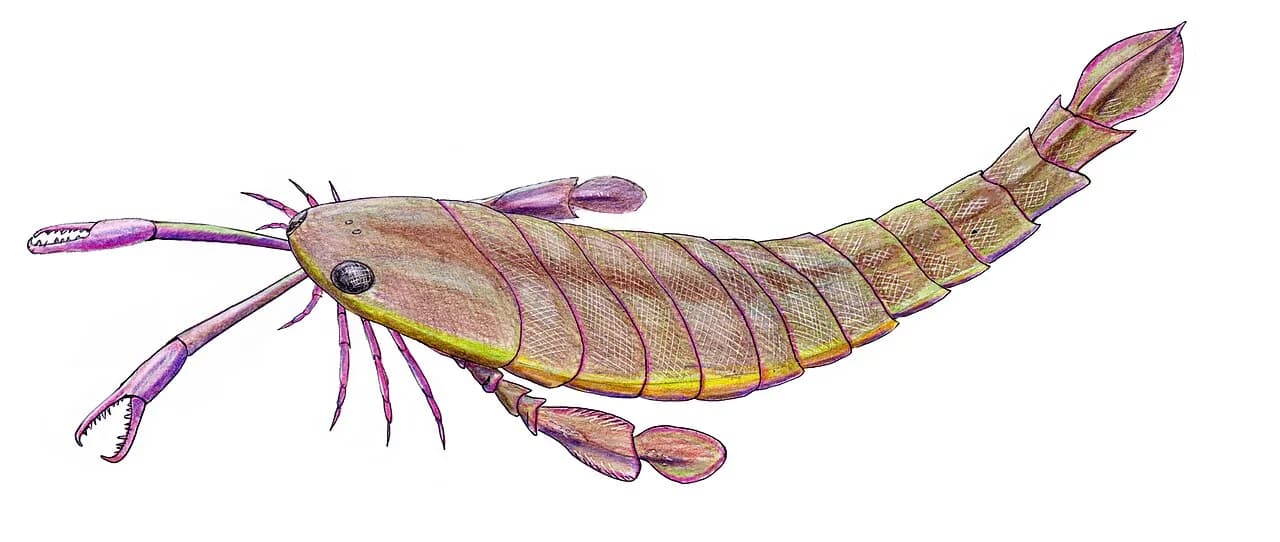
Pterygotus anglicus is one of the largest arthropods that ever lived, reaching an estimated length of 1.6 to 2.3 meters. Its elongated, segmented body terminated in a broad paddle-shaped telson (tail) serving as a rudder. Its chelicerae (mouth pincers) were massive, reaching 15 to 20 centimeters in length with sharp teeth along the edges. The sixth pair of legs was transformed into broad, flattened swimming paddles. For comparison, the largest living arthropod today — the Japanese spider crab — reaches a similar span but far less weight.
The apex predator of Silurian seas, Pterygotus actively hunted primitive jawless fish (ostracoderms and anaspids), trilobites, smaller eurypterids, and various marine invertebrates. Its massive, denticulated chelicerae served to grasp and slice prey. The size and morphology of its pincers indicate considerable gripping force, capable of crushing trilobite shells and the bony armor of early fish. It likely hunted by sight thanks to its large, well-developed compound eyes.
Pterygotus inhabited shallow epicontinental seas, lagoons, and estuaries of the Silurian. Environments ranged from normal marine waters to brackish coastal zones. Its fossils have been found primarily in Scotland, England, the eastern United States, and Australia, indicating a near-global distribution in warm tropical and subtropical waters. The sea floors of its habitat consisted of fine sediments suitable for ambush hunting.
Pterygotus's anatomy is typical of pterygotid eurypterids, with apex predator specializations. Its prosoma (head) bore a pair of large stalked compound eyes providing excellent binocular vision. The chelicerae were the largest and most robust of any eurypterid, with triangular teeth along the inner margins. The body comprised 12 abdominal segments followed by a broad, flattened telson. The sixth pair of appendages was modified into large swimming paddles, enabling rapid movement through water.
Pterygotus was an active and agile predator of Silurian seas. It swam using its posterior paddles and telson as propulsors, capable of speed bursts to capture prey. Its binocular vision, unusual among arthropods, allowed it to accurately judge distances — a crucial advantage for an active hunter. It probably combined active hunting and ambush tactics, resting on the sedimentary bottom to pounce on passing prey. Its imposing size placed it at the top of the food chain, with no known natural predator.
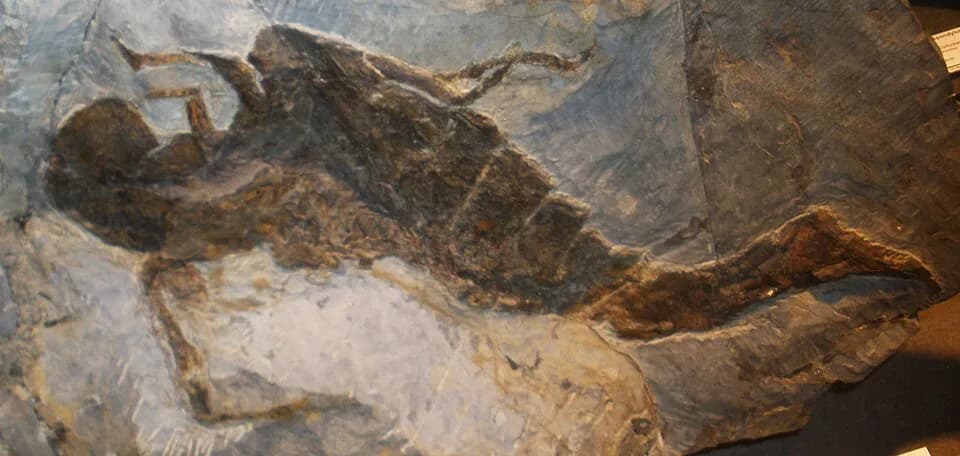
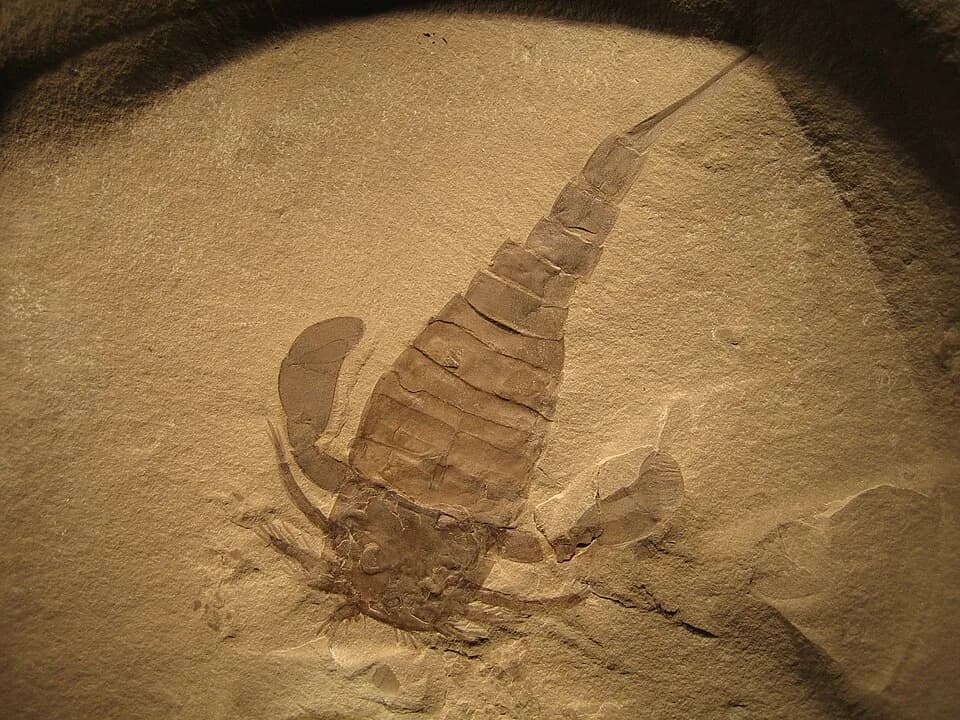
Pterygotus was one of the first eurypterids described, named by Agassiz in 1839 from Silurian fossils in Scotland. The type species P. anglicus is based on material from England. Since then, many species have been described worldwide, some now reclassified into other genera. The best-preserved fossils come from the Passage Beds sandstones in Scotland and the Bertie Formation in New York State. Complete specimens showing the giant chelicerae and swimming paddles are displayed at the Natural History Museum in London and the New York State Museum.
| Period | Silurien supérieur / Late Silurian |
| Era | Paléozoïque / Paleozoic |
| Age | 428-420 Ma |
| Location | Écosse, Angleterre, USA, Australie / Scotland, England, USA, Australia |
| Length | 1.6-2.3 m |
| Height | ~30 cm |
| Weight | ~20 kg |
| Diet | Carnivore (prédateur apex) |
| Discovery | 1839 |
Neither. Pterygotus anglicus was a eurypterid, a marine arthropod of the family Pterygotidae, sometimes called a 'sea scorpion.' It lived in the Late Silurian (428–420 Ma), over 200 million years before the first dinosaurs. Eurypterids are chelicerates — close relatives of scorpions and spiders — not insects.
Pterygotus anglicus reached 1.6 to 2.3 meters in length — one of the largest arthropods known. Its chelicerae (mouth pincers) measured 15 to 20 centimeters with triangular teeth. It hunted jawless fish (ostracoderms), trilobites, and smaller eurypterids. Its large stalked compound eyes provided binocular vision unusual for an arthropod.
Pterygotus anglicus inhabited shallow epicontinental seas and estuaries of the Late Silurian (428–420 Ma), a recovery period after the Ordovician extinction. Coral reefs flourished and warm tropical seas spread across what is now Scotland, England, the eastern United States, and Australia. The best fossils come from the Passage Beds sandstones in Scotland and the Bertie Formation in New York State.
Pterygotus anglicus life reconstruction
Wikimedia Commons