Dakosaurus
Dakosaurus maximus was a marine crocodilian described in 1856, found in Germany, England and Argentina between 157 and 137 million years ago. At 4 to 5 metres and 500 to 800 kilograms, it paired a short, massive skull with a streamlined dolphin-like body. National Geographic nicknamed it Godzilla for the shape of that skull.
Dakosaurus lived from the Late Jurassic to the Early Cretaceous, approximately 157 to 137 million years ago (Oxfordian to Valanginian stages). This formidable marine predator belonged to the family Metriorhynchidae, a group of crocodylomorphs that had completely abandoned terrestrial life to become fully aquatic animals. Unlike modern crocodiles that retain legs and an armor of bony scutes, Dakosaurus had evolved a perfectly hydrodynamic body plan adapted for life on the open sea. It lived in the warm, relatively shallow seas that covered much of Europe and South America during this period. Its name means "biter lizard" in ancient Greek, a direct reference to its impressive jaws that allowed it to tackle large prey in the oceans of the Jurassic period.
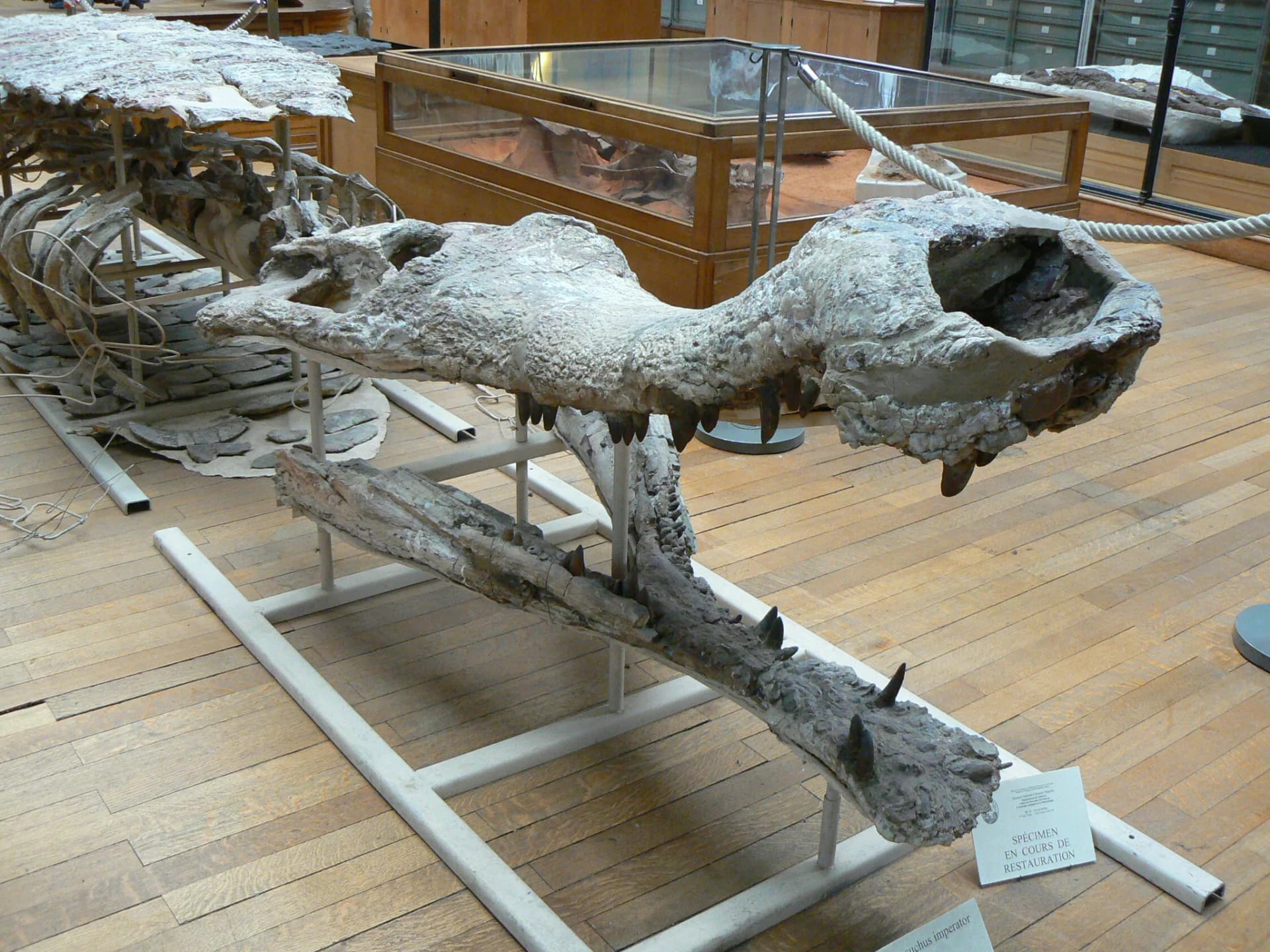
Dakosaurus maximus measured between 4 and 5 meters in total length, making it one of the largest members of the family Metriorhynchidae. Its weight is estimated at between 500 kilograms and one tonne, depending on paleontological reconstructions and the degree of robustness assumed for the body. Its skull, massive and short for a marine crocodylomorph, measured approximately 45 centimeters in length and displayed an unusually compact and tall shape that was far more reminiscent of a carnivorous theropod dinosaur than of any known crocodilian. This unique cranial morphology earned it the nickname "marine Godzilla" in the scientific press and popular media. Its teeth, broad and laterally compressed with finely serrated cutting edges, were designed for tearing flesh rather than grasping slippery fish, which clearly distinguished it from its piscivorous relatives with their elongated snouts.
Dakosaurus was a top-tier apex predator of the Jurassic seas, occupying the absolute summit of the marine food chain in its ecosystem. Unlike most other marine crocodylomorphs that fed primarily on fish and cephalopods using their long, narrow snouts perfectly adapted for quick lateral snapping, Dakosaurus possessed a short, powerful skull armed with large laterally compressed teeth bearing finely serrated cutting edges along their margins. This specialized dentition was ideal for attacking large-bodied prey, including other marine reptiles, large bony fish, and possibly giant cephalopods that inhabited the same waters. Its bite force must have been extremely powerful, proportionally comparable to that of the great terrestrial theropod dinosaurs. Biomechanical analyses of its skull strongly suggest that it practiced a violent "death roll" technique similar to modern crocodilians to tear chunks of flesh from its victims.
Dakosaurus inhabited the warm, relatively shallow epicontinental seas of the Late Jurassic and Early Cretaceous periods. The majority of its fossils come from Germany, particularly the famous lithographic limestones of Bavaria that have also yielded Archaeopteryx and numerous other exceptionally preserved specimens representing a remarkable window into Jurassic marine and coastal life. Specimens have also been discovered in England, in the marine formations of Dorset and Oxfordshire, as well as in France and Switzerland. The spectacular discovery of Dakosaurus andiniensis in Patagonian Argentina considerably expanded the known geographic range of the genus, demonstrating that these marine predators had either crossed the nascent Atlantic Ocean or dispersed via the Tethys seaway. These Jurassic seas teemed with diverse marine life, providing an ideal hunting ground for a top predator of this caliber.
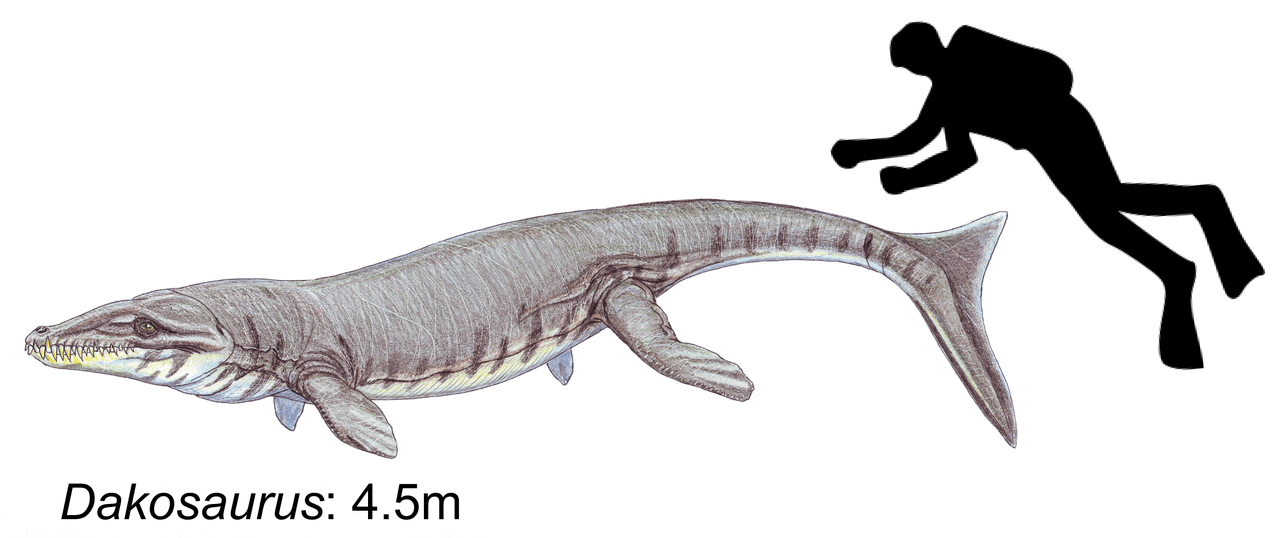
The anatomy of Dakosaurus represents one of the most radical adaptations ever observed among crocodylomorphs throughout their entire evolutionary history. Its short, massive skull, often compared to that of a miniature Tyrannosaurus rex, was mounted on a streamlined dolphin-shaped body, creating a silhouette absolutely unique in the animal kingdom both past and present. Its forelimbs and hindlimbs had been transformed into true hydromechanical flippers, having lost all capacity for terrestrial locomotion permanently. Its powerful tail terminated in a vertical crescent-shaped caudal fin, similar to that of ichthyosaurs, providing the primary propulsive thrust for swimming. Unlike modern crocodiles covered in protective osteoderms, Dakosaurus had lost its dermal armor entirely to reduce hydrodynamic drag and increase swimming efficiency. Its nostrils were positioned toward the back of the skull to allow rapid breathing at the surface while swimming at speed. It also possessed specialized salt glands to excrete excess sodium ingested with seawater.
Dakosaurus, nicknamed the "marine Godzilla" by National Geographic magazine, was most likely the undisputed apex predator of the Jurassic seas it frequented. Its unique cranial morphology, combining the bite force of a large theropod dinosaur with the aquatic agility of a dolphin, made it a devastatingly effective hunter capable of attacking prey of virtually all sizes available in its marine environment. Biomechanical analyses of its skull suggest it could exert considerable bite pressure, possibly accompanied by violent rotational movements similar to the "death roll" of modern crocodilians used to dismember large prey. Like all metriorhynchids, Dakosaurus was entirely pelagic and could no longer return to dry land under any circumstances, which implies obligate viviparity — it gave birth to live young in the open ocean. Its swimming was likely fast and sustained, powered by its muscular tail equipped with a crescent-shaped caudal fin.
The genus Dakosaurus was named by the German paleontologist Friedrich August von Quenstedt in 1856, based on fossil teeth discovered in the Jurassic formations of Swabia in southern Germany. The name, derived from the Greek dakos meaning "biter" and sauros meaning "lizard," reflects the impression of ferocity conveyed by its large serrated teeth. For a long time, Dakosaurus remained relatively unknown to the general public until the spectacular discovery of Dakosaurus andiniensis in Patagonian Argentina, formally described in 2005. This exceptionally well-preserved specimen, including a nearly complete skull, revealed for the very first time its unique cranial morphology featuring an unexpectedly short, tall snout completely unlike typical crocodylomorph skulls. National Geographic magazine immediately dubbed this species "Godzilla" due to the striking resemblance of its skull to that of the famous fictional monster from Japanese cinema. Fossils have since been found across Germany, England, France, Switzerland, and Argentina, attesting to a remarkably extensive geographic distribution for a marine predator of the Jurassic period.
| Period | Jurassique supérieur - Crétacé inférieur / Late Jurassic - Early Cretaceous |
| Era | Mésozoïque / Mesozoic |
| Age | 157-137 Ma |
| Location | Allemagne, Angleterre, Argentine / Germany, England, Argentina |
| Length | 4-5 m |
| Height | ~0.8 m |
| Weight | 500-800 kg |
| Diet | Carnivore |
| Discovery | 1856 |
Dakosaurus maximus was neither a dinosaur nor a true crocodile. It was a fully marine metriorhynchid crocodylomorph of the Late Jurassic to Early Cretaceous (157-137 Ma). Descended from terrestrial crocodyliformes, it had evolved by losing its legs, scaly armor, and all terrestrial capacity to become a pelagic predator with flippers and a crescent-shaped tail fin, unable to return to land.
The 2005 description of Dakosaurus andiniensis, found in Argentine Patagonia, revealed a short, tall, massive skull of 45 cm — radically different from the elongated snout typical of other marine crocodylomorphs. National Geographic immediately nicknamed the species 'Godzilla' due to the striking resemblance of this skull to the fictional Japanese monster, mounted on a dolphin-shaped body. Dakosaurus maximus (Europe) shared this unique morphology.
Dakosaurus maximus was the apex superpredator of the Jurassic seas. Its dentition — large laterally compressed teeth with serrated edges — allowed it to tear flesh from large prey: other marine reptiles, large fish, and cephalopods. Biomechanical analyses of its skull suggest it performed a 'death roll' like modern crocodilians, tearing off chunks of flesh by violent rotation, propelled by its powerful crescent-shaped tail fin.
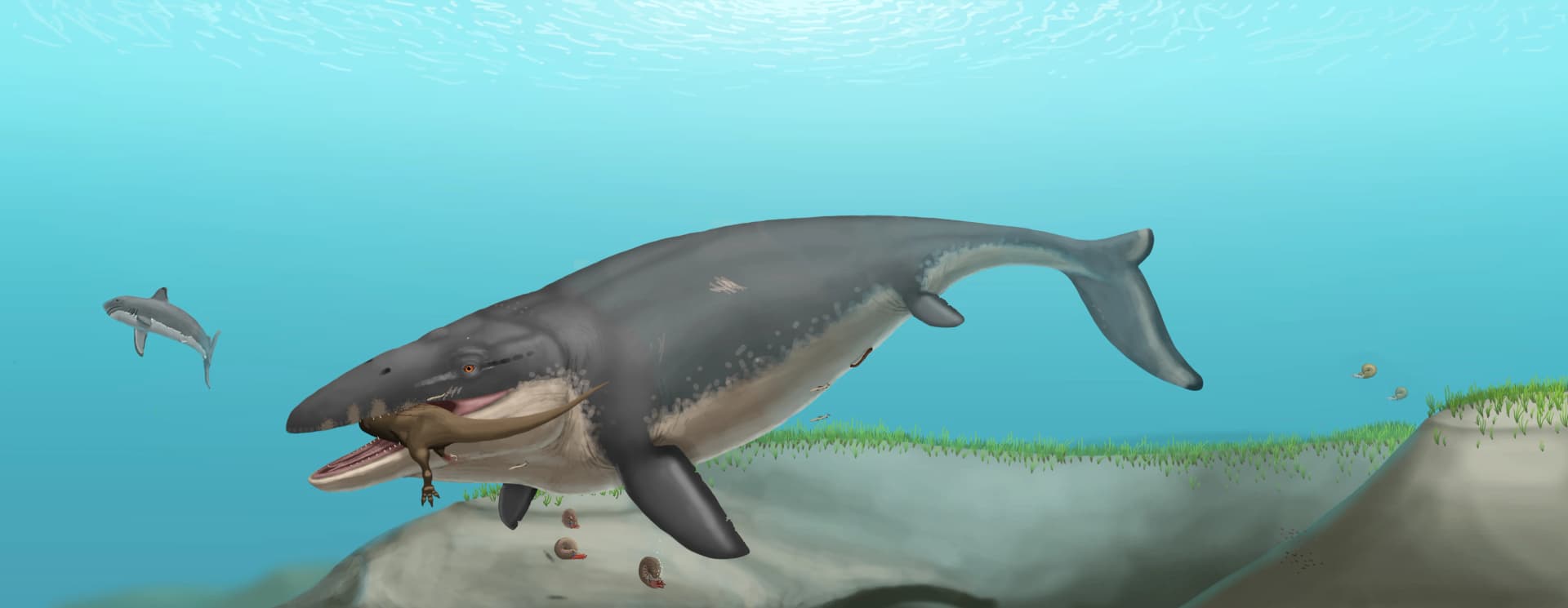
Dakosaurus maximus reconstruction
Wikimedia Commons
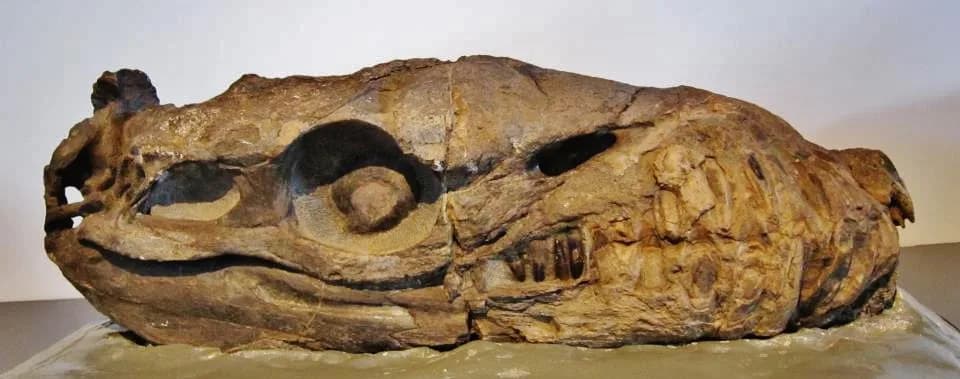
Dakosaurus skull
Wikimedia Commons