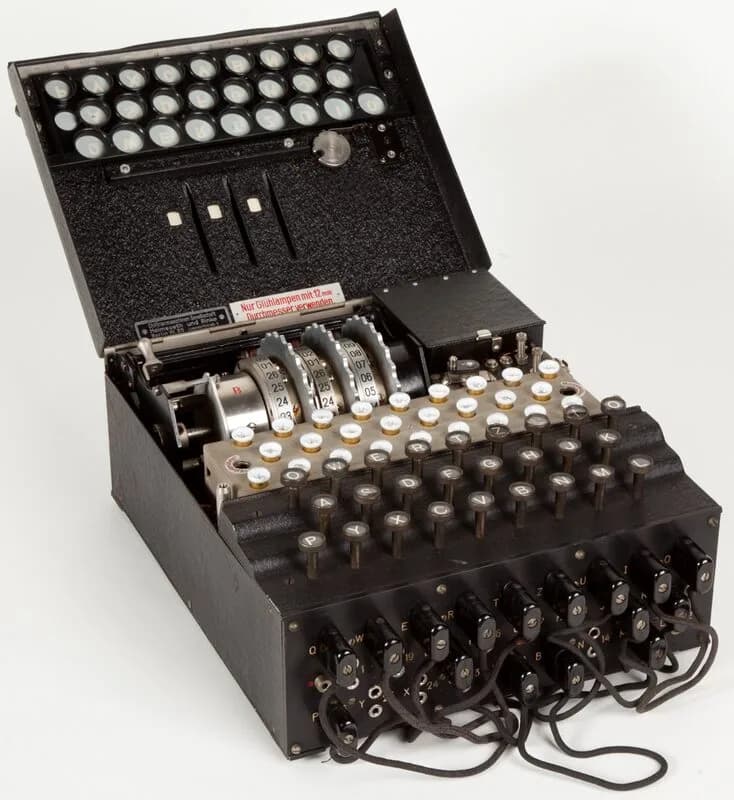
The Enigma machine was an electromechanical cipher device used by Nazi Germany to encrypt its military communications, and the Allied breaking of it at Bletchley Park supplied decisive intelligence throughout the war. That work, built on pre-war Polish groundwork, is credited with shortening the conflict by several years.
The Enigma machine traces its origins to the aftermath of World War I, when the German engineer Arthur Scherbius patented an electromechanical rotor cipher machine in 1918. Scherbius envisioned a commercial product for businesses seeking to protect trade secrets, and he founded the Chiffriermaschinen Aktiengesellschaft company in Berlin to manufacture and sell the device. The early commercial Enigma models attracted little interest from the business world, but they caught the attention of the German military, which recognized the potential for secure battlefield communications. The Reichswehr adopted a modified version of Enigma in 1926, and the Kriegsmarine followed in 1928. By the time the Nazi regime came to power in 1933, Enigma had become the standard encryption device for all branches of the German armed forces. The machine worked on the principle of polyalphabetic substitution, using a series of rotating electromechanical rotors to scramble plaintext messages into seemingly random sequences of letters. Each keystroke advanced the rotors, changing the electrical pathway and thus the substitution alphabet for the next character. The Wehrmacht version featured three rotors chosen from a set of five, a plugboard called the Steckerbrett that swapped pairs of letters before and after the rotor encryption, and a reflector that sent the electrical signal back through the rotors. This configuration produced an astronomical number of possible settings, estimated at approximately 158 million million million possible combinations, which the Germans believed made the cipher absolutely unbreakable. Polish intelligence, however, began working on breaking Enigma as early as 1932, recognizing the existential threat that encrypted German military communications posed to Poland's security.
The principles underlying the Enigma encryption system combined mechanical ingenuity with mathematical complexity to create what was believed to be an impenetrable cipher. At its core, Enigma employed the concept of polyalphabetic substitution, where each letter of the plaintext was replaced by a different letter depending on the current configuration of the machine, and this configuration changed with every single keystroke. The three rotors at the heart of the machine each contained twenty-six electrical contacts on either side, wired internally in a scrambled pattern. When a key was pressed, an electrical current passed through the plugboard, through each rotor in sequence, hit the reflector, and returned back through the rotors and plugboard to illuminate a lamp showing the encrypted letter. The stepping mechanism, inspired by an odometer, advanced the right rotor with each keystroke, with the middle and left rotors advancing at different intervals, creating a period of 16,900 letters before the rotor positions repeated. The plugboard added an enormous layer of complexity by swapping pairs of letters, typically ten pairs in military use, before and after the rotor encryption. The daily settings, distributed in codebooks, specified the rotor order, ring settings, plugboard connections, and initial rotor positions. Operators also chose a random three-letter message key for each transmission, which was encrypted and sent at the beginning of the message. One critical design feature that ultimately proved to be a fatal weakness was that Enigma could never encrypt a letter as itself. This property, a consequence of the reflector design, gave cryptanalysts a crucial piece of information to exploit. The Germans continually improved the system throughout the war, adding additional rotors to the naval Enigma, introducing a fourth rotor for U-boat communications in 1942 with the Triton cipher, and changing procedures to increase security. Despite these improvements, the fundamental mathematical properties of the machine remained exploitable by determined and brilliant cryptanalysts.
The application of Enigma breaking evolved through several critical phases spanning from the early 1930s to the end of the war. The first breakthroughs came from Polish mathematicians, particularly Marian Rejewski, Jerzy Różycki, and Henryk Zygalski, who worked at the Polish Cipher Bureau in Warsaw. In 1932, Rejewski used mathematical group theory combined with intelligence obtained from French spy Hans-Thilo Schmidt, who provided German cipher documents, to deduce the internal wiring of the Enigma rotors, a feat previously thought impossible. The Poles developed several techniques and devices to exploit Enigma, including the cyclometer, the card catalog of rotor characteristics, and most importantly the bomba kryptologiczna, an electromechanical device designed to test possible rotor settings. By the late 1930s, however, German security improvements including the addition of two new rotors and changes to operating procedures overwhelmed Polish resources. In July 1939, just weeks before the German invasion, Polish intelligence shared all their Enigma work with British and French allies at a secret meeting near Pyry, south of Warsaw. This transfer of knowledge was one of the most consequential intelligence gifts in history. At Bletchley Park in Buckinghamshire, the British Government Code and Cypher School assembled an extraordinary team of mathematicians, linguists, and puzzle solvers. Alan Turing, a brilliant Cambridge mathematician, designed an improved version of the Polish bomba called the Bombe, which could test thousands of possible Enigma settings per hour. Gordon Welchman added the diagonal board improvement that dramatically increased the Bombe's efficiency. By 1941, Bletchley Park was regularly reading Luftwaffe and Wehrmacht Enigma traffic, providing intelligence codenamed Ultra. The naval Enigma proved more difficult, as the Kriegsmarine used more rigorous procedures. The capture of codebooks and Enigma machines from U-boats, notably U-110 in May 1941, provided crucial material. When the four-rotor naval Enigma was introduced in February 1942, creating a blackout that lasted nearly ten months, it was the capture of materials from U-559 in October 1942 that enabled the breakthrough. By 1943, the industrial-scale Colossus computers at Bletchley Park were tackling even more complex German ciphers, and the intelligence flow from Ultra had become integral to Allied strategic planning.
The results of the Enigma intelligence operation, codenamed Ultra, were immense and arguably shortened the war by two to three years, according to estimates by historians and former intelligence officials. In the Battle of the Atlantic, Ultra intelligence allowed the Admiralty's Operational Intelligence Centre to reroute convoys away from wolfpack patrol lines, saving millions of tons of shipping and countless lives. During the critical months of 1943, the ability to read U-boat communications helped turn the tide decisively against the submarine threat. In North Africa, Ultra provided Montgomery with detailed knowledge of Rommel's supply situation, troop dispositions, and planned offensives before the Battle of El Alamein in 1942, contributing significantly to the Allied victory. Ultra intelligence was instrumental in the Mediterranean campaign, revealing Axis supply routes to North Africa and enabling Allied naval and air forces to interdict them with devastating effectiveness. During the preparations for D-Day, Ultra confirmed that the elaborate Allied deception operations, particularly Operation Fortitude, had successfully convinced the German high command that the main invasion would target the Pas-de-Calais rather than Normandy. After the Normandy landings, Ultra provided continuous intelligence on German troop movements, counterattack plans, and defensive dispositions. The intelligence was so valuable that elaborate security measures were implemented to protect its source, including the creation of fictitious intelligence networks to explain how the Allies obtained such detailed information. Despite its enormous value, Ultra had limitations. The intelligence was only useful if it could be acted upon quickly enough, and there were periods when the codes could not be broken, particularly the ten-month blackout on naval Enigma in 1942. Furthermore, Ultra intelligence had to be used carefully to avoid revealing to the Germans that their codes were compromised. The total effort at Bletchley Park grew to encompass nearly ten thousand personnel by 1945, supported by thousands more operating the Bombe machines at outstations across Britain. The secret of Ultra was maintained for nearly thirty years after the war, only being revealed publicly in 1974 with the publication of Frederick Winterbotham's book The Ultra Secret, which forced a fundamental reassessment of the history of the Second World War.
The analysis of the Enigma story reveals one of the most remarkable intellectual achievements in military history and offers profound lessons about the relationship between technology, human ingenuity, and warfare. From a cryptographic standpoint, the Enigma machine represented a significant advance over previous cipher systems, but its designers made several critical assumptions that proved fatal. The most fundamental error was the belief that the sheer number of possible settings made brute-force attacks impossible. While this was true for manual analysis, the development of electromechanical and eventually electronic computing machines at Bletchley Park transformed the equation entirely. The Germans also underestimated the mathematical vulnerabilities inherent in the machine's design, particularly the property that no letter could encrypt as itself, which provided cryptanalysts with a powerful constraint for eliminating impossible configurations. The human factor played an equally important role in Enigma's downfall. German operators frequently violated security procedures, using predictable message keys, repeating standard phrases at predictable times such as weather reports, and sometimes retransmitting the same message in different ciphers. These human errors, known as cribs, gave Bletchley Park the known plaintext needed to attack the daily settings. The organizational dimension was equally significant. The Allied effort at Bletchley Park represented perhaps the first truly industrialized intelligence operation, combining pure mathematics, engineering, linguistics, and what would later be called operations research into a systematic production line for intelligence. The interdisciplinary approach, bringing together academics, chess champions, crossword puzzle experts, and linguists, created an intellectual environment that fostered innovation. Alan Turing's contribution extended far beyond Enigma itself, as his theoretical work on computable numbers laid the foundations for modern computer science. The strategic lessons of Enigma remain relevant to modern cybersecurity and signals intelligence. The German experience demonstrates that no encryption system should be considered unbreakable, that security depends as much on operational procedures as on the underlying technology, and that overconfidence in one's own cipher systems can have catastrophic consequences. The Enigma story also raises ethical questions about the use of intelligence, particularly the Allied decisions about when to act on Ultra information and when to allow attacks to proceed to protect the source, decisions that sometimes cost lives in the short term to preserve a strategic advantage.
Polish mathematicians Marian Rejewski, Jerzy Różycki, and Henryk Zygalski of the Warsaw Cipher Bureau were the first to break Enigma. In 1932, Rejewski used group theory combined with German documents obtained by spy Hans-Thilo Schmidt to deduce the internal wiring of the rotors. In July 1939, Poland transferred all their work to British and French services at a secret meeting near Pyry.
Enigma's fatal weakness was that it could never encrypt a letter as itself — a consequence of the reflector design. This mathematical property gave Bletchley Park cryptanalysts a constraint to test configurations. German operator errors also helped: predictable message keys, repeated standard phrases. Alan Turing's Bombe machine, improved by Gordon Welchman, tested thousands of possible settings per hour.
According to estimates from historians and former intelligence officials, Ultra intelligence from Enigma decryption shortened World War II by two to three years. The Ultra secret was maintained for nearly thirty years after the war, revealed publicly only in 1974 with the publication of Frederick Winterbotham's book The Ultra Secret. At its peak, Bletchley Park employed nearly 10,000 personnel.
Information cross-checked against Wikipedia and reference historical works.
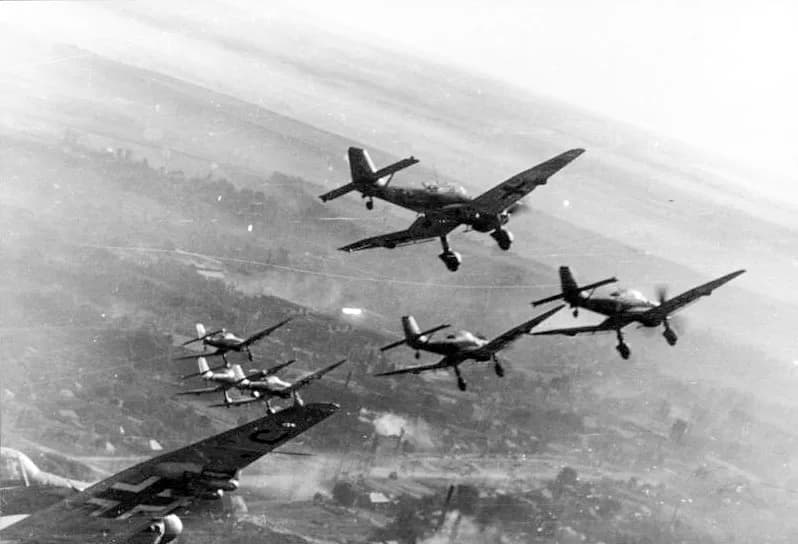
Blitzkrieg
Blitzkrieg, or lightning war, is a German military doctrine combining armour, aircraft and motorised infantry to break through enemy lines and rapidly encircle opposing forces. Applied in Poland in 1939 and then in France in 1940, it brought down a country in six weeks and reshaped modern warfare before stalling on the Eastern Front.
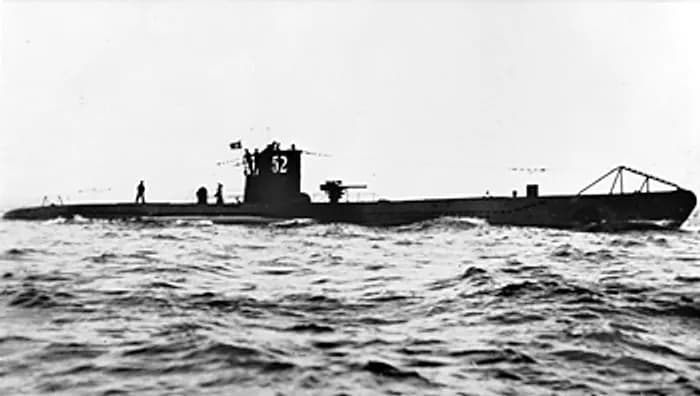
Submarine Warfare
The German submarine war, waged by the Kriegsmarine's U-boats, aimed to cut Britain's transatlantic supply lines, threatening the island's very survival during the Battle of the Atlantic. The reversal came in 1943, with the breaking of Enigma, shipborne radar and long-range escort vessels.
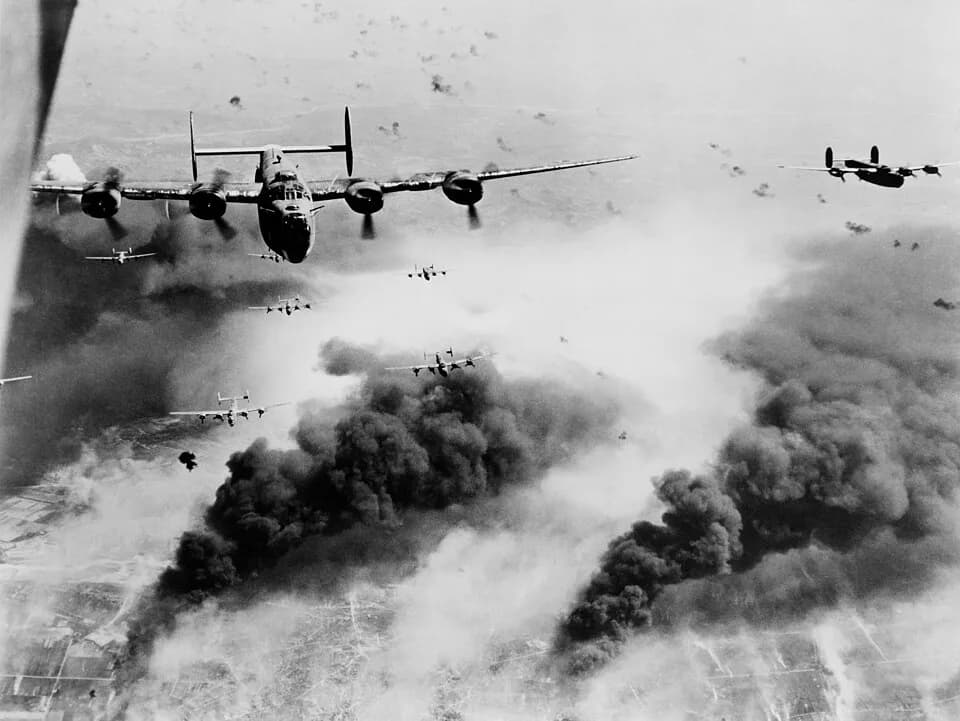
Strategic Bombing
Allied strategic bombing aimed to destroy the industrial and military apparatus of Nazi Germany through massive air raids, mixing American daylight precision bombing with British night-time area bombing. Waged from 1940 to 1945, it diverted a considerable share of German production toward air defence, at the cost of heavy civilian casualties.
Defense in Depth
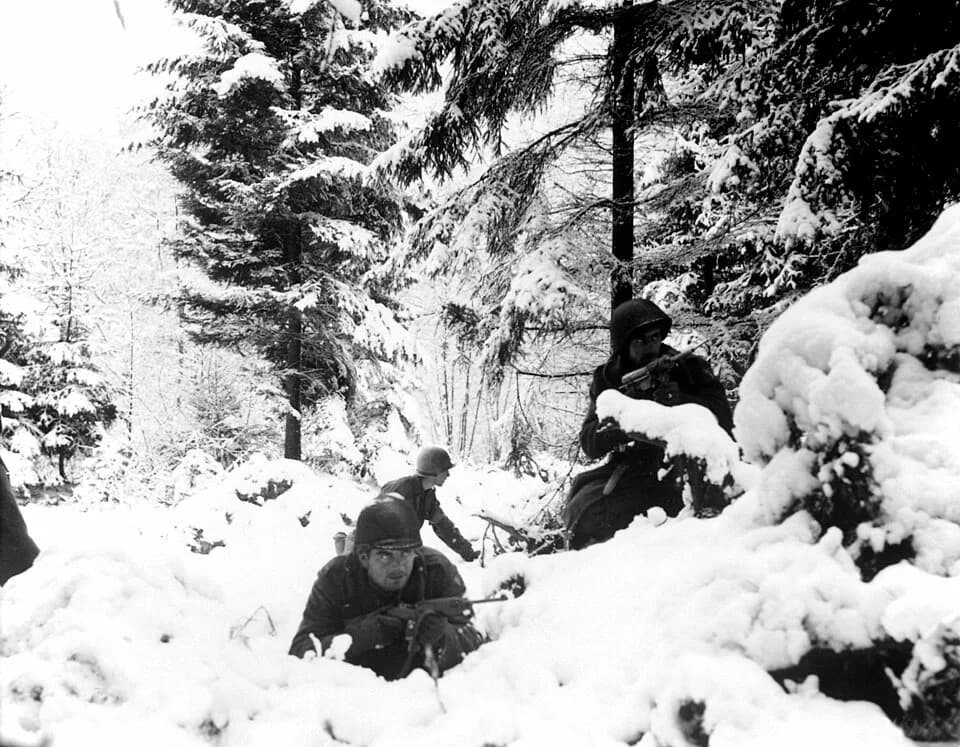
The Soviet defence in depth organised successive defensive zones across tens of kilometres, in order to absorb German armoured breakthroughs, exhaust the attacker and set up decisive counter-offensives. Applied at Kursk in 1943, it rested on minefield belts, anti-tank ditches and dug-in artillery, prepared months before the assault.
