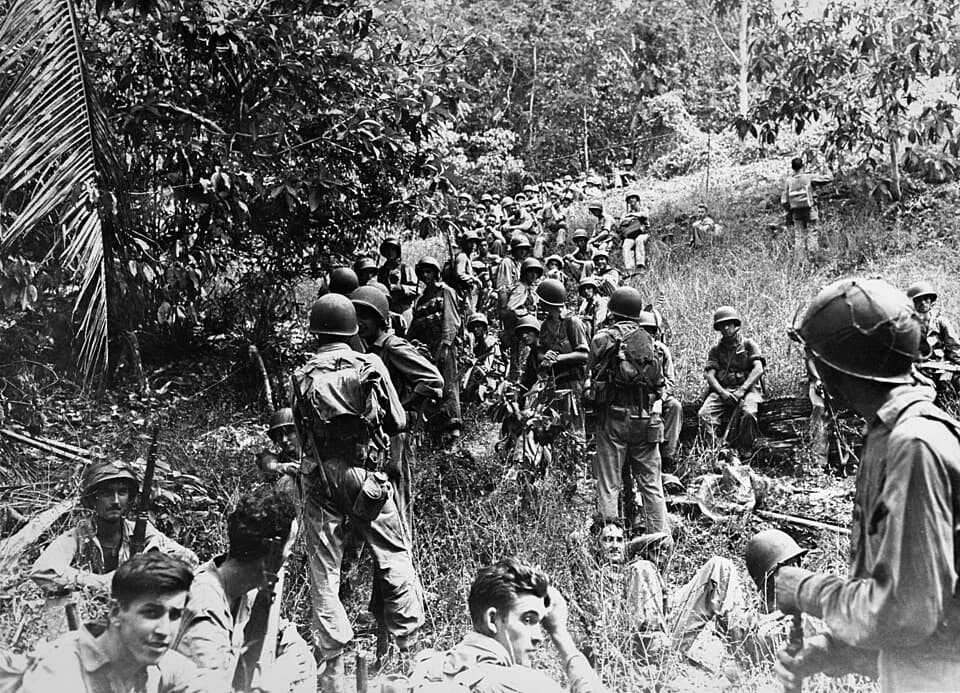
Island hopping was the American strategy of bypassing fortified Japanese garrisons to seize less defended islands, gradually bringing Allied forces closer to Japan. The strongholds left behind, cut off from all resupply, ceased to be a threat without ever having to be stormed.
The Island Hopping strategy, sometimes called leapfrogging, emerged from the necessity of finding an effective approach to cross the immensity of the Pacific theater and defeat Imperial Japan. After the attack on Pearl Harbor on December 7, 1941, and the series of Japanese conquests that followed, the forces of the Empire of the Rising Sun controlled a defensive perimeter extending from the Aleutian Islands in the north to Burma in the southwest, passing through the Philippines, the Dutch East Indies, New Guinea, and countless archipelagos of the Central Pacific. This Greater East Asia Co-Prosperity Sphere represented a maritime empire of colossal dimensions, defended by often fanatical garrisons entrenched in underground fortifications. The conventional approach of reconquering every island and Japanese position one by one would have required decades and cost millions of lives. The idea of bypassing fortified positions to strike at weak points was not entirely new. General Douglas MacArthur, commander of Allied forces in the Southwest Pacific, had begun applying this concept during the New Guinea campaign in 1943, bypassing the powerful Japanese base at Rabaul rather than attacking it frontally. Admiral Chester Nimitz, commanding Central Pacific forces, adopted a similar approach on a larger scale. The rivalry between MacArthur and Nimitz gave birth to two complementary axes of advance toward Japan. MacArthur advanced through the southwest via New Guinea and the Philippines, while Nimitz progressed through the Central Pacific across the Gilberts, Marshalls, Marianas, and Carolines. This dual advance forced the Japanese to disperse their forces and prevented defensive concentration on a single axis. The intellectual origins of the strategy also drew from prewar planning. War Plan Orange, developed by the US Navy in the 1920s and 1930s, had already envisioned a progression by leaps across the Central Pacific in case of conflict with Japan. Admiral Raymond Spruance and General Holland Smith were among the principal architects of the strategy's practical application, developing the amphibious landing techniques that were its essential operational component.
The principles of Island Hopping rested on an elegant strategic logic that transformed the Pacific's immensity from obstacle into advantage for American forces. The fundamental principle was objective selection. Rather than attacking every island held by the Japanese, American planners identified positions offering the greatest strategic value in terms of airfields, deep-water harbors, and proximity to the final objective, Japan itself. Japanese garrisons isolated on bypassed islands were simply cut off from all resupply and left to wither, neutralized without needing to shed blood to conquer them. This principle of isolation saved lives and time while depriving the enemy of considerable resources. The second principle was aeronaval supremacy. Each forward leap first required establishing air and naval superiority in the operational zone. The carriers of Task Force 58, under Admiral Marc Mitscher's command, played a crucial role in neutralizing surrounding Japanese airfields before and during landings. The US Navy, thanks to its industrial superiority, could assemble fleets of considerable size, with dozens of carriers, battleships, cruisers, and destroyers operating simultaneously. The third principle was mastery of amphibious warfare. Each Island Hopping operation culminated in an amphibious assault, one of the most complex and dangerous military operations possible. The Marines and Army developed sophisticated techniques including preparatory naval bombardment, assault waves in landing craft, use of tracked amphibious Amtrac vehicles to cross coral reefs, and close naval fire support during the critical first hours. The fourth principle was rapid base construction. Once an island was conquered, naval construction battalions, the famous Seabees, rapidly transformed the island into an air and logistics base to support the next forward leap. Airstrips were constructed within days on coral islets, enabling bombers to strike objectives increasingly close to Japan. Finally, the principle of continuous pressure prevented the Japanese from reorganizing between offensives, maintaining a sustained operational tempo that progressively exhausted Japanese resources.
The application of Island Hopping unfolded through a series of increasingly massive amphibious campaigns, extending from late 1943 until Japanese surrender in August 1945. The first major operation was the assault on Tarawa in the Gilbert Islands in November 1943. This battle of extreme violence saw the Marines suffer heavy casualties on the beaches of Betio Atoll, where Japanese defenders had built concrete and coconut log fortifications of unexpected resilience. In 76 hours of fierce combat, the Marines lost approximately 1,000 killed and 2,000 wounded to conquer an islet of less than three square kilometers. Tarawa's lessons led to major improvements in amphibious tactics, notably longer preparatory naval bombardment and increased use of Amtracs. In February 1944, Nimitz's forces seized the Marshall Islands, where the Kwajalein base was conquered with far fewer casualties thanks to Tarawa's lessons. Eniwetok Atoll was taken in quick succession, while the powerful Japanese base of Truk in the Carolines was neutralized by massive air raids rather than direct assault, a perfect illustration of the bypass principle. In June 1944, the invasion of the Mariana Islands marked a major escalation. The Battle of Saipan, from June 15 to July 9, was one of the bloodiest of the Pacific campaign, with over 3,400 Americans killed. The capture of Saipan, followed by Guam and Tinian, placed the Japanese home islands within range of B-29 Superfortress bombers, opening the way for the strategic bombing campaign against Japan. The Battle of the Philippine Sea in June 1944 saw the destruction of Japanese naval aviation in what Americans dubbed the Great Marianas Turkey Shoot. In October 1944, MacArthur kept his promise to return to the Philippines with the Leyte landing, triggering the Battle of Leyte Gulf, the largest naval battle in history. The reconquest of the Philippines continued until war's end. The last great Island Hopping operations were the battles of Iwo Jima in February-March 1945 and Okinawa in April-June 1945, which gave a terrifying preview of the human cost an invasion of mainland Japan would have entailed.
The results of the Island Hopping strategy were decisive for Allied victory in the Pacific, though the human cost remained considerable. Strategically, Island Hopping allowed American forces to cross the Pacific's immensity and reach Japan's approaches in less than two years, a remarkable logistical and military feat. Hundreds of thousands of Japanese soldiers were effectively neutralized without combat on bypassed islands. The Rabaul garrison, over 100,000 strong, was rendered powerless through isolation, as were garrisons at Truk, Wewak in New Guinea, and numerous other positions. These forces, cut off from all resupply, could not participate in decisive battles and suffered famine and disease until surrender. This approach is estimated to have potentially saved hundreds of thousands of American lives that would have been lost in frontal assaults against these fortified positions. The capture of the Marianas was probably Island Hopping's most significant result. Airfields at Saipan, Tinian, and Guam enabled the launch of the strategic bombing campaign against Japan by the XXI Bomber Command's B-29s, including the devastating incendiary raids on Tokyo and other major Japanese cities. It was from Tinian that the B-29s Enola Gay and Bockscar took off carrying the atomic bombs dropped on Hiroshima and Nagasaki. American casualties during the major Island Hopping operations were nevertheless severe. At Tarawa, 1,009 Marines were killed. At Saipan, 3,426 Americans perished. At Peleliu, a controversial battle some consider unnecessary, 1,794 Marines and soldiers were killed. At Iwo Jima, 6,821 Marines died in some of the fiercest combat of the entire war. And at Okinawa, the last great battle, over 12,500 Americans were killed, plus thousands of sailors who fell victim to kamikaze attacks. On the Japanese side, losses were catastrophic. Virtually the entirety of garrisons on attacked islands were annihilated, with the Japanese almost always fighting to the last man. Over 100,000 Japanese soldiers were killed at Okinawa, along with an estimated 40,000 to 150,000 civilians. The Imperial Japanese Navy was virtually destroyed during the great naval battles of the Philippine Sea and Leyte Gulf. Island Hopping succeeded in its ultimate objective of bringing American forces close enough to Japan to make possible either an invasion or the use of atomic weapons that ended the conflict.
Analysis of the Island Hopping strategy reveals an approach that made the best use of American industrial and technological superiority while minimizing, to the extent possible, the human cost of victory in the Pacific. The fundamental strength of this strategy lay in its ability to impose an insoluble strategic dilemma on Japan. The Japanese could not defend their entire perimeter with sufficient forces everywhere and never knew what the next American objective would be. This uncertainty forced them to disperse their forces across countless islands and garrisons, while the Americans could concentrate overwhelming power against the chosen objective. American naval and air superiority, growing throughout the war thanks to the prodigious industrial output of shipyards and aircraft factories, enabled maintaining an operational tempo Japan could not match. Each conquered island became a springboard for the next, creating an inexorable acceleration effect. One of the most important innovations was the development of mobile logistics. Service Squadron Ten, or ServRon Ten, created a system of floating logistical bases that allowed the fleet to remain at sea for weeks, resupplying fuel, ammunition, and provisions without returning to a fixed base. This unprecedented logistical capability gave American forces a strategic mobility the Japanese could not counter. However, Island Hopping also had its limits and flaws. The principal problem was the human cost of amphibious assaults. Despite bypassing many positions, islands that had to be taken by force were generally defended with extraordinary fanaticism. Japanese defensive tactics evolved throughout the war, shifting from beach defense, relatively vulnerable to naval bombardment, to defense in depth using networks of tunnels and caves, as at Iwo Jima and Okinawa. These underground defenses were practically impervious to bombardment and had to be reduced bunker by bunker, cave by cave, in combat of unimaginable brutality. The question of objective selection was also debated. MacArthur's decision to invade the Philippines was controversial, with some strategists arguing these islands could have been bypassed in favor of a more direct advance toward Formosa or Japan. The Battle of Peleliu, ordered to protect the flank of the Philippine landings, proved particularly costly and retrospectively unnecessary. Finally, the battles of Iwo Jima and Okinawa raised the fundamental question of whether an invasion of mainland Japan, Operation Downfall, was feasible at an acceptable human cost. Projections of American casualties, ranging from 250,000 to over one million depending on estimates, contributed to the decision to employ atomic weapons. Island Hopping remains a model of creative strategic adaptation, demonstrating how a maritime power can project its force across oceanic distances and defeat a determined adversary by exploiting mobility, surprise, and material superiority.
Island Hopping, developed by General Douglas MacArthur and Admiral Chester Nimitz, consisted of bypassing the most heavily fortified Japanese bases to capture less defended islands, progressively bringing Allied forces closer to Japan. Isolated Japanese garrisons, like the 100,000-strong force at Rabaul, were simply cut off from resupply and left to wither without direct combat, saving hundreds of thousands of American lives.
Island Hopping battles cost severe casualties: at Tarawa (November 1943), 1,009 Marines killed in 76 hours; at Saipan (June-July 1944), 3,426 Americans killed; at Peleliu, 1,794 dead; at Iwo Jima (February-March 1945), 6,821 Marines killed; at Okinawa (April-June 1945), over 12,500 Americans. These figures led planners to estimate an invasion of Japan would cost between 250,000 and one million American casualties.
The capture of the Mariana Islands in June-July 1944 — Saipan, Guam, and Tinian — was probably Island Hopping's most decisive result. These bases placed the Japanese home islands within range of B-29 Superfortress bombers of the XXI Bomber Command. It was from Tinian that the B-29s Enola Gay and Bockscar took off carrying the atomic bombs dropped on Hiroshima on August 6 and Nagasaki on August 9, 1945.
Information cross-checked against Wikipedia and reference historical works.
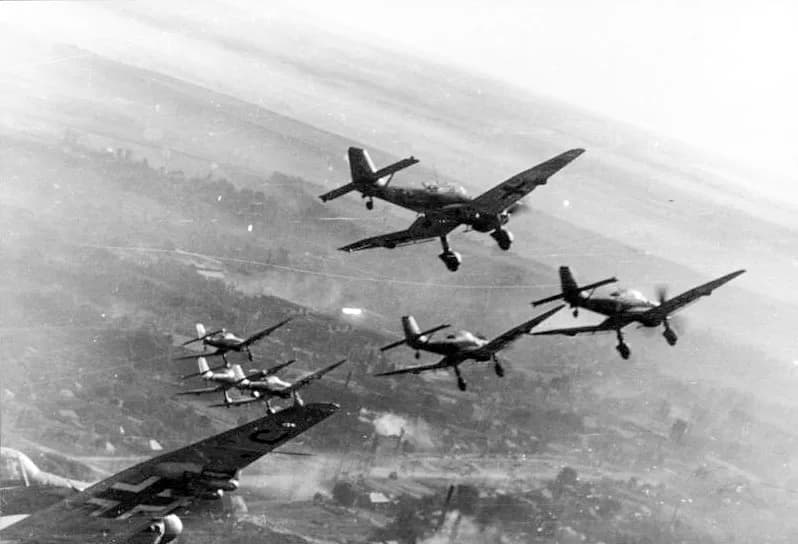
Blitzkrieg
Blitzkrieg, or lightning war, is a German military doctrine combining armour, aircraft and motorised infantry to break through enemy lines and rapidly encircle opposing forces. Applied in Poland in 1939 and then in France in 1940, it brought down a country in six weeks and reshaped modern warfare before stalling on the Eastern Front.
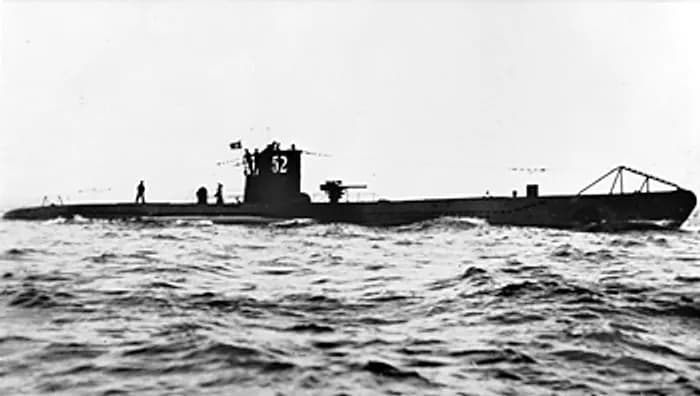
Submarine Warfare
The German submarine war, waged by the Kriegsmarine's U-boats, aimed to cut Britain's transatlantic supply lines, threatening the island's very survival during the Battle of the Atlantic. The reversal came in 1943, with the breaking of Enigma, shipborne radar and long-range escort vessels.
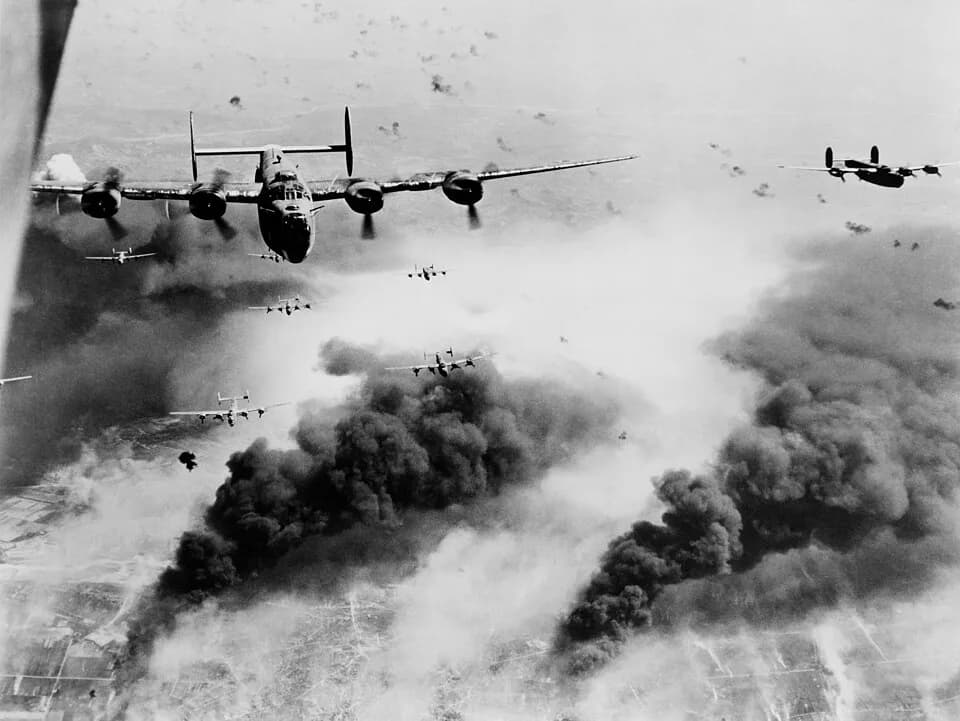
Strategic Bombing
Allied strategic bombing aimed to destroy the industrial and military apparatus of Nazi Germany through massive air raids, mixing American daylight precision bombing with British night-time area bombing. Waged from 1940 to 1945, it diverted a considerable share of German production toward air defence, at the cost of heavy civilian casualties.
Defense in Depth
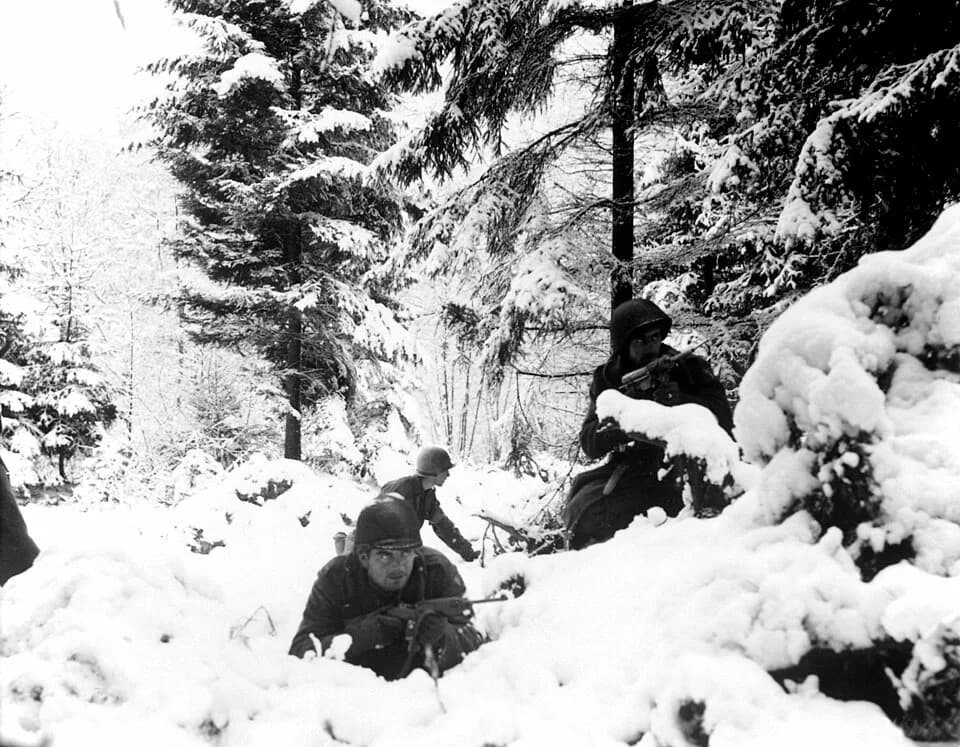
The Soviet defence in depth organised successive defensive zones across tens of kilometres, in order to absorb German armoured breakthroughs, exhaust the attacker and set up decisive counter-offensives. Applied at Kursk in 1943, it rested on minefield belts, anti-tank ditches and dug-in artillery, prepared months before the assault.
