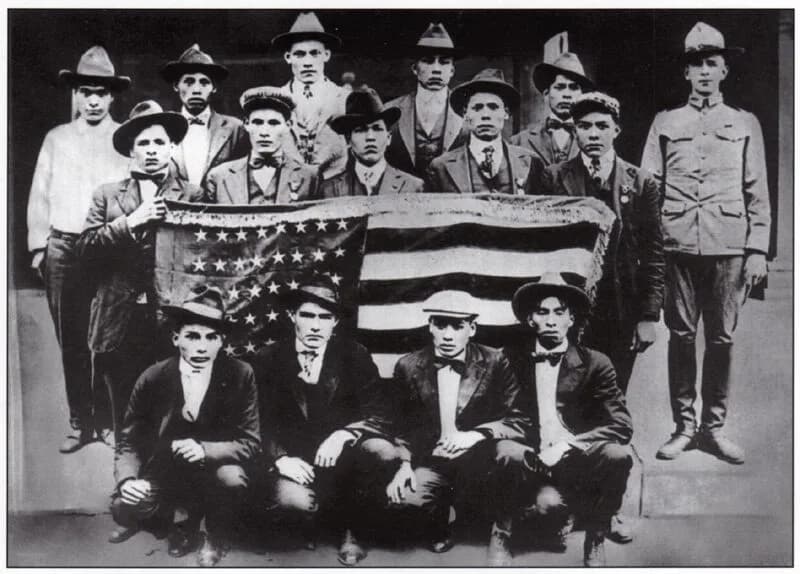
The Navajo Code was a military communication system using the Navajo language as an encryption basis during World War II. Employed by the US Marines in the Pacific, this code transmitted orally by Navajo Code Talkers was never broken by the Japanese, contributing decisively to victories at Iwo Jima and Okinawa.
The idea of using Native American languages for military communications dates back to World War I, when Choctaw soldiers transmitted messages in the Choctaw language on the Western Front, confounding German listening services. However, the systematic use of the Navajo language as a military code was the idea of Philip Johnston, son of a Protestant missionary who grew up on the Navajo reservation and one of the few non-Navajos to master the language. In February 1942, Johnston presented his concept to Major General Clayton Vogel, commander of the Amphibious Force Pacific, at Camp Elliott in California. He organized a demonstration during which Navajo speakers transmitted and decoded military messages in seconds, where conventional encryption machines took dozens of minutes. The Marine Corps, impressed, authorized the recruitment of 29 Navajos in May 1942 to form the first platoon of Code Talkers. These 'Original 29' were sent to Camp Pendleton where they created the code by developing a military vocabulary based on the Navajo language. Navajo was ideal because it was extremely complex, tonal, had no standardized written form, and was spoken by only 50,000 people, all within the United States.
The Navajo code operated on two levels of encryption. The first level was a coded alphabet: each letter of the English alphabet was represented by a Navajo word designating an animal, plant, or object beginning with that letter in English. For example, 'A' was 'wol-la-chee' (ant), 'B' was 'shush' (bear), 'C' was 'moasi' (cat). To prevent frequency analysis, each common letter had three possible substitutes: 'A' could also be 'be-la-sana' (apple) or 'tse-nill' (axe). The second level was a direct military vocabulary: approximately 450 military terms received mnemonic Navajo translations. A fighter plane was 'da-he-tih-hi' (hummingbird), a bomber was 'jay-sho' (buzzard), a battleship was 'lo-tso' (whale), a submarine was 'besh-lo' (iron fish), and the United States was 'ne-he-mah' (our mother). Ranks, tactical formations, ammunition types, and geographical terms all had their Navajo equivalents. The beauty of the system was that a Navajo speaker who had not been trained in the code could not understand it, because the words used in a military context had no literal meaning. An intercepted message resembled a series of unrelated Navajo words, making any cryptanalysis impossible without knowing the attribution rules.
The Navajo Code Talkers were first deployed in combat during the Battle of Guadalcanal in August 1942, attached to the 1st Marine Division. Their effectiveness was immediately demonstrated: they transmitted tactical orders, artillery coordinates, and situation reports in real time, where conventional encrypted communications took 30 minutes to encode and decode. The program was rapidly expanded: in total, between 375 and 420 Navajos served as Code Talkers in all six Marine divisions during the war. They participated in every major Pacific battle: Guadalcanal, Tarawa, Saipan, Guam, Peleliu, Iwo Jima, and Okinawa. During the Battle of Iwo Jima (February-March 1945), six Code Talkers worked without interruption for the first 48 hours, transmitting over 800 messages without a single error. Major Howard Connor, signal officer of the 5th Marine Division, stated: 'Were it not for the Navajos, the Marines would never have taken Iwo Jima.' Code Talkers often operated in pairs, one forward with combat troops and one at the rear command post. Their personal security was critical: each Code Talker was accompanied by a bodyguard with orders to protect him at all costs — and, according to some accounts, to kill him rather than allow his capture by the enemy.
The Navajo Code is the only vocal code in military history never to have been broken. Japanese intelligence services, which succeeded in decrypting US Army and Air Force codes, were completely powerless against Navajo. Even a Japanese soldier of Navajo descent, Joe Kieyoomia, captured in the Philippines, could not understand intercepted transmissions because the code had no literal meaning in Navajo. Transmission speed was the other decisive advantage: a message that took 30 minutes to encrypt, transmit, and decrypt with conventional machines was transmitted in 20 seconds by Code Talkers. This speed proved crucial during amphibious assaults where tactical decisions had to be made in real time. The Code Talkers' error rate was remarkably low, under 1%, thanks to their intensive training and perfect memorization of the code. Marine division commanders systematically requested Code Talkers for their operations, and their value was recognized at every level of command. The code was expanded from 211 terms in 1942 to approximately 411 terms by 1945 to cover the evolving military vocabulary.
The Navajo Code illustrates a notable paradox of military history: in a war dominated by technology, one of the most effective weapons was an ancestral language transmitted orally for centuries. The German Enigma machines and Japanese Purple codes, despite their mechanical sophistication, were all broken by Allied cryptanalysts, while a code based on a human language resisted every decryption attempt. This success rested on several unique factors: Navajo's grammatical complexity (verbs with over 350,000 conjugated forms), the absence of non-indigenous speakers, the addition of a code layer on top of the language itself, and the impossibility of applying classical cryptanalysis techniques to a spoken language. The historical irony is bitter: the Navajos, a people persecuted for centuries by the American government — forced deportations (the Long Walk of 1864), children torn from families and sent to boarding schools where speaking Navajo was punished — used their threatened language to save the nation that had oppressed them. Code Talkers returned from war to an America where Native Americans did not yet have the right to vote in all states. Their contribution remained classified until 1968. It was not until 2001 that the Original 29 received the Congressional Gold Medal, and the other Code Talkers the Silver Medal. The program demonstrates that cultural and linguistic diversity is a strategic asset, a lesson that remains relevant in the field of modern cybersecurity.
The Navajo language is extremely complex, tonal, has no standardized written form, and was spoken by only 50,000 people in 1942, all within the United States. The code added a second encryption layer on top of the language: Navajo words had no literal meaning in their military context. Japanese intelligence services were unable to apply classical cryptanalysis techniques to a spoken language they did not master.
Between 375 and 420 Navajos served as Code Talkers in all six Marine divisions during the war. The program began in May 1942 with 29 recruits (the 'Original 29') sent to Camp Pendleton to create the code. The program remained classified until 1968. In 2001, the Original 29 received the Congressional Gold Medal; other Code Talkers received the Silver Medal.
During the Battle of Iwo Jima (February-March 1945), six Code Talkers worked without interruption for the first 48 hours, transmitting over 800 messages without a single error. Major Howard Connor, signal officer of the 5th Marine Division, stated: 'Were it not for the Navajos, the Marines would never have taken Iwo Jima.' Their speed — a message in 20 seconds versus 30 minutes for conventional systems — proved decisive.
Information cross-checked against Wikipedia and reference historical works.
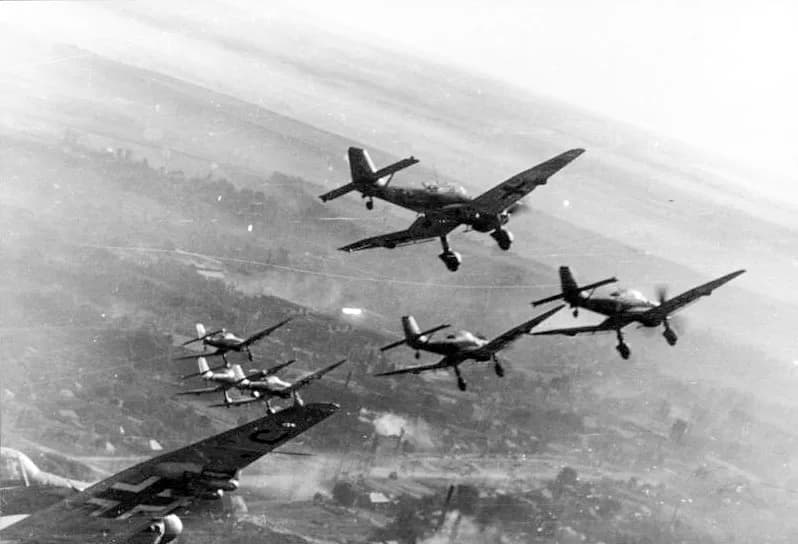
Blitzkrieg
Blitzkrieg, or lightning war, is a German military doctrine combining armour, aircraft and motorised infantry to break through enemy lines and rapidly encircle opposing forces. Applied in Poland in 1939 and then in France in 1940, it brought down a country in six weeks and reshaped modern warfare before stalling on the Eastern Front.
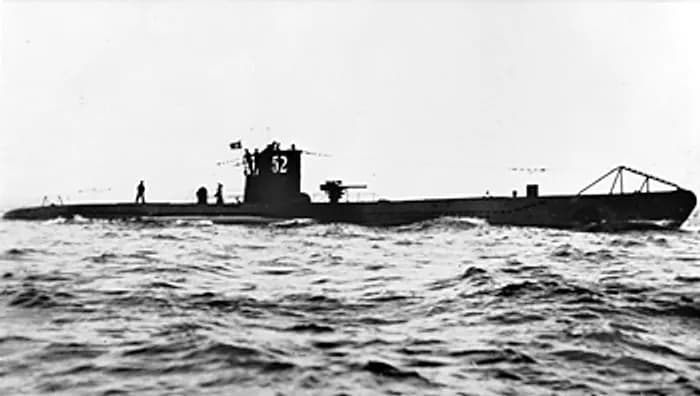
Submarine Warfare
The German submarine war, waged by the Kriegsmarine's U-boats, aimed to cut Britain's transatlantic supply lines, threatening the island's very survival during the Battle of the Atlantic. The reversal came in 1943, with the breaking of Enigma, shipborne radar and long-range escort vessels.
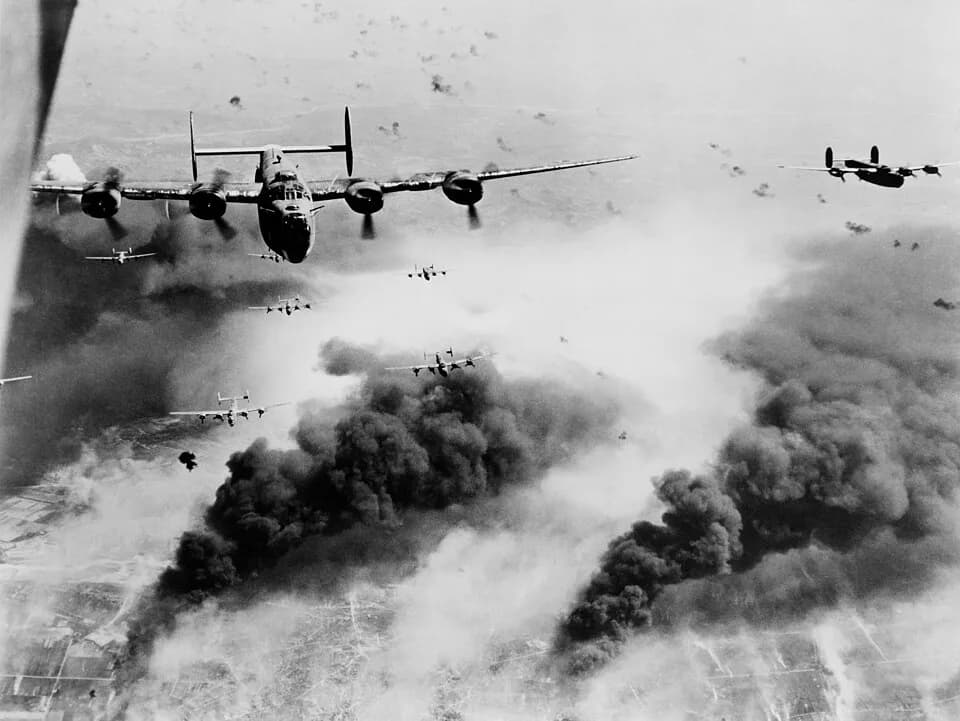
Strategic Bombing
Allied strategic bombing aimed to destroy the industrial and military apparatus of Nazi Germany through massive air raids, mixing American daylight precision bombing with British night-time area bombing. Waged from 1940 to 1945, it diverted a considerable share of German production toward air defence, at the cost of heavy civilian casualties.
Defense in Depth
The Soviet defence in depth organised successive defensive zones across tens of kilometres, in order to absorb German armoured breakthroughs, exhaust the attacker and set up decisive counter-offensives. Applied at Kursk in 1943, it rested on minefield belts, anti-tank ditches and dug-in artillery, prepared months before the assault.
