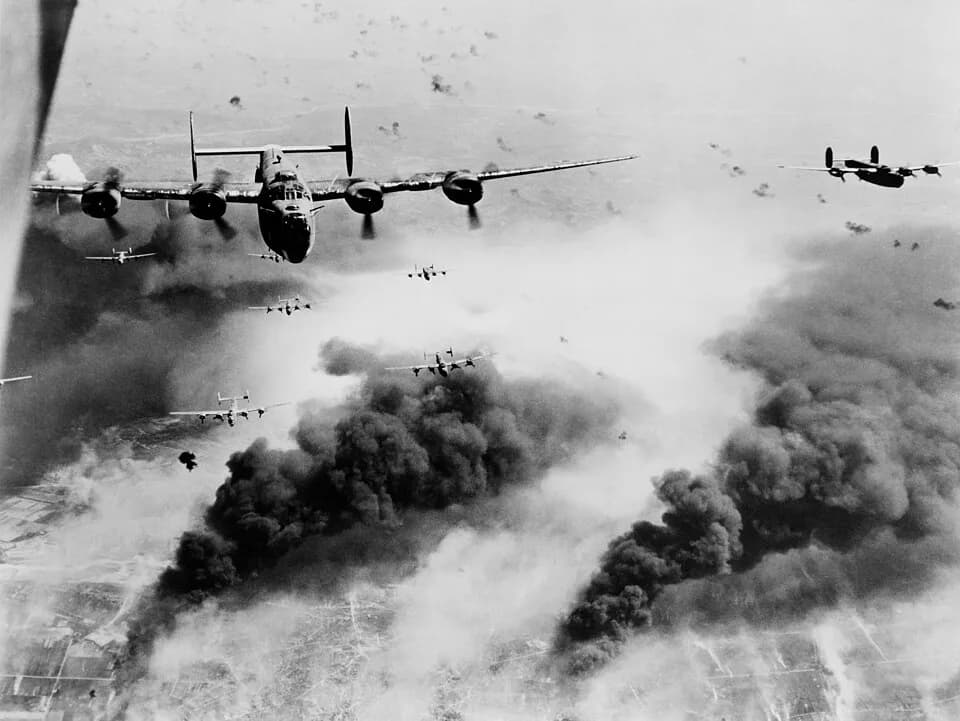
Allied strategic bombing aimed to destroy the industrial and military apparatus of Nazi Germany through massive air raids, mixing American daylight precision bombing with British night-time area bombing. Waged from 1940 to 1945, it diverted a considerable share of German production toward air defence, at the cost of heavy civilian casualties.
The concept of strategic bombing found its theoretical roots in interwar writings, notably those of Italian General Giulio Douhet, British Brigadier Billy Mitchell, and Air Marshal Hugh Trenchard. These thinkers argued that air power alone could decide the outcome of a conflict by destroying the enemy's industrial capacity and civilian morale, thus rendering ground combat superfluous. Douhet, in his work Il Dominio dell'Aria published in 1921, postulated that fleets of heavy bombers attacking urban and industrial centers could force an adversary to capitulate within days. These theories were enthusiastically adopted by the Royal Air Force, which created Bomber Command in 1936 as its main offensive force. Bomber Command doctrine rested on the conviction that the bomber would always get through, meaning no defense could prevent a determined bombing force from reaching its objectives. On the American side, the Air Corps Tactical School at Maxwell Field developed the doctrine of daytime precision bombing, targeting vital nodes of the enemy economy such as ball bearing factories, oil refineries, and railway junctions. The Americans firmly believed their bombers, flying in tight formation and armed with numerous machine guns, could defend themselves without fighter escort, and that the Norden bombsight would enable surgical precision bombing. The Luftwaffe, for its part, had primarily developed tactical aviation in support of ground forces, lacking long-range heavy strategic bombers. The He 177 heavy bomber program was a technical failure. The first experiences of strategic bombing occurred during the German Blitz on London and other British cities in 1940-1941, but the Luftwaffe lacked the critical mass necessary for a decisive bombing campaign. It was in this context that the RAF and USAAF undertook to carry the war to the heart of Germany, with industrial and human resources unprecedented in the history of military aviation. The Casablanca Conference in January 1943 formalized the combined bomber offensive strategy, assigning Bomber Command nighttime area raids and the Eighth Air Force daytime precision missions.
The principles of Allied strategic bombing unfolded in two distinct but complementary approaches, forming what planners called round-the-clock bombing. British Bomber Command, under Air Marshal Arthur Harris's direction, adopted the doctrine of nighttime area bombing. After finding that attempts at daytime precision bombing resulted in unsustainable losses against German fighters and Flak, the RAF turned to massive night raids on industrial urban areas. The area bombing directive of February 1942 formalized this approach, explicitly targeting the morale of the German working population. Raids used a calculated mix of high explosive and incendiary bombs, the former destroying roofs and opening buildings, the latter igniting exposed structures. The Pathfinders, specialized target-marking units, led the way by dropping flares and colored markers to guide subsequent waves of bombers. The RAF also developed sophisticated electronic countermeasures, notably Window (aluminum strips to jam radars) and various radio jamming devices. On the American side, the Eighth Air Force, followed by the Fifteenth Air Force based in Italy, pursued the doctrine of daytime precision bombing. Tight formations of B-17 Flying Fortresses and B-24 Liberators, flying at high altitude, were to destroy specific industrial targets identified as bottlenecks in the German war economy. The guiding principle was that by destroying a limited number of critical targets, one could paralyze entire sectors of enemy military production. The Americans successively identified ball bearing factories, aircraft factories, synthetic fuel refineries, and transportation networks as priority targets. The reality of aerial combat forced numerous adaptations, however. The appalling losses suffered during unescorted raids on Schweinfurt and Regensburg in 1943 demonstrated that bomber formations could not defend themselves alone, leading to the crucial development of the long-range P-51 Mustang escort fighter, which fundamentally changed the equation of the air war over Europe.
The application of strategic bombing saw a progressive escalation, from the first hesitant raids of 1940 to the massive operations of 1944-1945. Bomber Command's first operations in 1940-1941 were largely ineffective. Crews navigated by dead reckoning, bombs frequently fell miles from their targets, and the Butt Report of 1941 revealed that only one-third of bombers claiming to have reached their objective had actually dropped their bombs within five miles of the designated target. Arthur Harris's arrival at the head of Bomber Command in February 1942 marked a turning point. He immediately launched a series of spectacular raids, including the first thousand-bomber raid on Cologne on May 30, 1942, which destroyed 600 acres of the city. The Battle of the Ruhr in spring 1943, the Battle of Hamburg in July 1943 with its terrifying firestorms that killed approximately 37,000 people in a week, and the Battle of Berlin from November 1943 to March 1944 marked the great milestones of the British night offensive. The American Eighth Air Force began operations from England in August 1942 with limited raids on coastal targets in France. Missions gradually extended deeper into enemy territory, culminating in the disastrous raids on Schweinfurt and Regensburg on August 17 and October 14, 1943, where the Eighth Air Force lost over 120 bombers. These unsustainable losses forced a pause in deep penetration operations until the arrival of the P-51 Mustang in early 1944. Big Week in February 1944 marked the beginning of the decisive air offensive, massively targeting the German aircraft industry. From spring 1944, strategic bombing forces were temporarily diverted to targets related to the Normandy invasion, destroying the railway network and bridges of northern France in the Transportation Plan. After D-Day, bombers resumed strategic missions with increased intensity, notably targeting synthetic fuel plants in the Oil Campaign, which progressively deprived the Wehrmacht and Luftwaffe of fuel needed for operations. The war's final months saw apocalyptic destruction, the bombing of Dresden on February 13-15, 1945, becoming the most controversial symbol of the bombing campaign.
The results of Allied strategic bombing were the subject of intense debate during and after the war, and historians continue to evaluate its effectiveness and moral consequences. On the material level, the figures are impressive. Bomber Command dropped approximately 955,000 tons of bombs on Europe, while American air forces dropped about 1,460,000 tons. In total, bombing destroyed or severely damaged millions of dwellings and thousands of industrial installations in Germany. Cities like Cologne, Hamburg, Dresden, Essen, and Berlin were largely reduced to rubble. Allied bombing is estimated to have killed between 305,000 and 600,000 German civilians, depending on sources and counting methods. On the Allied side, losses were also considerable. Bomber Command lost approximately 55,573 crew members killed, a mortality rate of about 44 percent. The Eighth Air Force lost over 26,000 men. In total, more than 21,000 Allied bombers and fighters were destroyed during the campaign. The impact on the German war economy was real but more complex than hoped. German industrial production paradoxically continued to increase until mid-1944, thanks to Albert Speer's rationalization efforts and factory dispersal. However, this increase would have been much greater without the bombing, which forced Germany to devote considerable resources to air defense. In 1944, approximately one-third of German artillery production was allocated to Flak, thousands of 88mm guns that could have been deployed on land fronts. Over two million people were employed in air defenses and damage repair. The Oil Campaign of 1944-1945 was arguably the most decisive aspect of the campaign, reducing synthetic fuel production from 316,000 tons in May 1944 to only 17,000 tons in September. This fuel shortage progressively paralyzed the Luftwaffe and Wehrmacht, directly contributing to German defeat. Bombing of the transportation network finished disorganizing the German war economy in the conflict's final months.
Analysis of strategic bombing raises fundamental questions about military effectiveness, the morality of warfare, and the limits of air power. Interwar theorists had considerably overestimated the effects of aerial bombardment, both materially and psychologically. The belief that a few massive raids would suffice to break a population's morale and push them to demand peace proved entirely wrong. Far from breaking German morale, bombing often reinforced the population's determination, a phenomenon already observed during the London Blitz. Aerial terror nowhere produced the popular revolts hoped for by Allied strategists. The Nazi regime skillfully exploited bombing for propaganda purposes, reinforcing national cohesion around the Führer. In terms of military effectiveness, strategic bombing was long a far less precise instrument than its proponents claimed. American precision bombing in reality scattered its bombs over much wider areas than planned, due to weather conditions, Flak, enemy fighters, and technical limitations of bombsights. British area bombing, while not claiming precision, raised profound moral questions about the deliberate targeting of civilian populations. The bombing of Dresden, a city of refugees without great military importance, provoked controversy as early as 1945 and continues to symbolize the potential excesses of strategic bombing. Nevertheless, reducing strategic bombing to a failure would be inaccurate. The campaign against synthetic fuel was devastating for the German war effort. The massive diversion of resources toward air defense deprived land fronts of guns, ammunition, and manpower. The destruction of the transportation network paralyzed German logistics in the war's final months. And the conquest of air superiority by Allied fighters from 1944 onward was an indispensable prerequisite for the Normandy invasion. The legacy of strategic bombing profoundly influenced Cold War nuclear doctrine, with nuclear deterrence doctrine essentially adopting Douhet's principles adapted to atomic weapons. The wars in Vietnam, the Gulf, and contemporary conflicts continue to raise questions about the effectiveness and morality of aerial bombardment, questions born in the blazing skies over Europe during the Second World War.
Arthur Harris's British Bomber Command practiced nighttime area bombing: massive raids on German industrial urban neighborhoods, deliberately targeting working-class morale. The American Eighth Air Force favored daytime precision bombing, targeting specific industrial facilities — ball bearing factories, synthetic fuel refineries, railway networks. These two approaches formed the 'round-the-clock' bombing formalized at the Casablanca Conference in January 1943.
British Bomber Command lost approximately 55,573 crew members killed (44% mortality rate). The American Eighth Air Force lost over 26,000 men. More than 21,000 Allied bombers were destroyed. The impact on Germany was real: synthetic fuel production fell from 316,000 tons in May 1944 to only 17,000 tons in September, paralyzing the Luftwaffe. In 1944, one-third of German artillery production fed the Flak rather than land fronts.
On February 13-15, 1945, British Bomber Command and the American Eighth Air Force bombed Dresden, a city full of refugees and of limited military importance at that stage of the war. Firestorms ravaged the city and killed tens of thousands of civilians — estimates vary widely. This destruction, judged disproportionate by critics, symbolizes the potential excesses of area bombing and raises questions about the moral limits of aerial warfare, debated since 1945.
Information cross-checked against Wikipedia and reference historical works.
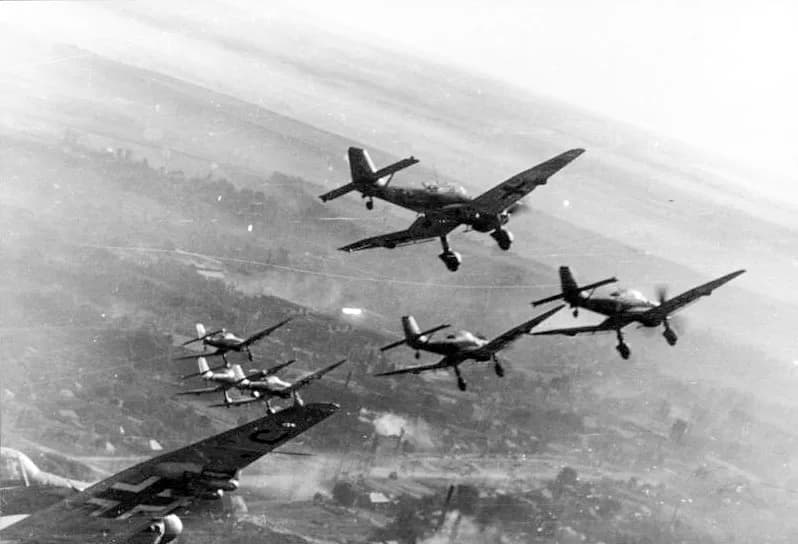
Blitzkrieg
Blitzkrieg, or lightning war, is a German military doctrine combining armour, aircraft and motorised infantry to break through enemy lines and rapidly encircle opposing forces. Applied in Poland in 1939 and then in France in 1940, it brought down a country in six weeks and reshaped modern warfare before stalling on the Eastern Front.
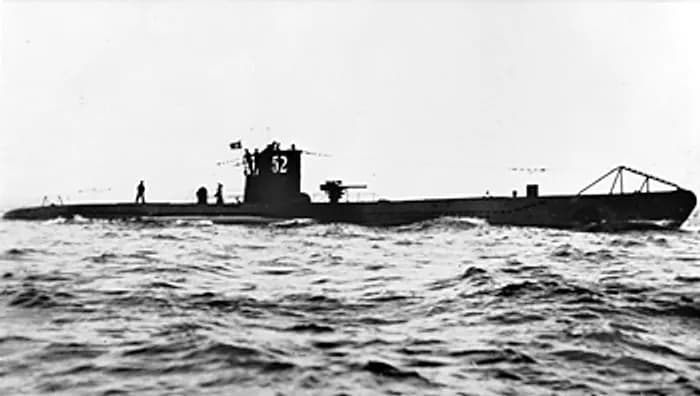
Submarine Warfare
The German submarine war, waged by the Kriegsmarine's U-boats, aimed to cut Britain's transatlantic supply lines, threatening the island's very survival during the Battle of the Atlantic. The reversal came in 1943, with the breaking of Enigma, shipborne radar and long-range escort vessels.
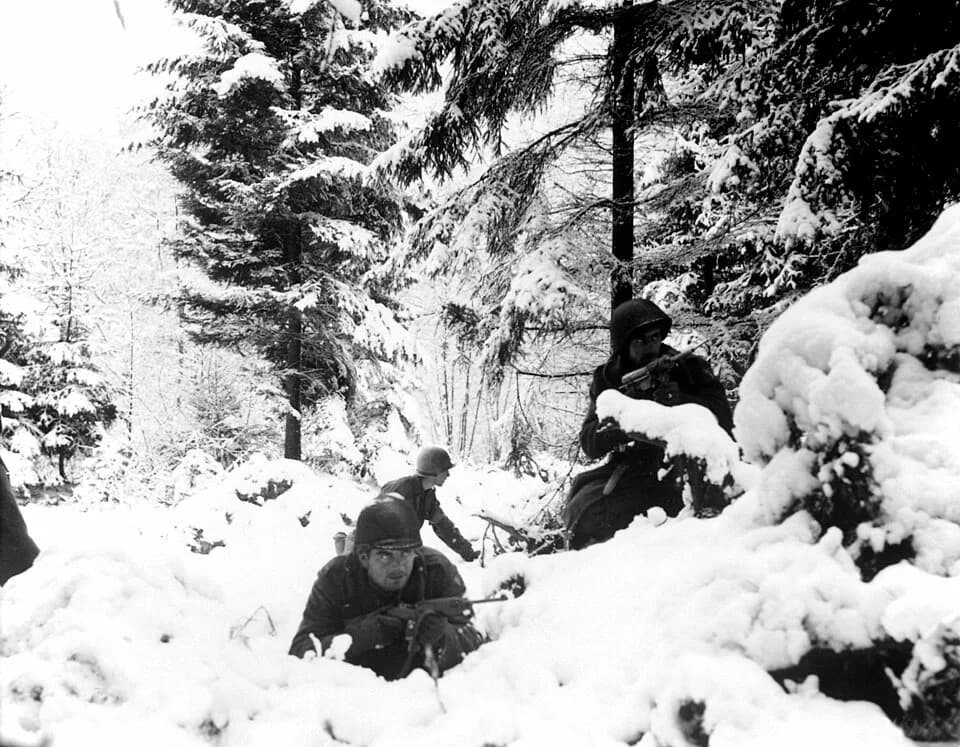
Defense in Depth
The Soviet defence in depth organised successive defensive zones across tens of kilometres, in order to absorb German armoured breakthroughs, exhaust the attacker and set up decisive counter-offensives. Applied at Kursk in 1943, it rested on minefield belts, anti-tank ditches and dug-in artillery, prepared months before the assault.
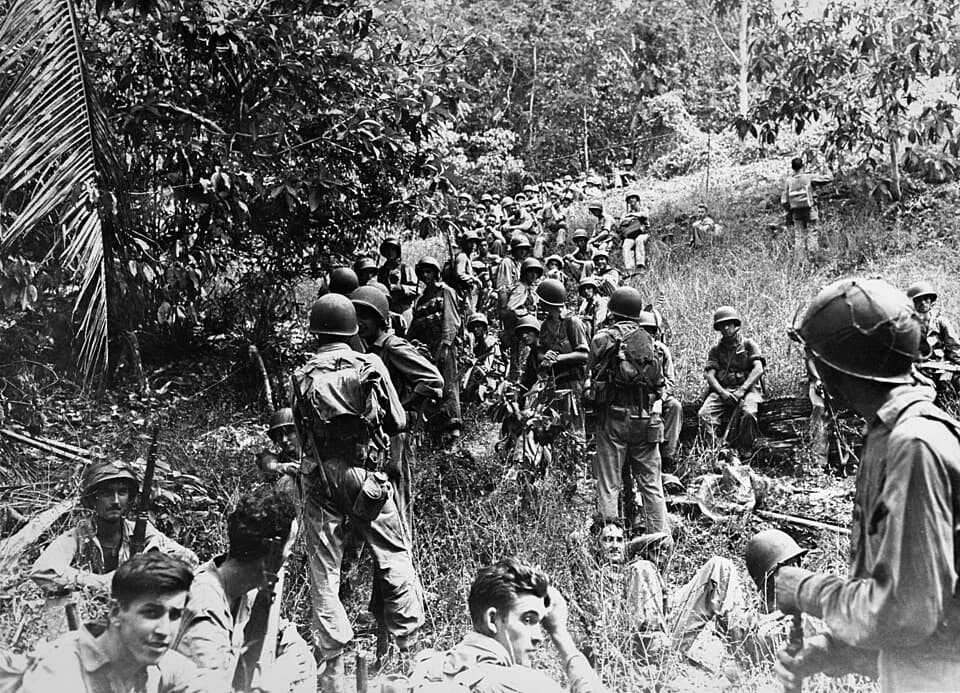
Island Hopping
Island hopping was the American strategy of bypassing fortified Japanese garrisons to seize less defended islands, gradually bringing Allied forces closer to Japan. The strongholds left behind, cut off from all resupply, ceased to be a threat without ever having to be stormed.
