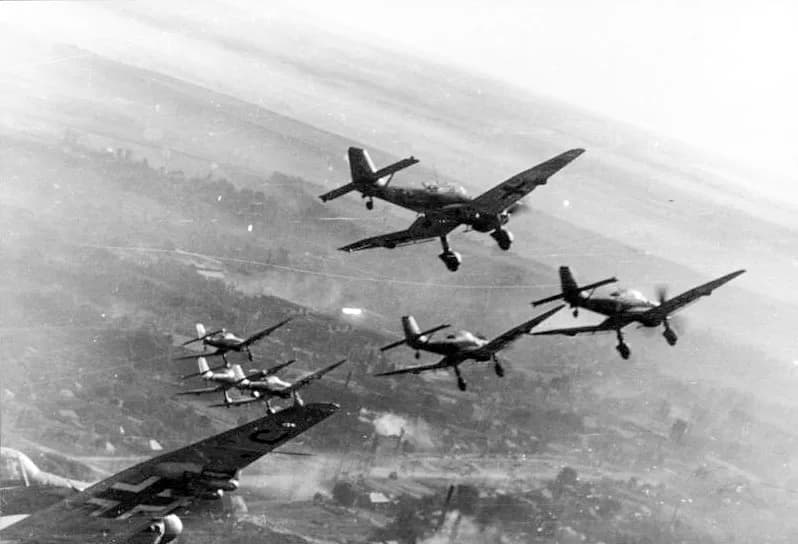
Blitzkrieg, or lightning war, is a German military doctrine combining armour, aircraft and motorised infantry to break through enemy lines and rapidly encircle opposing forces. Applied in Poland in 1939 and then in France in 1940, it brought down a country in six weeks and reshaped modern warfare before stalling on the Eastern Front.
Blitzkrieg found its roots in the military reflections of the interwar period, a time when several theorists sought to avoid repeating the horrors of World War I trench warfare. The trauma of the Great War, with its deadly frontal offensives and negligible territorial gains, pushed strategists to imagine new forms of combat. In Germany, officers such as Heinz Guderian, who published his foundational work Achtung Panzer in 1937, developed a revolutionary vision of mechanized warfare. Guderian drew inspiration notably from the writings of the British theorist J.F.C. Fuller and the Frenchman Charles de Gaulle, both of whom had advocated for the concentrated use of tanks rather than their dispersal in infantry support roles. The central idea was to create autonomous armored divisions capable of breaking through enemy lines at a weak point, then exploiting this breakthrough in depth without waiting for the rest of the army. Tactical aviation, notably the Junkers Ju 87 Stuka dive bombers, was to serve as flying artillery to prepare and accompany the armored advance. The Reichswehr, and later the Wehrmacht, experimented with these concepts during large-scale maneuvers and exercises throughout the 1930s. The Spanish Civil War also provided a testing ground for certain aerial tactics with the Condor Legion. The term Blitzkrieg itself was not an official doctrinal term of the German army but was popularized by the Western press after the stunning campaigns of 1939 and 1940. The roots of this strategy also reached into the Prussian tradition of Bewegungskrieg, or war of movement, which favored maneuver and encirclement over frontal attrition. The Germans also integrated technological advances in radio communications, enabling unprecedented coordination between different arms on the battlefield. This combination of innovative tactical thinking, modern technology, and German military tradition created a doctrine that would transform the face of warfare in the twentieth century.
The fundamental principles of Blitzkrieg rested on several interdependent pillars that, when combined, created a devastating effect on enemy forces. The first principle was the concentration of armored forces at a Schwerpunkt, a focal point of attack. Unlike French and British doctrines that dispersed tanks along the front line, the Wehrmacht grouped its Panzer divisions into massive formations capable of overwhelming enemy defenses at a precise point. This concentration of power made it possible to achieve overwhelming local superiority, even if the German army as a whole did not necessarily possess overall numerical superiority. The second principle was speed of execution. Once the breakthrough was achieved, armored forces were to advance as rapidly as possible into enemy territory, without concerning themselves with securing their flanks or waiting for foot infantry. This speed created a psychological shock effect on the adversary, disorganizing their command and communications well before combat reached their positions. The third principle was combined arms cooperation, or Zusammenwirken. Motorized infantry followed the armor to consolidate breakthroughs and reduce pockets of resistance. Self-propelled artillery provided mobile fire support. And crucially, the Luftwaffe provided close air support, destroying communication nodes, troop concentrations, and approaching enemy reserves. The fourth principle was Auftragstaktik, or mission-type command, a Prussian tradition allowing junior officers to take tactical initiatives within the framework of a defined strategic objective. This decentralization of command gave armored units the flexibility needed to exploit unforeseen opportunities on the ground. The fifth principle was encirclement, inherited from the battles of Cannae and Tannenberg. Armored forces, after breaking through, executed vast pincer movements to encircle entire armies, cutting them off from their supply and communication lines. Finally, the role of psychological warfare should not be underestimated. The wailing sirens of the Stukas, columns of refugees blocking roads, and the sheer speed of the German advance created a panic that paralyzed the enemy's ability to react.
The first major application of Blitzkrieg took place during the invasion of Poland in September 1939, known as Fall Weiss. In barely five weeks, the Wehrmacht crushed Polish forces through a combination of rapid armored breakthroughs and massive aerial bombardment. The Panzer divisions, supported by Stukas, pierced Polish lines at multiple points and converged on Warsaw, encircling entire armies. Although the Polish army fought courageously, it could not withstand the speed and coordination of German forces. This campaign served as a dress rehearsal and allowed the Germans to identify certain weaknesses in their organization. However, it was during the Fall of France in May-June 1940, Fall Gelb, that Blitzkrieg reached its zenith. Erich von Manstein's bold plan called for an armored breakthrough through the Ardennes, considered impassable for tanks. Guderian's Panzer Corps crossed the Ardennes forests in three days, bridged the Meuse at Sedan on May 13, and raced toward the English Channel, cutting the Allied forces in two. In six weeks, France, considered the world's foremost land military power, capitulated. The Allied Northern Army Group, including the British Expeditionary Force and the best French divisions, was encircled at Dunkirk. This victory stunned the entire world and seemed to confirm the invincibility of the German war machine. In the Balkans in spring 1941, Blitzkrieg enabled the rapid conquest of Yugoslavia and Greece in just a few weeks. Operation Barbarossa, launched on June 22, 1941, against the Soviet Union, represented the most ambitious application of Blitzkrieg. The first months were spectacular, with massive encirclements at Minsk, Smolensk, and Kiev, where hundreds of thousands of Soviet soldiers were captured. Army Group Center advanced over 600 kilometers in just weeks. However, the immense distances of Soviet territory, the fierce resistance of the Red Army, and the arrival of the Russian winter began to reveal the strategy's limitations.
The results of Blitzkrieg were both spectacular in its initial successes and revealing in its subsequent failures. On the success side, the Polish campaign demonstrated the superiority of mechanized warfare over conventional tactics, with the Wehrmacht defeating a nation of 35 million inhabitants in five weeks with relatively limited losses. The French campaign was even more impressive, resulting in the defeat of the French army, long considered the most powerful in Europe, in only six weeks. German losses were approximately 27,000 killed, compared to over 90,000 on the French side. These lightning victories gave Germany control of most of Western and continental Europe. Blitzkrieg also revolutionized military thinking worldwide. All major powers began reorganizing their armed forces around armored and mechanized divisions. The United States, the Soviet Union, and Great Britain developed their own armored warfare doctrines, drawing direct inspiration from German successes. However, the limits of Blitzkrieg became clearly apparent before Moscow in December 1941. The Wehrmacht, stretched across a front of over 1,800 kilometers, could not maintain the pace of its advances against the immensity of Soviet territory, the growing resistance of the Red Army, and extreme weather conditions. The Soviet counteroffensive before Moscow marked the first major strategic failure of Blitzkrieg. Subsequently, the Battle of Stalingrad in 1942-1943 confirmed that lightning war could not work against an adversary possessing deep strategic reserves and sufficient territorial space to absorb initial blows. The failure of the last great German armored offensive at Kursk in July 1943 definitively ended the era of Blitzkrieg. The Soviets had learned to construct defenses in depth capable of absorbing armored breakthroughs, then launching their own mechanized counteroffensives. Blitzkrieg nonetheless left a lasting legacy in military doctrine, influencing NATO's air-land warfare concepts during the Cold War and the US Army's AirLand Battle doctrine successfully employed during the 1991 Gulf War.
Analysis of Blitzkrieg reveals a strategy that was both brilliant in its conception and fundamentally limited in its long-term application. On the tactical and operational level, Blitzkrieg represented a considerable advance in the art of war. The combination of armored concentration, close air support, radio communications, and decentralized command created an operational tempo that Germany's adversaries could not initially match. The psychological shock effect was as important as the material damage, paralyzing enemy headquarters and preventing any coordinated response. However, deeper analysis reveals that Blitzkrieg suffered from fundamental internal contradictions. First, it rested on the assumption of a short, decisive war. Nazi Germany did not possess the economic resources and raw material reserves necessary to sustain a prolonged conflict. Blitzkrieg was not merely a tactical preference but a strategic necessity imposed by the Reich's economic limitations. Second, the strategy depended heavily on surprise and enemy unpreparedness. As soon as adversaries understood Blitzkrieg's mechanisms and developed appropriate countermeasures, notably antitank defenses in depth and the use of mobile reserves, its effectiveness diminished considerably. Third, Blitzkrieg did not solve the fundamental logistical problem of modern warfare. Armored divisions, advancing rapidly far from their bases, depended on supplies of fuel, ammunition, and spare parts that German logistics, still largely dependent on horse-drawn transport, could not ensure over great distances. This problem was particularly acute in Russia, where distances were immense and road and rail infrastructure inadequate. Fourth, the success of Blitzkrieg in France created overconfidence in the German high command, which gravely underestimated the difficulties of a campaign against the Soviet Union. Hitler and his generals projected onto the Eastern Front the results obtained in the West, without accounting for fundamental differences in geography, climate, and mobilization capacity. In summary, Blitzkrieg remains one of the most significant military innovations of the twentieth century, but its analysis shows it was more of an operational method suited to short campaigns against vulnerable adversaries than a true strategy for victory in a prolonged total war.
This article draws on historical works, military archives and recognized academic publications.
General Heinz Guderian, author of Achtung Panzer published in 1937, was the main architect of Blitzkrieg. Its principles rest on five pillars: concentration of armor at the Schwerpunkt (focal point), speed of exploitation after breakthrough, combined arms cooperation between armor, infantry, and aviation, Auftragstaktik (decentralized mission-type command), and encirclement of large enemy formations. Radio communications enabled unprecedented coordination between units.
Blitzkrieg reached its zenith during the French campaign (May-June 1940): Guderian's Panzer Corps crossed the Ardennes, bridged the Meuse at Sedan on May 13, and raced to the Channel, defeating in six weeks a French army at a cost of 90,000 French dead versus 27,000 Germans. Its limits emerged before Moscow in December 1941, then at Stalingrad (1942-1943) and Kursk (July 1943), where Soviet defenses in depth absorbed armored breakthroughs.
Blitzkrieg rested on the assumption of a short, decisive war, a strategic necessity imposed by the economic limitations of the German Reich. On the Eastern Front, the immense distances (over 1,800 kilometers), insufficient logistics (still largely horse-drawn), the Red Army's resistance, and the Russian winter paralyzed the advance. Once the Soviets learned to build deep anti-tank defenses and launch their own mechanized counteroffensives, the lightning war had been surpassed.
Information cross-checked against Wikipedia and reference historical works.
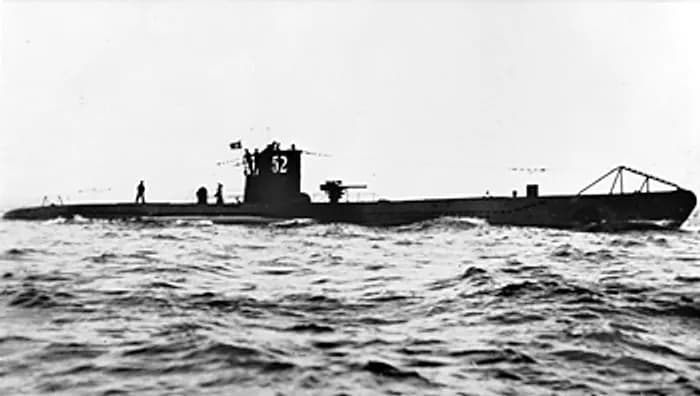
Submarine Warfare
The German submarine war, waged by the Kriegsmarine's U-boats, aimed to cut Britain's transatlantic supply lines, threatening the island's very survival during the Battle of the Atlantic. The reversal came in 1943, with the breaking of Enigma, shipborne radar and long-range escort vessels.
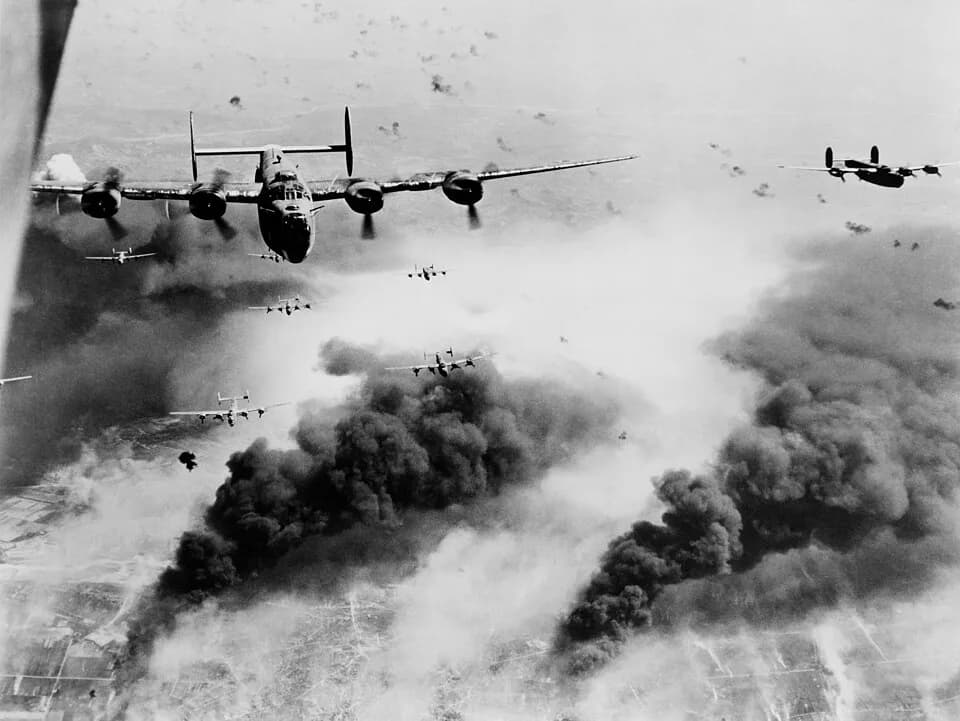
Strategic Bombing
Allied strategic bombing aimed to destroy the industrial and military apparatus of Nazi Germany through massive air raids, mixing American daylight precision bombing with British night-time area bombing. Waged from 1940 to 1945, it diverted a considerable share of German production toward air defence, at the cost of heavy civilian casualties.
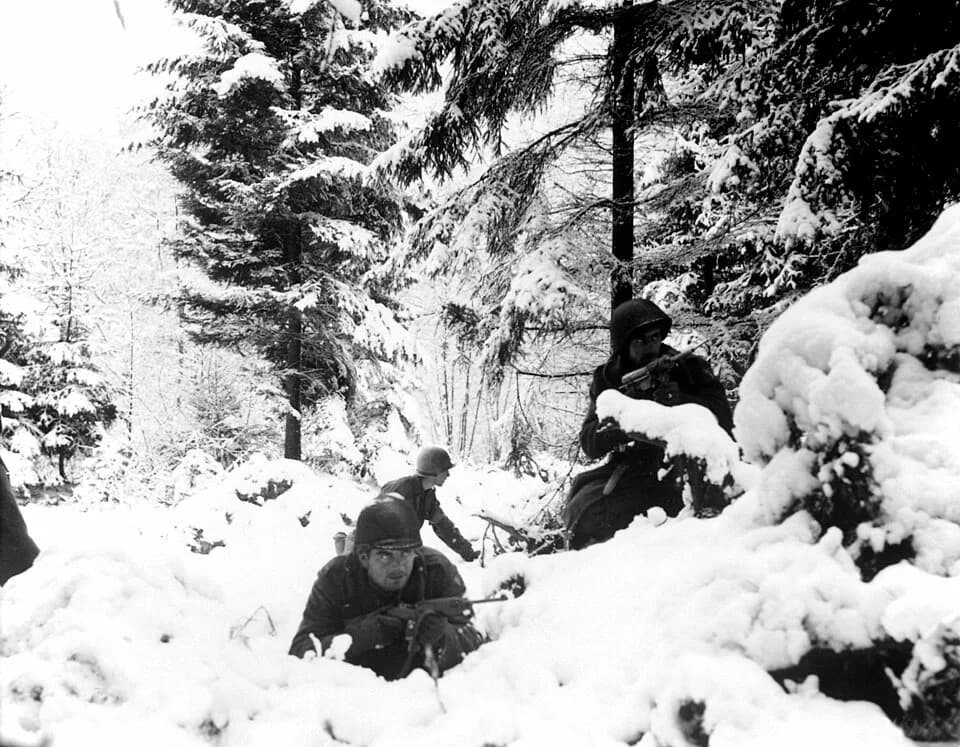
Defense in Depth
The Soviet defence in depth organised successive defensive zones across tens of kilometres, in order to absorb German armoured breakthroughs, exhaust the attacker and set up decisive counter-offensives. Applied at Kursk in 1943, it rested on minefield belts, anti-tank ditches and dug-in artillery, prepared months before the assault.
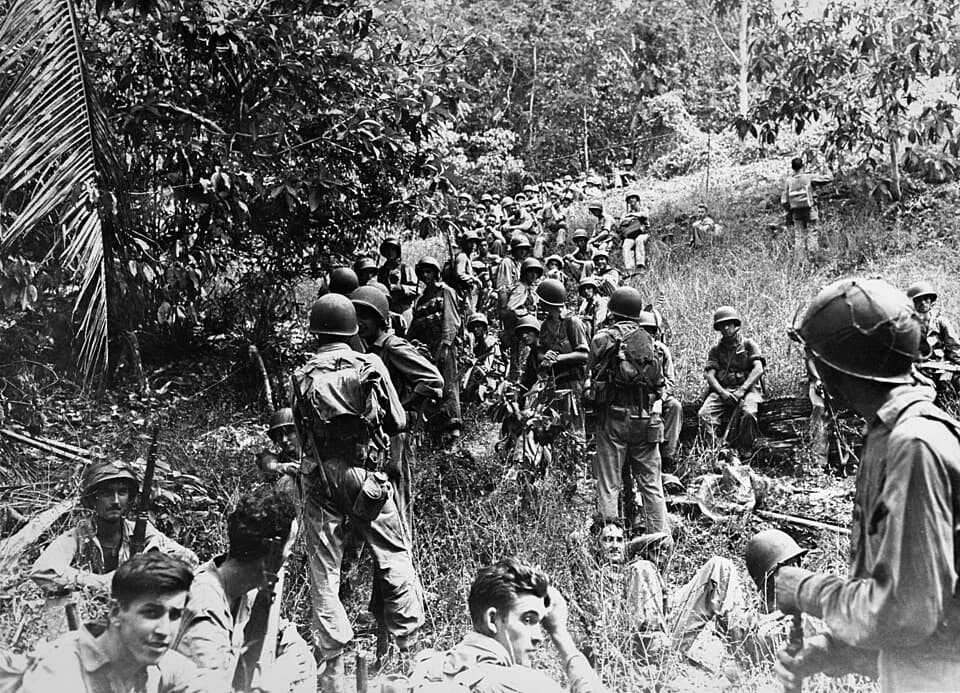
Island Hopping
Island hopping was the American strategy of bypassing fortified Japanese garrisons to seize less defended islands, gradually bringing Allied forces closer to Japan. The strongholds left behind, cut off from all resupply, ceased to be a threat without ever having to be stormed.
