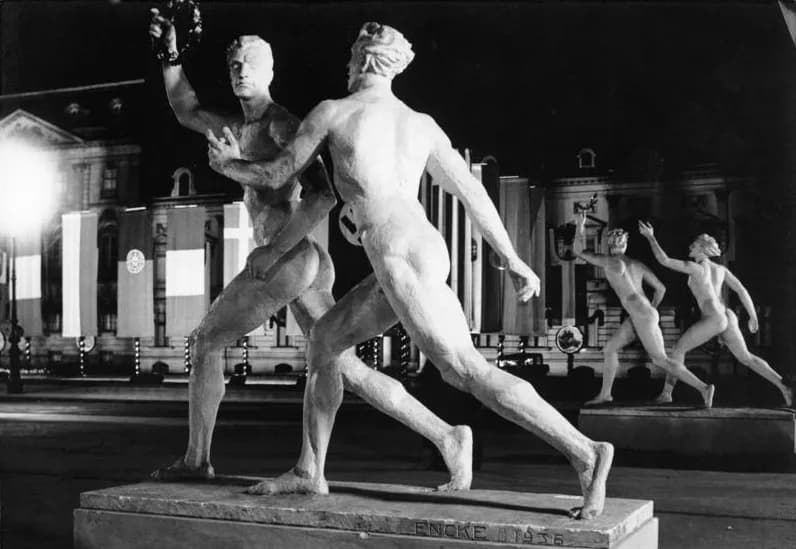
The Third Reich, led by Adolf Hitler from 1933 to 1945, plunged the world into World War II and perpetrated the Holocaust, causing tens of millions of deaths before its unconditional surrender in May 1945. Born of Hitler's appointment as chancellor on 30 January 1933, the regime dismantled the Weimar Republic within months and turned Germany into a one-party state.
Nazi Germany, officially known as the Third Reich, was born from Adolf Hitler's appointment as Chancellor on January 30, 1933. This rise to power resulted from a combination of economic, political, and social factors that had weakened the Weimar Republic since its creation in 1919. The global economic crisis of 1929, mass unemployment, the humiliation felt after the Treaty of Versailles, and chronic political instability had created fertile ground for extremist movements. The National Socialist German Workers' Party, the NSDAP, had exploited these resentments by promising the restoration of German greatness, full employment, and the revision of conditions imposed by the victors of World War I. From the moment he took power, Hitler set about consolidating his authority in a methodical and ruthless manner. The Reichstag fire in February 1933 served as a pretext for suspending fundamental civil liberties. The Enabling Act of March 1933 allowed the government to legislate without parliamentary approval. Political parties were banned one by one, trade unions dissolved, the press muzzled, and opponents sent to the first concentration camps, notably Dachau. The Night of the Long Knives in June 1934 eliminated potential rivals within the party itself, definitively consolidating Hitler's power. Upon President Hindenburg's death in August 1934, Hitler combined the functions of chancellor and president, becoming the undisputed Führer of the Reich. The Nazi regime's foreign policy was characterized by aggressive territorial expansion that systematically violated international agreements. The remilitarization of the Rhineland in 1936, the Anschluss with Austria in March 1938, and the annexation of the Sudetenland in October 1938, ratified by the Munich Agreement, were all steps toward war. The invasion of Czechoslovakia in March 1939 demonstrated that the Western democracies' appeasement policy had failed. The German-Soviet non-aggression pact signed in August 1939 secured Germany's eastern flank and enabled the invasion of Poland on September 1, 1939, officially triggering World War II. The first years of the conflict were marked by spectacular Wehrmacht victories. Blitzkrieg enabled the rapid conquest of Poland, Denmark, Norway, the Netherlands, Belgium, and France. By the summer of 1940, Germany dominated most of continental Europe. However, the failure of the Battle of Britain and the fateful decision to invade the Soviet Union in June 1941 with Operation Barbarossa marked the beginning of the decline. The defeat at Stalingrad in February 1943 constituted a major turning point on the Eastern Front, while Allied landings in North Africa, Italy, and then Normandy in June 1944 opened new fronts in the West. The end of the Third Reich was a total collapse. Encircled by Soviet armies in the East and Anglo-American forces in the West, Germany suffered devastating bombing that reduced its cities to rubble. Hitler committed suicide in his Berlin bunker on April 30, 1945. Unconditional surrender was signed on May 8, 1945, ending twelve years of Nazi rule and six years of war in Europe. The human toll was staggering, with tens of millions dead, including six million Jews murdered during the Holocaust.
Nazi Germany's military machine was one of the most powerful and formidable in modern history. The Wehrmacht, officially created in 1935 in violation of the Treaty of Versailles, comprised three main branches: the Heer (army), the Kriegsmarine (navy), and the Luftwaffe (air force). At its peak in 1943, the Wehrmacht had approximately 13 million men under arms, making it the largest military force ever assembled by Germany. The Heer formed the backbone of German military power. It was organized into army groups, armies, corps, and divisions, with a command structure that allowed great tactical flexibility. The armored divisions, the Panzer-Divisionen, were the spearheads of the Blitzkrieg. Equipped with tanks such as the Panzer III, Panzer IV, then the formidable Panther and Tiger, these units combined armored firepower with mechanized infantry and close air support to break through enemy lines and exploit breaches in depth. This doctrine of mobile warfare revolutionized military art and enabled the lightning conquests of 1939 to 1941. The Luftwaffe, commanded by Hermann Göring, played a crucial role in early German successes. It possessed high-quality aircraft such as the Messerschmitt Bf 109 fighter, the Junkers Ju 87 Stuka dive bomber, and the Heinkel He 111 medium bomber. The Luftwaffe excelled in the close tactical support role, working in close coordination with ground forces during Blitzkrieg campaigns. However, it was never designed as a long-range strategic bombing force, which proved a major weakness when the war evolved into a prolonged war of attrition. The Battle of Britain in 1940 revealed its limitations against a determined and well-organized air defense. The Kriegsmarine, though more modest than the British Royal Navy, waged a devastating submarine war in the Atlantic. The U-boats, under Admiral Karl Dönitz's command, used wolfpack tactics to attack Allied convoys and threaten vital supply lines between North America and Great Britain. The Battle of the Atlantic was one of the longest and fiercest engagements of the war, lasting from 1939 to 1945. However, the development of radar, sonar, Enigma code-breaking, and maritime patrol aviation allowed the Allies to gradually gain the upper hand. Outside the Wehrmacht, the Waffen-SS constituted a parallel military force of growing importance throughout the conflict. Initially conceived as Hitler's personal guard, it expanded to comprise 38 divisions by war's end, approximately 900,000 men. Some of its units, such as the Leibstandarte, Das Reich, and Totenkopf divisions, acquired a reputation for fierce fighting ability but also extreme brutality toward prisoners of war and civilian populations. The Waffen-SS also recruited extensively among foreign volunteers, forming divisions composed of French, Belgian, Dutch, Scandinavian, and other nationalities. Germany's armaments industry, directed by Albert Speer from 1942, achieved remarkable production feats despite intensive Allied bombing. Germany developed technologically advanced weapons, including V-1 and V-2 rockets, the first operational jet aircraft such as the Messerschmitt Me 262, and heavy tanks like the Tiger II. However, these innovations arrived too late and in insufficient quantities to reverse the course of the war against the Allies' overwhelming numerical superiority.
Nazi Germany's economy underwent a radical transformation between 1933 and 1945, shifting from an economy devastated by the Great Depression to a total war machine. When Hitler came to power in January 1933, Germany had more than six million unemployed, roughly one-third of the workforce. The banking system was fragile, industrial production had collapsed, and social misery fueled despair and political radicalization. The new regime made unemployment reduction its absolute priority, understanding that its political legitimacy depended directly upon it. Economics Minister Hjalmar Schacht implemented a series of bold measures to revive economic activity. Public works programs, notably the construction of the Autobahnen highways, provided employment for hundreds of thousands of workers. MEFO bills, an ingenious financial instrument, enabled secret rearmament financing without it appearing in the official budget. Exchange controls, bilateral barter agreements with Southeast European and Latin American countries, and autarky policies aimed to reduce Germany's dependence on imports of strategic raw materials. Rearmament quickly became the main driver of German economic growth. Military spending rose from less than 1% of GDP in 1933 to over 20% in 1939. This militarization of the economy effectively created full employment by 1936, but at the cost of a growing structural imbalance. The German economy was producing guns at the expense of butter, according to Göring's famous phrase. Inflation was artificially contained through price and wage controls, but shortages of consumer goods became increasingly frequent. The Four-Year Plan of 1936, placed under Göring's direction, intensified the drive toward autarky and economic preparation for war. Enormous investments were devoted to producing synthetic rubber (Buna), synthetic fuel from coal (the Fischer-Tropsch process), and other substitutes for imported raw materials. The giant IG Farben plant at Auschwitz-Monowitz, which exploited forced labor from the neighboring concentration camp, sinisterly illustrated the fusion between industry and the Nazi concentration camp system. During the war, the German economy was progressively converted into a total war economy, a process not truly completed until 1943 under Albert Speer's direction. Before that date, Hitler had hesitated to impose excessive sacrifices on the civilian population, fearing a repetition of the 1918 morale collapse. Speer reorganized industrial production with remarkable efficiency, tripling armaments production between 1942 and 1944 despite increasingly intense Allied strategic bombing. Factory decentralization, intensive use of forced labor and prisoners of war, and production standardization enabled these impressive results. The systematic plundering of occupied countries constituted an essential pillar of the Nazi war economy. Requisitions of raw materials, food products, machine tools, and labor fed the German war machine while starving occupied populations. The Compulsory Labor Service sent millions of foreign workers to German factories. By war's end, approximately eight million foreign forced laborers and prisoners of war worked in the Reich's economy, representing nearly a quarter of the total workforce.
Nazi Germany's political system represents one of the most complete and destructive totalitarian regimes in history. Founded on National Socialist ideology, it combined an extreme nationalism, pseudo-scientific racism, virulent antisemitism, and a total rejection of liberal democracy and Marxism. The Führerprinzip, or leader principle, constituted the keystone of the Nazi political edifice: all authority emanated from the Führer and descended through a hierarchy of sub-leaders, each exercising absolute power within their domain of competence. The structure of the Nazi state was characterized by a complex tangle of rival institutions competing for power and the Führer's favor. This polycracy, as historians have described it, was not accidental but resulted from a deliberate strategy by Hitler to keep his subordinates in permanent competition with each other. The party, the state, the SS, the military, ministries, and special commissariats overlapped in their jurisdictions, creating bureaucratic chaos that only the Führer's arbitration could resolve, thus reinforcing his position of supreme power. The NSDAP, the sole party, penetrated all aspects of German social life. Its affiliated organizations regimented the population from birth to death: the Hitler Youth for boys, the League of German Girls for girls, the German Labor Front for workers, the NS-Frauenschaft for women. Party membership became practically obligatory for anyone aspiring to a career in civil service, education, or the professions. The Gauleiter, the party's district leaders, wielded considerable power in their respective regions, often acting as virtual local satraps. Propaganda, orchestrated with diabolical skill by Joseph Goebbels, Minister of Public Enlightenment and Propaganda, played a central role in consolidating and maintaining Nazi power. Total control of media, cinema, radio, press, and publishing made it possible to shape public opinion and create a personality cult around Hitler. The mass rallies at Nuremberg, grandiose military parades, and ritualized party ceremonies created an aesthetic of power that both fascinated and intimidated. Antisemitic propaganda methodically prepared the psychological ground for the persecution and then extermination of European Jews. The apparatus of terror constituted the regime's other pillar. The Gestapo, the state secret police directed by Heinrich Müller under Heinrich Himmler's authority, possessed unlimited powers to arrest, interrogate, and detain anyone suspected of opposition to the regime. The concentration camp system, which evolved from political detention camps to industrial extermination camps, represented the most monstrous culmination of Nazi totalitarian logic. Himmler's SS became a veritable state within a state, controlling the police, camps, intelligence services, and even possessing its own military branch, the Waffen-SS. Racial policy was at the heart of the Nazi project. The Nuremberg Laws of 1935 institutionalized discrimination against Jews, stripping them of German citizenship and forbidding mixed marriages. Kristallnacht in November 1938 marked a dramatic escalation toward open violence. During the war, the Wannsee Conference in January 1942 organized the Final Solution, the systematic genocide of six million European Jews in the extermination camps of Auschwitz-Birkenau, Treblinka, Sobibor, Belzec, Chelmno, and Majdanek. Roma, disabled persons, homosexuals, and political opponents were also victims of the Nazi death machine.
Nazi Germany's legacy constitutes one of the darkest chapters in human history. In twelve years of existence, the Third Reich provoked the deadliest war in history, perpetrated genocide of unprecedented scale, and left Europe in ruins. The figures, in their statistical coldness, can only sketch the scope of the catastrophe, but they give the measure of destruction caused by the Nazi regime and the war it unleashed. In human terms, the losses were staggering. Germany itself lost between 6.9 and 7.4 million people, including approximately 5.3 million military personnel killed in combat or who died in captivity. German civilian losses from strategic bombing, fighting on German soil, expulsions from the East, and reprisals amounted to approximately 1.5 to 2 million people. In total, World War II in Europe caused the deaths of more than 40 million people. The Soviet Union alone lost approximately 27 million citizens, a large proportion being civilians who fell victim to the Nazi extermination policy in the East. Poland lost approximately 6 million people, nearly 17% of its prewar population. The Holocaust, the Shoah, represents the most emblematic and horrifying crime of the Nazi regime. Six million European Jews were murdered in a systematic and industrial manner, approximately two-thirds of Europe's prewar Jewish population. Extermination methods ranged from mass shootings by the Einsatzgruppen on the Eastern Front to gas chambers in extermination camps. Millennial Jewish communities were annihilated within months. In addition to Jews, the Nazi regime exterminated approximately 500,000 Roma and Sinti, thousands of homosexuals, tens of thousands of disabled persons under the T4 euthanasia program, and countless political opponents. Material destruction was colossal. German cities were reduced to rubble by Allied bombing: Dresden, Hamburg, Cologne, Berlin, and dozens of other historic cities were devastated. But destruction was not limited to Germany. Warsaw was systematically razed on Hitler's orders after the 1944 uprising. Stalingrad, Leningrad, Rotterdam, Coventry, and hundreds of other European cities suffered massive destruction. Transport infrastructure, bridges, railways, and industrial installations were destroyed across much of the continent. The postwar period saw Germany divided into four occupation zones, then into two separate states: the Federal Republic of Germany in the West and the German Democratic Republic in the East. This division, a symbol of the emerging Cold War, lasted until reunification in 1990. The Nuremberg Trials, which judged the principal surviving Nazi leaders between November 1945 and October 1946, established fundamental principles of international law regarding war crimes, crimes against humanity, and genocide. Twelve defendants were sentenced to death, including Göring, Ribbentrop, Keitel, and Jodl. The moral legacy of Nazism continues to haunt the world's conscience. The Holocaust has become the universal symbol of absolute evil and led to the creation of the State of Israel in 1948, the adoption of the Universal Declaration of Human Rights, and the establishment of international mechanisms for genocide prevention. The duty of remembrance, education about the dangers of totalitarianism and antisemitism, and vigilance against the resurgence of extremism remain moral imperatives that flow directly from this tragic period of human history.
This article draws on historical works, military archives and recognized academic publications.
Nazi Germany dominated Europe through Blitzkrieg, a war doctrine combining tanks, mechanized infantry, and close air support. Between 1939 and 1941, the Wehrmacht conquered Poland, Denmark, Norway, the Netherlands, Belgium, and France in a matter of weeks each. Military spending had risen from less than 1% of GDP in 1933 to over 20% in 1939, supported by secret rearmament.
Nazi Germany was responsible for the deaths of more than 40 million people in Europe during World War II. The Holocaust alone killed six million European Jews, approximately two-thirds of the prewar Jewish population, in the extermination camps of Auschwitz-Birkenau, Treblinka, Sobibor, and others. The regime also exterminated approximately 500,000 Roma, thousands of homosexuals, and tens of thousands of disabled persons.
The Nuremberg Laws (1935) institutionalized discrimination by stripping Jews of German citizenship and banning mixed marriages. The Wannsee Conference (January 1942) organized the 'Final Solution': the systematic genocide of Europe's Jews. These two legal milestones illustrate how the Third Reich transformed antisemitic ideology into state policy, culminating in the Holocaust.
Information cross-checked against Wikipedia and reference historical works.
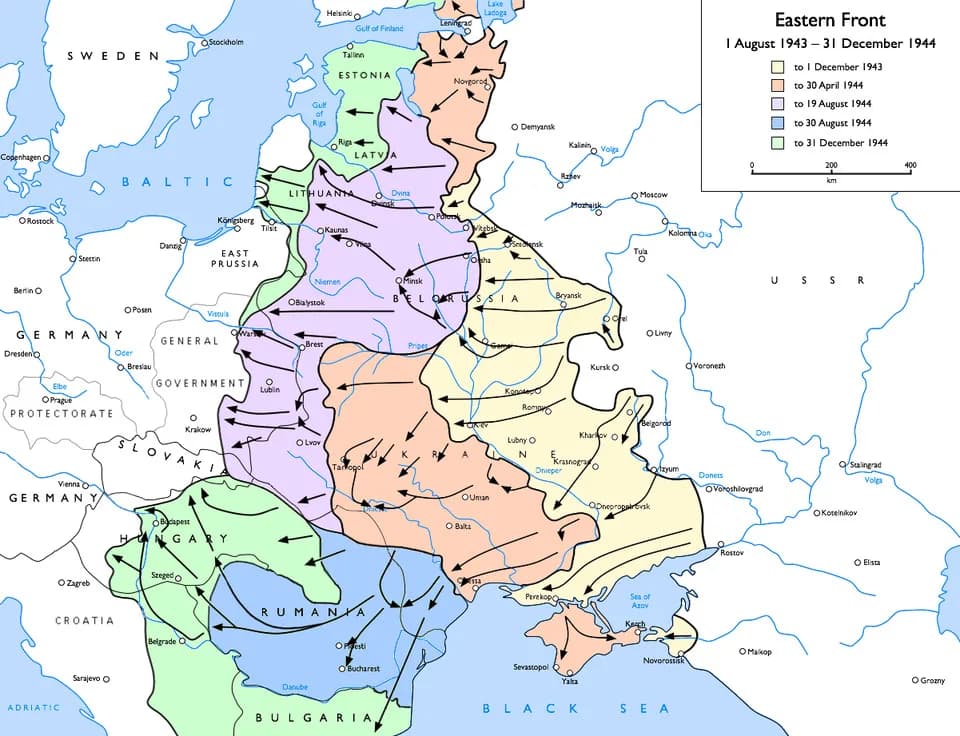
Soviet Union
The Union of Soviet Socialist Republics, led by Joseph Stalin during World War II, played a decisive role in the defeat of Nazi Germany at the cost of 27 million dead, the heaviest losses of the entire conflict. Its factories were moved beyond the Urals in 1941 to keep producing.
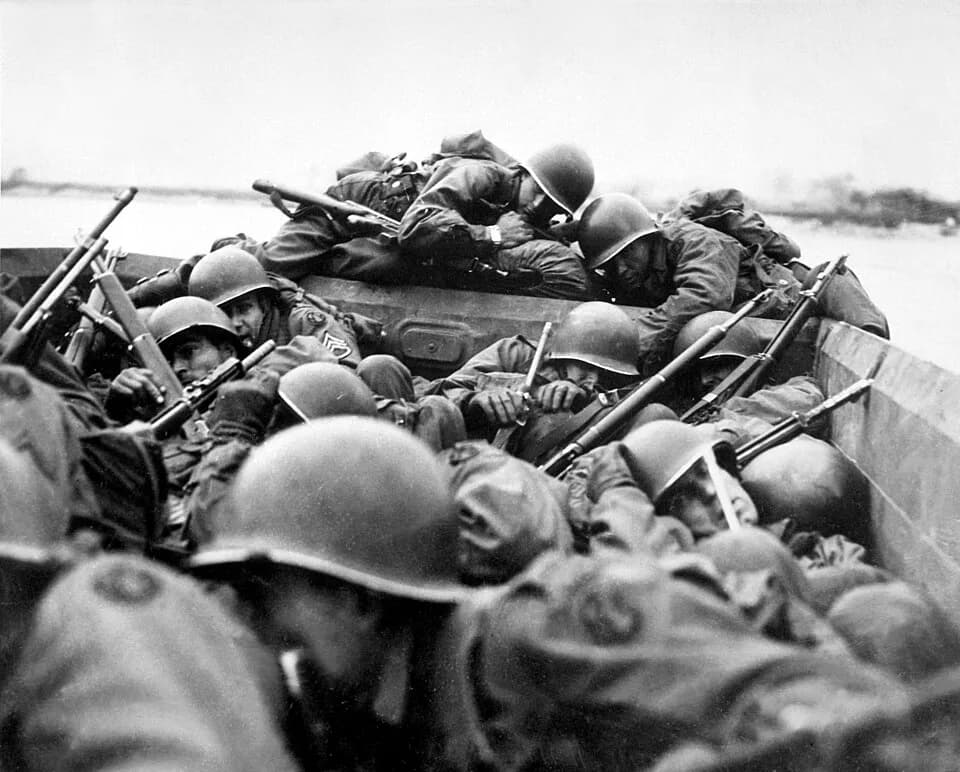
United States
The United States, drawn into the war after the attack on Pearl Harbor on 7 December 1941, became the arsenal of democracy and the decisive industrial and military power that helped the Allies to victory on both theatres of operations. Its war production alone exceeded that of all the Axis powers combined.
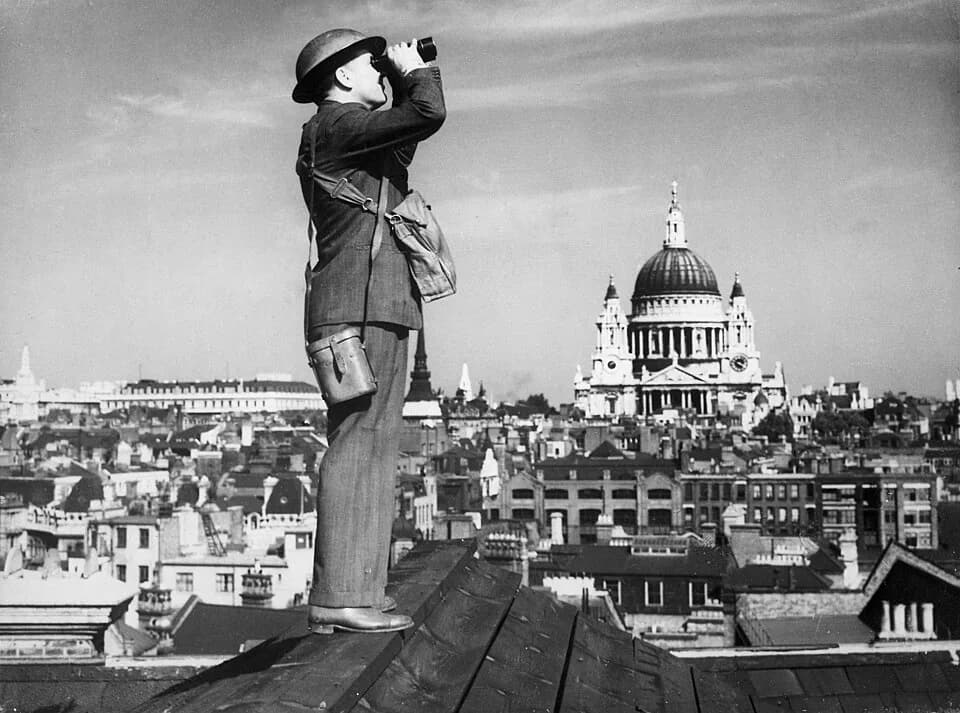
United Kingdom
The United Kingdom of Great Britain and Northern Ireland, led by Winston Churchill from May 1940, was the only major European power to fight Nazi Germany without interruption from September 1939 to May 1945. For a year after the fall of France, it stood alone against the Axis in Europe.
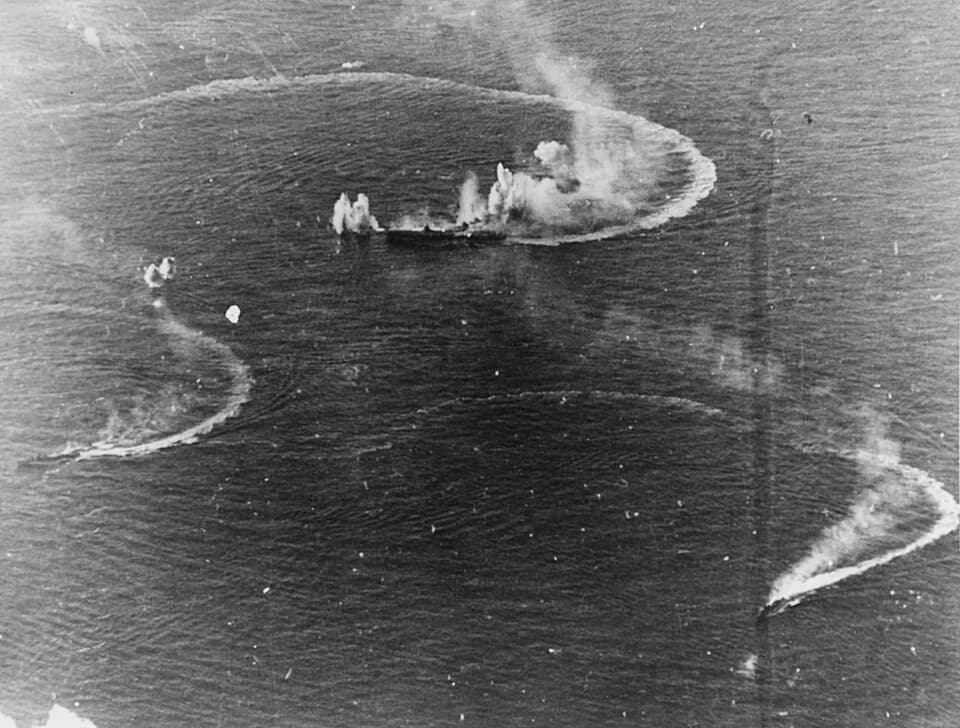
Empire of Japan
The Empire of Japan, led by Emperor Hirohito and the militarists in power, waged a war of expansion across Asia and the Pacific from 1937 to 1945, before surrendering after the atomic bombings of Hiroshima and Nagasaki in August 1945. Its Co-Prosperity Sphere project presented that conquest as a liberation of Asia from Western colonial powers.
