
Spinosaurus mirabilis: new sabre-crested species
For the first time in over a century, a new Spinosaurus species gets a name — and it wore a blade of bone on its skull.
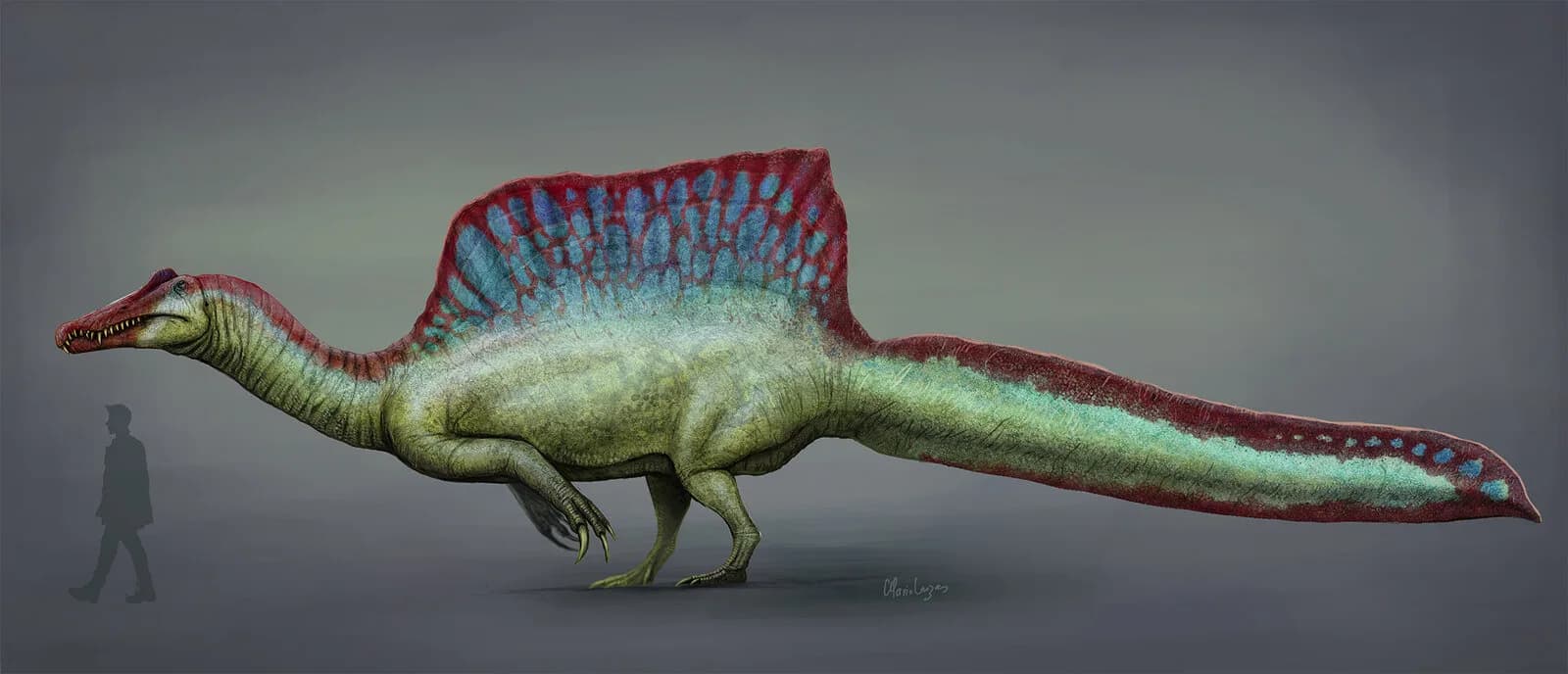
In Science (February 2026), Paul Sereno describes a new Spinosaurus species from Niger — the first in over a century. Its scimitar-shaped cranial crest is the tallest ever found on a theropod.
A first in over a century
On February 19, 2026, the journal Science published the description of Spinosaurus mirabilis, a new predatory dinosaur species found in Niger, in the Jengueb fossil area deep in the central Sahara. The team led by paleontologist Paul Sereno (University of Chicago) calls it the first unequivocally named Spinosaurus species in over a hundred years — the genus had not welcomed a confirmed new member since it was first erected in the early 20th century.
The animal lived about 95 million years ago, in the Cretaceous. A surprising detail: its fossils were recovered 500 to 1,000 km from the era's marine shoreline — far inland for a fish-hunter. This new species joins the better-known Spinosaurus genus, whose semi-aquatic anatomy our encyclopedia already covers in depth.
A scimitar crest, the tallest on any theropod
The defining feature of Spinosaurus mirabilis is its cranial crest, curved like a scimitar and rising toward the sky. According to the team, it is the tallest head crest known on any theropod — no documented predatory dinosaur carried anything comparable. The bone's surface texture and internal vascular canals suggest it was sheathed in keratin in life, like the horn of a modern animal.
What was this blade of bone for? Not for fighting or hunting, the authors say, but for display: a visual signal to communicate with others of its kind, likely brightly coloured. Sereno describes it as a "blade-shaped beacon" curving upward.
« This display feature was brightly coloured in life, curving toward the sky as a blade-shaped beacon. »
— Paul Sereno, Université de Chicago
The "hell heron," a coelacanth hunter
Like its cousins, Spinosaurus mirabilis fed on large fish, especially coelacanths of the genus Mawsonia. Its upper and lower teeth interlocked — an ideal trap for holding slippery prey. Sereno pictures the animal as a "hell heron": it would wade on its sturdy legs into two metres of water, but spent most of its time stalking fish in the shallows.
This lifestyle extends what paleontology has established about Spinosaurus since the 2014 revision by Ibrahim and colleagues: a water-bound predator built to fish rather than chase land prey. The new species confirms this lineage occupied the rivers and wetlands of Cretaceous Africa across a wide territory.
A find that almost went unnoticed
The dig story hung by a thread. When the team unearthed the first crest in November 2019, its shape was so unexpected that no one immediately grasped what it was. It took a return trip in 2022 with a larger crew, and the recovery of two more crests, to realize this was a new kind of skull ornament — and therefore a new species.
Spinosaurus, from science to your server
Spinosaurus remains one of the most-played dinosaurs in survival games. On La Meute QC's Path of Titans server, in realistic-survival mode, Spinosaurus is a semi-aquatic creature that dominates the rivers of the Riparia map — exactly the ecological role science assigns to mirabilis. Here's how to dig into the topic from both angles, science and game:
📚 Verified sources
- Sci.News — New Spinosaurus Species Discovered in Niger(verified 2026-06-11)
- Phys.org — New 'scimitar-crested' Spinosaurus species discovered in the central Sahara(verified 2026-06-11)
- Science (19 fév. 2026) — DOI 10.1126/science.adx5486(verified 2026-06-11)