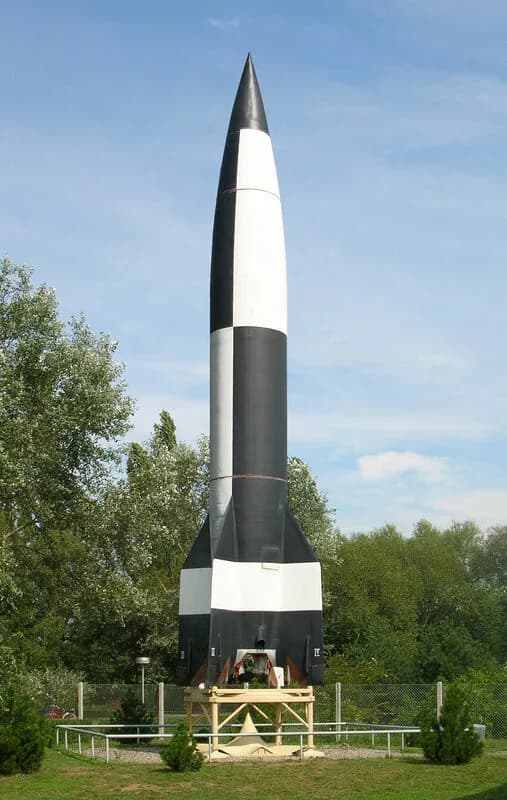
The V-2, or Vergeltungswaffe 2 (retaliation weapon 2), was the first ballistic missile in history. Designed by Wernher von Braun at Peenemünde, this 14-meter supersonic missile struck London and Antwerp with no possibility of interception, foreshadowing the era of intercontinental ballistic missiles and space exploration.
Development of the V-2 began in the 1930s under the direction of Walter Dornberger and the young engineer Wernher von Braun, passionate about rocketry since his adolescence. The German military rocket program started in 1932 at Kummersdorf, near Berlin, before relocating in 1937 to the Peenemünde research center on the island of Usedom in the Baltic Sea, a site chosen for its isolation. The project, designated Aggregat 4 (A-4), aimed to create a long-range ballistic missile capable of striking England from the continent. After years of development and numerous failures, the first successful A-4 flight occurred on October 3, 1942: the missile reached an altitude of 84.5 km and traveled 190 km, becoming the first man-made object to reach space. Dornberger declared: 'Today, the spaceship was born.' Hitler, initially skeptical, became enthusiastic and ordered mass production. Albert Speer, Armaments Minister, entrusted production to the sinister SS General Hans Kammler. The underground Mittelwerk factory, carved into the Harz Mountains by prisoners from the Dora-Mittelbau concentration camp, was the main production site. Conditions were horrific: approximately 20,000 prisoners died manufacturing V-2s, more than the casualties from its bombardments.
The V-2 measured 14m tall with a diameter of 1.65m and weighed 12,508 kg at launch. Propulsion was provided by a liquid-fuel rocket engine burning a mixture of ethanol (75%) and liquid oxygen, developing 25 tons of thrust for 65 seconds. The missile reached a maximum speed of 5,760 km/h (Mach 4.7) and a maximum altitude of 88 km during its parabolic ballistic trajectory. Operational range was approximately 320 km. The warhead contained 980 kg of Amatol, a powerful explosive. The guidance system combined a gyroscope and an accelerometer that cut off the engine when the calculated velocity was reached, but accuracy remained poor: the CEP (circular error probable) was approximately 17 km, limiting the V-2 to a terror weapon against urban areas rather than a precise military tool. The V-2 was launched from mobile Meillerwagen platforms, making launch sites extremely difficult to locate and destroy. Preparation time for firing was approximately 90 minutes. Over 3,000 V-2s were produced at Mittelwerk between September 1944 and March 1945.
The first operational V-2 struck Paris on September 8, 1944, followed the same day by the first launch against London. Unlike the V-1, a slow and noisy cruise missile that could be intercepted by fighters and anti-aircraft guns, the V-2 arrived at Mach 4.7 with no warning: the explosion preceded the sound of the missile. There was no defense against the V-2 — the Allies could only bomb production sites and attempt to capture launch areas. London received 1,358 V-2s between September 1944 and March 1945, killing 2,754 people and wounding 6,523. The deadliest attack struck a Woolworths store in New Cross on November 25, 1944, killing 168 people. Antwerp, vital for Allied supply, was the primary target with 1,610 V-2s, killing 1,736 civilians and 682 military personnel. The worst incident was a V-2 explosion at the Rex Cinema on December 16, 1944, killing 567 people including 296 Allied servicemen. The Netherlands also suffered devastating bombardments. In total, approximately 3,225 V-2s were fired operationally, killing approximately 9,000 civilians and military personnel.
The V-2 was the last in a series of experimental Aggregat rockets. The A-1 and A-2 were small test rockets from the 1930s. The A-3, tested in 1937, failed due to guidance problems. The A-5, a scaled-down A-4 version, served as a test bed. The V-2 itself had planned but never realized evolutions: the A-4b added wings to increase range (a prototype was tested in January 1945), the A-9 was a piloted long-range version, and the A-10, a giant first stage, was to serve as a booster for the A-9, creating an intercontinental missile capable of striking New York (the Amerika-Bomber project). These projects remained conceptual. The Germans also developed the Wasserfall, a guided anti-aircraft version of the V-2, and the Taifun, a small unguided anti-aircraft rocket. The V-1, a pulse-jet cruise missile, is often associated with the V-2 but relied on entirely different technology. After the war, captured V-2s became the foundation of both American and Soviet space programs: von Braun's Redstone, Jupiter, and Saturn rockets descended directly from the V-2, as did Sergei Korolev's Soviet R-1 missile.
The V-2 is one of the most significant weapons in history, not for its direct military impact — relatively limited compared to conventional bombing — but for the technologies it pioneered. It was the first man-made object to reach space, the first operational ballistic missile, and the direct ancestor of all modern space rockets and intercontinental ballistic missiles. The V-2's moral legacy is deeply troubling. Wernher von Braun, a Nazi Party member and SS officer, used forced labor from concentration camp prisoners to realize his space dream. After the war, he was recruited by the Americans under Operation Paperclip and became the father of the American space program, designing the Saturn V rocket that sent men to the Moon in 1969. On the other side, the Soviets captured V-2 engineers and equipment to launch their own missile program, leading to Sputnik and the Space Race. Satirist Tom Lehrer summed up this moral ambiguity in his song about von Braun: 'Once the rockets are up, who cares where they come down? That's not my department, says Wernher von Braun.' The V-2 remains the symbol of science exploited by barbarism, and the morally ambiguous recovery of that science by the victors.
The V-2 (Vergeltungswaffe 2), designed by Wernher von Braun at Peenemünde, is the first operational ballistic missile in history. Measuring 14m, it reached Mach 4.7 (5,760 km/h) and an altitude of 88 km in flight — the first man-made object to reach space, on October 3, 1942. It arrived with no audible warning, the explosion preceding the sound of the missile, making any defense impossible.
London received 1,358 V-2s between September 1944 and March 1945, killing 2,754 people and wounding 6,523. The deadliest attack struck a Woolworths store in New Cross on November 25, 1944, killing 168 people. Antwerp, the primary target with 1,610 V-2s, lost 1,736 civilians and 682 military personnel. The worst incident was a V-2 explosion at the Rex Cinema on December 16, 1944, killing 567 people.
The underground Mittelwerk factory, carved into the Harz Mountains by prisoners from the Dora-Mittelbau concentration camp, was the main V-2 production site. Approximately 20,000 prisoners died there from overwork, starvation, and mistreatment manufacturing the missiles — more than the approximately 9,000 civilian and military casualties from their operational bombardments.
Information cross-checked against Wikipedia and reference historical works.
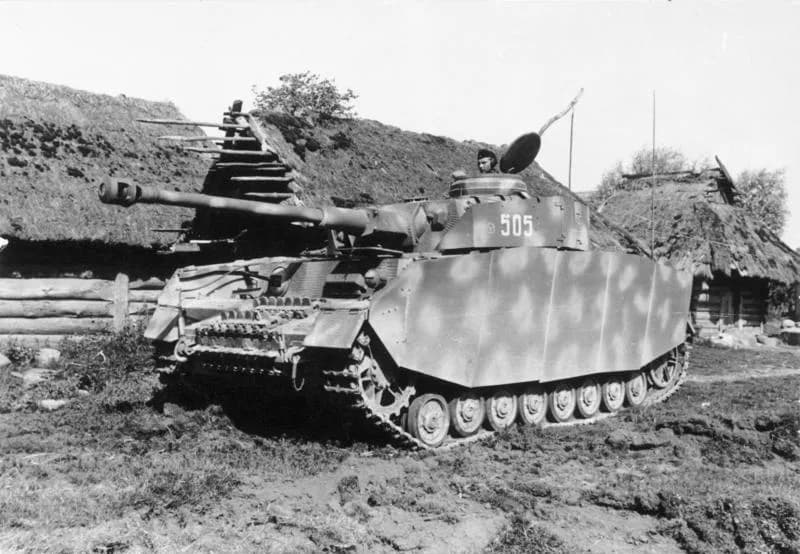
Panzer IV
The Panzerkampfwagen IV was the most produced German medium tank of World War II, with over 8,500 built. Originally designed as an infantry support tank, it evolved into the backbone of the Panzer divisions on every front. It is the only German tank in production from 1939 to 1945.
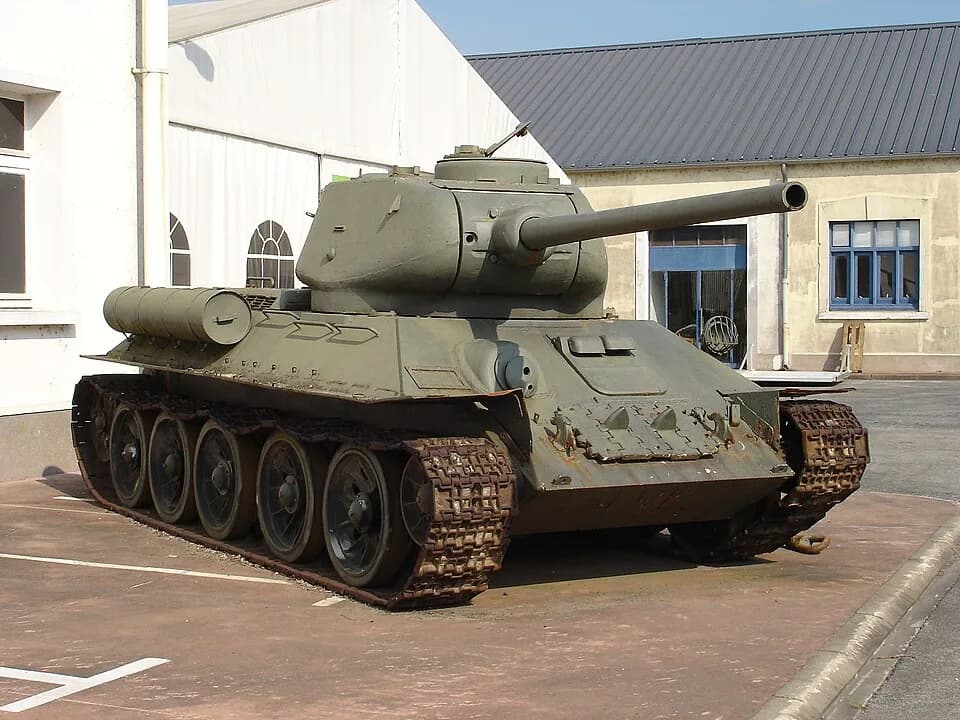
T-34
The T-34 is widely considered the best medium tank of World War II and one of the most influential in military history. Produced in over 84,000 units, its combination of sloped armor, mobility and firepower shocked the Germans in 1941 and shifted the balance of power on the Eastern Front.
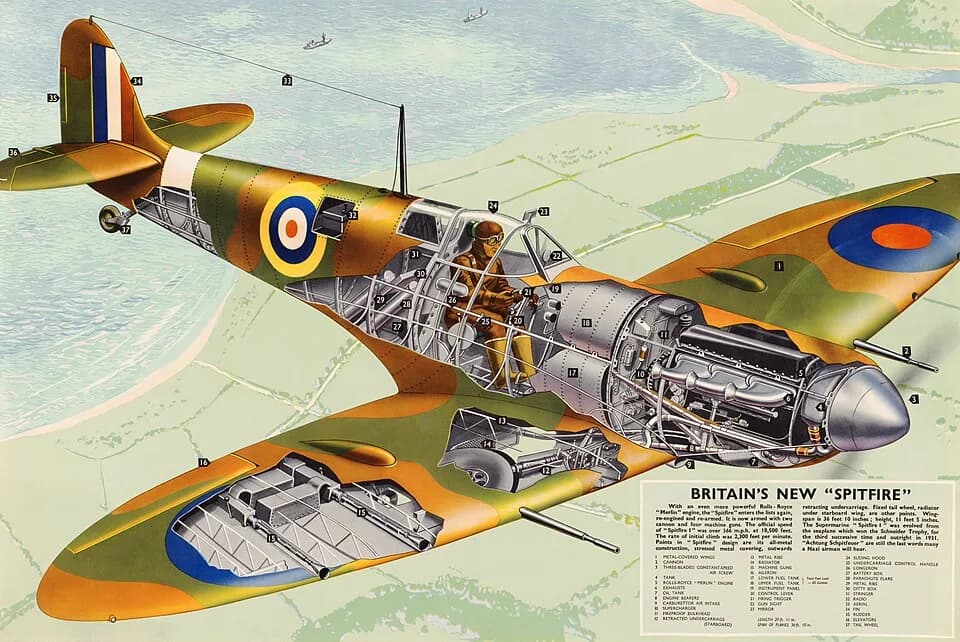
Supermarine Spitfire
The Supermarine Spitfire is the iconic fighter aircraft of the Royal Air Force and a symbol of British resistance during the Battle of Britain. Designed by R.J. Mitchell, its combination of elliptical wings, Rolls-Royce Merlin engine and exceptional agility made it one of the finest fighters of the war.
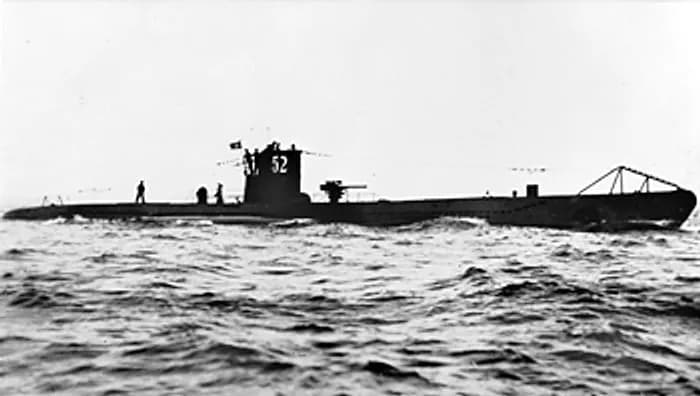
U-Boat Type VII
The Type VII U-boat is the most produced submarine in history with 703 built. The backbone of the Kriegsmarine during the Battle of the Atlantic, these vessels nearly severed the vital supply lines between America and Britain, threatening Great Britain's very survival.
