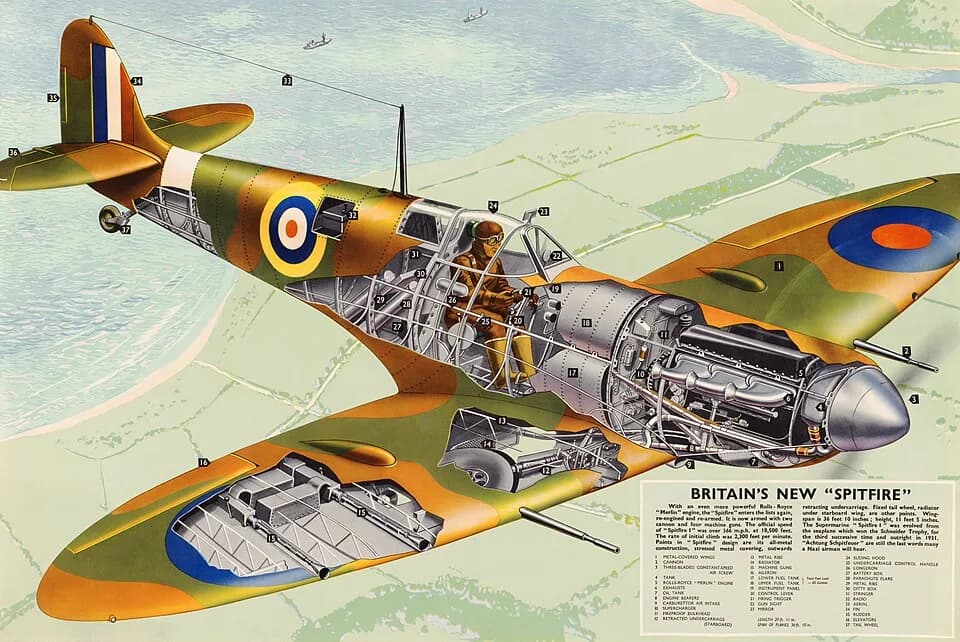
The Supermarine Spitfire is the iconic fighter aircraft of the Royal Air Force and a symbol of British resistance during the Battle of Britain. Designed by R.J. Mitchell, its combination of elliptical wings, Rolls-Royce Merlin engine and exceptional agility made it one of the finest fighters of the war.
The Spitfire was born from the mind of Reginald Joseph Mitchell, Supermarine's chief engineer, who made his name designing racing seaplanes for the Schneider Trophy in the 1920s-1930s. Drawing on this cutting-edge aerodynamic experience, Mitchell designed a revolutionary monoplane fighter in 1934 in response to Air Ministry specification F.7/30. The elliptical wing, its most distinctive feature, offered the best compromise between low aerodynamic drag and space for retractable landing gear and armament. Prototype K5054 made its maiden flight on March 5, 1936, at Eastleigh, Southampton. Mitchell tragically died of cancer in June 1937 at age 42, never seeing the Spitfire enter service. Joseph Smith succeeded him and oversaw development of 24 variants (Marks). Serial production began in 1938 at the Castle Bromwich factory, but delays were such that only 306 Spitfires were in service at the outbreak of war in September 1939. Lord Beaverbrook, appointed Minister of Aircraft Production in 1940, accelerated production to a critical pace just before the Battle of Britain.
The Spitfire Mk V (most common version in 1941-1943) was powered by a Rolls-Royce Merlin 45 producing 1,470 horsepower. Maximum speed: 594 km/h at 5,900m altitude. Ceiling: 11,300m. Range: 756 km. Armament: two 20mm Hispano cannons and four 7.7mm Browning machine guns. The 9.12m-span elliptical wing offered an exceptionally tight turning rate — superior to the Messerschmitt Bf 109 — which proved crucial in dogfighting. The Spitfire Mk IX, an urgent response to the Focke-Wulf Fw 190, mounted the two-stage supercharged Merlin 61, reaching 650 km/h. Later versions (Mk XIV and beyond) adopted the 2,050-horsepower Rolls-Royce Griffon engine, pushing speed beyond 720 km/h and making the Spitfire one of the fastest propeller-driven fighters ever built. The aircraft was relatively light (2,300 kg empty for the Mk I) thanks to its aluminum alloy construction. Its main drawback was limited range, unsuitable for long-distance bomber escort.
The Spitfire entered legend during the Battle of Britain (July-October 1940), where it faced Messerschmitt Bf 109 fighters and Luftwaffe bombers. Although the more numerous Hurricane shot down more German aircraft, it was the Spitfire that captured the public's imagination. Standard tactics had Hurricanes attacking bombers while Spitfires engaged escort fighters at high altitude. Over Dunkirk, Spitfires provided crucial air cover for the evacuation, even though soldiers on the ground, unable to see them, wrongly accused them of inaction. The Spitfire constantly evolved to remain competitive: the Mk V dominated in 1941, was outclassed by the Fw 190 in 1942, before the Mk IX restored parity. Photographic reconnaissance versions (PR), stripped of armament but fitted with cameras and extra fuel tanks, overflew occupied Europe at high altitude. The Spitfire also fought in the Mediterranean (Malta, North Africa, Italy), Burma, and even on the Eastern Front, where 1,300 were delivered to the USSR via Lend-Lease.
The Spitfire was produced in 24 main marks and numerous sub-variants, a record for a combat aircraft. The Mk I (1938) was the Battle of Britain model with eight machine guns. The Mk V (1941) added cannons and an improved engine. The Mk IX (1942) with its Merlin 61 was the response to the Fw 190 and the most produced version (5,656 units). The Mk VIII, designed for tropical theaters, fought in the Mediterranean and Asia. The Mk XIV (1944) was the first with the Griffon engine, capable of intercepting German V-1 flying bombs. The Seafire was the navalised version for Royal Navy aircraft carriers, with arrester hook and folding wings. The PR.XI was a high-altitude photographic reconnaissance aircraft. The Spiteful, a version with laminar flow wing, arrived too late to fight. In total, 20,351 Spitfires were produced (plus 2,556 Seafires), making it the most produced British fighter. The Spitfire's last operational sortie took place in Malaya in 1954.
The Spitfire transcended its role as a mere combat aircraft to become a cultural symbol. During the Battle of Britain, it embodied a nation's resistance standing alone against the Nazi threat. The 1940 'Spitfire Fund,' where the public donated money to finance building new aircraft, was one of history's first examples of crowdfunding. Churchill immortalized Spitfire and Hurricane pilots with his phrase: 'Never in the field of human conflict was so much owed by so many to so few.' On the technical front, the Spitfire demonstrated the importance of an aircraft's capacity for evolution: its basic airframe, designed in 1934, remained competitive until 1945 through continuous engine and armament improvements — going from 300 km/h with 8 machine guns to 720 km/h with cannons. Today, approximately 70 Spitfires still fly worldwide, making every air show appearance an event. The distinctive sound of its Merlin engine remains immediately recognizable and deeply moving for the British public.
This article draws on historical works, military archives and recognized academic publications.
The Supermarine Spitfire was designed by Reginald Joseph Mitchell, Supermarine's chief engineer, drawing on his experience with racing seaplanes for the Schneider Trophy. Prototype K5054 made its first flight on March 5, 1936, at Eastleigh, Southampton. Mitchell died of cancer in June 1937 at age 42 without seeing the Spitfire enter service; Joseph Smith succeeded him and oversaw development of 24 variants.
In total, 20,351 Spitfires were produced, plus 2,556 Seafires (navalised version), making the Spitfire the most manufactured British fighter of the war. The Spitfire Mk IX, an urgent response to the Focke-Wulf Fw 190, is the most produced version with 5,656 units. The Spitfire's last operational sortie took place in Malaya in 1954, eighteen years after its first flight.
The Spitfire's main weakness was its limited range: 756 km for the Mk V, making it unsuitable for long-distance bomber escort. Over Dunkirk in May-June 1940, Spitfires could only patrol for a few minutes before having to return. Its complex elliptical wings also slowed production rates compared to the Hurricane, which was simpler to build.
Information cross-checked against Wikipedia and reference historical works.
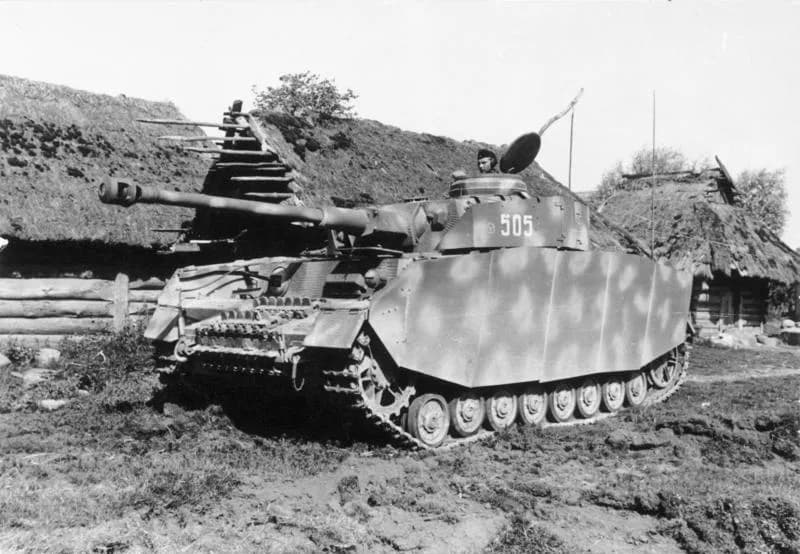
Panzer IV
The Panzerkampfwagen IV was the most produced German medium tank of World War II, with over 8,500 built. Originally designed as an infantry support tank, it evolved into the backbone of the Panzer divisions on every front. It is the only German tank in production from 1939 to 1945.
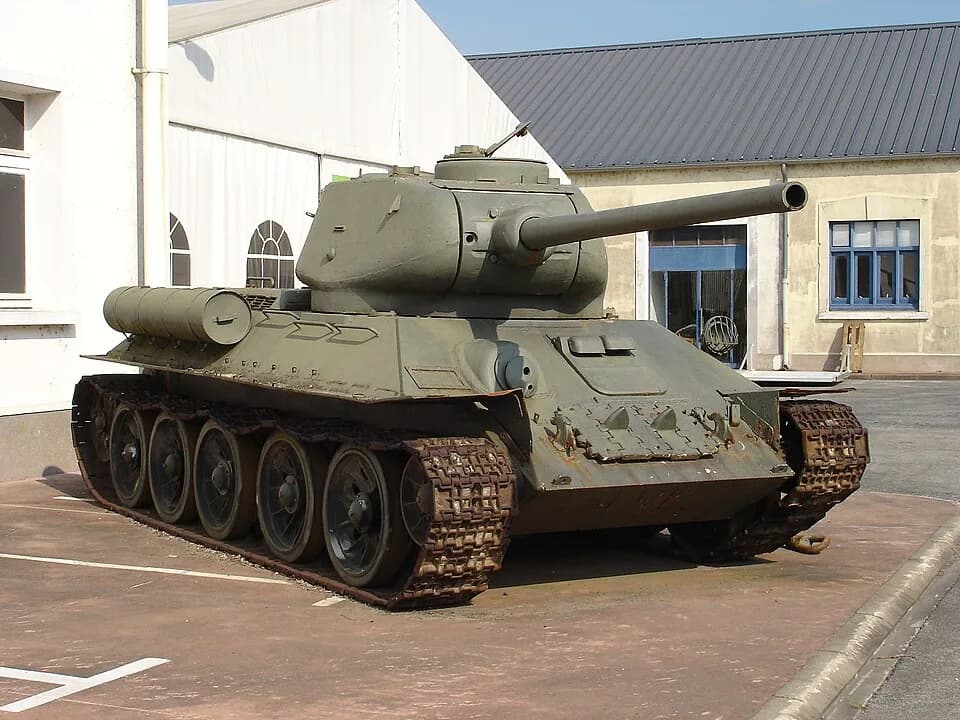
T-34
The T-34 is widely considered the best medium tank of World War II and one of the most influential in military history. Produced in over 84,000 units, its combination of sloped armor, mobility and firepower shocked the Germans in 1941 and shifted the balance of power on the Eastern Front.
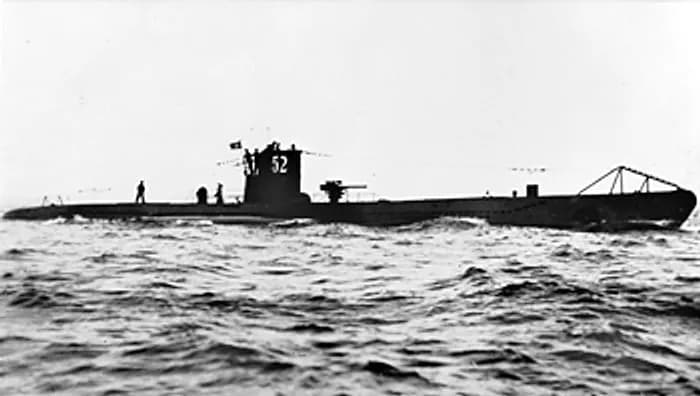
U-Boat Type VII
The Type VII U-boat is the most produced submarine in history with 703 built. The backbone of the Kriegsmarine during the Battle of the Atlantic, these vessels nearly severed the vital supply lines between America and Britain, threatening Great Britain's very survival.
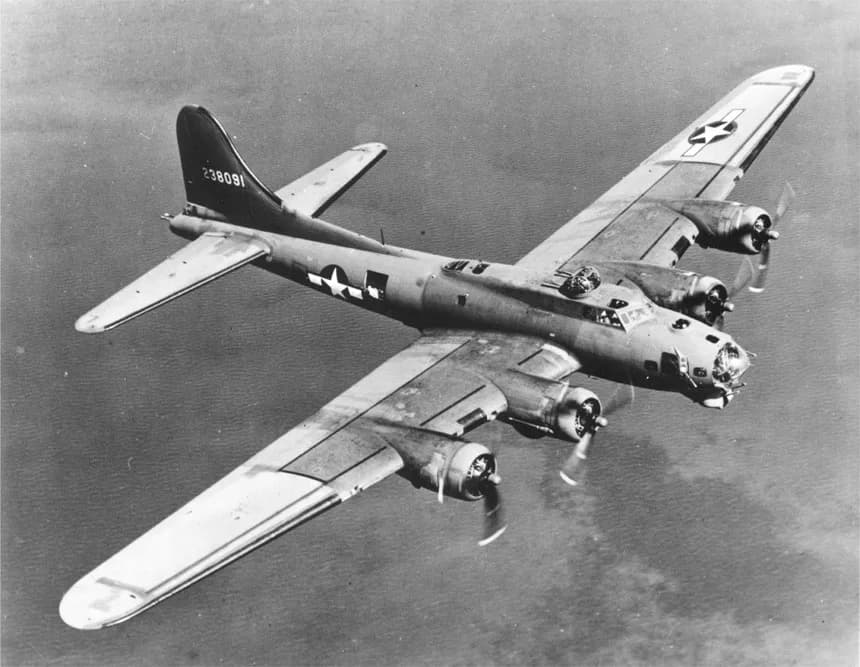
B-17 Flying Fortress
The Boeing B-17 Flying Fortress is the iconic heavy bomber of the US Army Air Forces in Europe. With its 13 machine guns and ability to absorb considerable damage, it symbolized the strategic bombing campaign that devastated German industry and cities.
