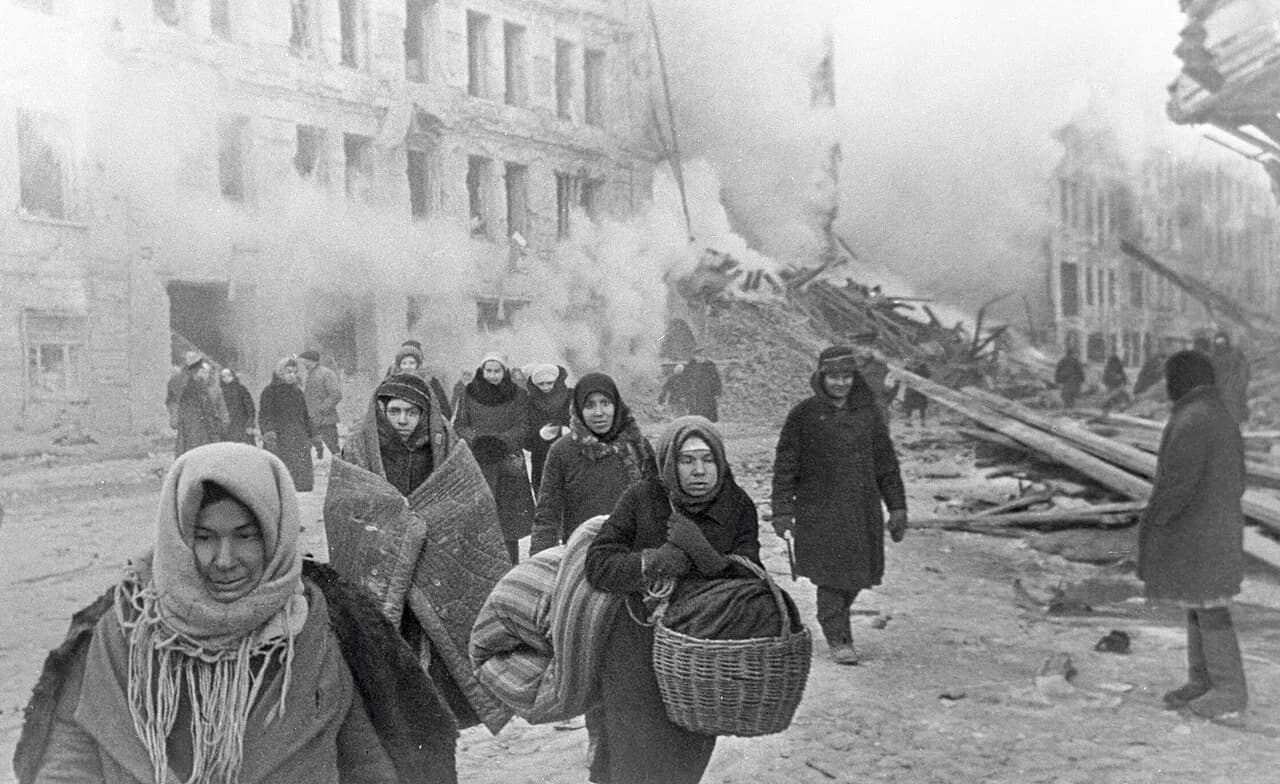
The Siege of Leningrad, lasting 872 days, was the longest siege in modern history, causing the death of over one million civilians from starvation, cold and bombardment. Supplies reached the city only across the frozen Lake Ladoga, on the route known as the Road of Life.
When Nazi Germany launched Operation Barbarossa on June 22, 1941, Leningrad was among the priority objectives. The Soviet Union's second-largest city with approximately three million inhabitants, the former imperial capital renamed in honor of Lenin, the city held considerable strategic, industrial, and symbolic importance. Army Group North, commanded by Field Marshal Wilhelm Ritter von Leeb, advanced rapidly through the Baltic states with the mission of capturing Leningrad. Hitler had expressed his desire not to capture the city but to annihilate it completely, ordering that it be wiped from the face of the earth through a starvation siege. The directive was clear: no capitulation would be accepted, no additional mouths were to be fed. Finnish forces, allied with Germany, advanced simultaneously from the north, recapturing territories lost during the Winter War. By September 1941, German forces reached Leningrad's southern outskirts and cut all land communication routes, leaving only Lake Ladoga as the sole link with the rest of the Soviet Union.
The forces involved in the Siege of Leningrad were considerable on both sides. German Army Group North initially fielded approximately 725,000 men organized into two armies and an armored group, supported by Luftflotte 1. Finnish forces to the north, under Marshal Mannerheim's command, comprised approximately 200,000 soldiers advancing into Karelia to recapture territories lost in 1940, but Mannerheim deliberately refused to push beyond the former border to participate directly in the siege. On the Soviet side, Leningrad's defense was ensured by the Leningrad Front, commanded successively by several generals before Marshal Leonid Govorov took command in 1942. Soviet forces comprised approximately 500,000 regular troops, supplemented by people's militia divisions formed from civilian volunteers, naval units from the Baltic Fleet whose heavy guns participated in the defense, and thousands of civilian workers mobilized to dig trenches and build fortifications. The Baltic Fleet, trapped in Leningrad's harbor, used its naval guns as static heavy artillery, contributing significantly to the city's defense.
The Siege of Leningrad began on September 8, 1941, when German forces cut the last land route connecting the city to the rest of the country. Very quickly, the food situation became catastrophic. Food reserves were sufficient for only a few weeks, and rations were drastically reduced. By November 1941, workers received 250 grams of bread per day and non-workers only 125 grams — a piece of black bread barely larger than a hand, often mixed with sawdust and glue. The first winter, from 1941 to 1942, was the deadliest. Temperatures dropped to minus 40 degrees, water pipes froze, heating ceased to function, and electricity became sporadic. Inhabitants burned their furniture and books for warmth. Starvation killed thousands of people each day; bodies accumulated in the streets because nobody had the strength to bury them. Cases of cannibalism were documented by Soviet police. The Road of Life, a supply route crossing frozen Lake Ladoga in winter and by boats in summer, became the sole vital link with the outside. Trucks traversed the ice under German bombardment, and thousands of drivers perished. Despite the losses, this route enabled the evacuation of approximately one million civilians and delivered just enough supplies to prevent the city from dying completely.
The turning point of the Siege of Leningrad came in January 1943, during Operation Iskra (Spark), when Soviet forces managed to break through a narrow land corridor connecting Leningrad to the rest of the country. Troops from the Leningrad Front, attacking eastward, and those from the Volkhov Front, attacking westward, linked up after a week of fierce fighting in the frozen marshes south of Lake Ladoga, liberating a strip of land only 8 to 11 kilometers wide. Although this corridor was constantly under German artillery fire, a railroad was built in record time, considerably increasing the flow of supplies to the besieged city. This breakthrough did not end the siege but radically transformed the situation: famine gradually receded, food rations increased, and the population's morale recovered. Another major psychological turning point was the decision to maintain the city's cultural life during the siege. On August 9, 1942, Shostakovich's 7th Symphony, composed during the siege, was performed by the starving Leningrad orchestra in the Philharmonic's great hall, broadcast through loudspeakers toward German lines. This performance became a worldwide symbol of human resistance against barbarism.
The consequences of the Siege of Leningrad were of unprecedented tragic scale in modern history. The human toll remains the most horrific of any siege in history: an estimated 800,000 to 1.5 million civilians perished, the majority from starvation and malnutrition-related diseases, making the Siege of Leningrad the deadliest event for a single city in human history. Soviet military casualties during the 872 days of the siege amounted to approximately 1 million soldiers killed, wounded, or missing during multiple attempts to break the encirclement. The siege was finally lifted on January 27, 1944, during the Leningrad-Novgorod Offensive, which pushed German forces more than 100 kilometers from the city. The city itself was devastated: thousands of buildings were destroyed by bombardment, and urban infrastructure lay in ruins. After the war, Leningrad received the title of Hero City of the Soviet Union, and the siege became a central element of Russian collective memory, symbolizing both the horror of war and the extraordinary resilience of the Soviet people. The Piskaryovskoye Memorial Cemetery, where approximately 500,000 siege victims rest in mass graves, remains one of the most poignant memorial sites of World War II. The siege also influenced international law, contributing to the recognition of deliberate starvation as a war crime.
This article draws on historical works, military archives and recognized academic publications.
The Siege of Leningrad lasted 872 days, from September 8, 1941, to January 27, 1944, making it the longest siege in modern history. Between 800,000 and 1.5 million civilians perished, the majority from starvation — rations reached 125 grams of bread per day for non-workers by November 1941 — and malnutrition-related diseases. This is the highest death toll for a single city in human history.
The Road of Life was a supply route crossing frozen Lake Ladoga in winter and by boat in summer, the sole link between besieged Leningrad and the rest of the Soviet Union. Trucks traversed the ice under German bombardment; thousands of drivers lost their lives. This route enabled the evacuation of approximately one million civilians and delivered enough supplies to prevent the total extinction of the population.
A partial land corridor was broken through in January 1943 during Operation Iskra (Spark), enabling emergency railroad construction. The siege was definitively lifted on January 27, 1944, during the Leningrad-Novgorod Offensive, which pushed German forces more than 100 kilometers from the city. Leningrad received the title of Hero City of the Soviet Union; the Piskaryovskoye Cemetery holds approximately 500,000 victims.
Information cross-checked against Wikipedia and reference historical works.
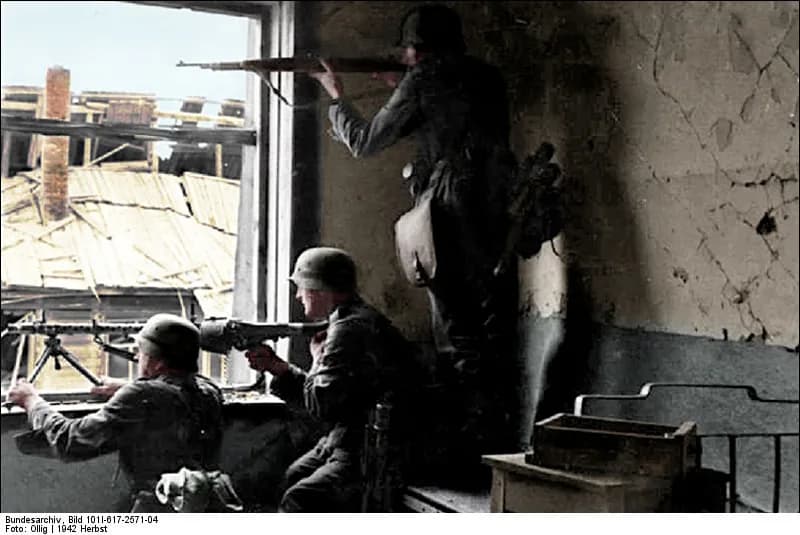
Battle of Stalingrad
The Battle of Stalingrad was among the deadliest clashes of World War II, pitting German and Soviet forces against each other in devastating urban combat that marked a decisive turning point on the Eastern Front. From 23 August 1942 to 2 February 1943, Operation Uranus encircled the German Sixth Army, whose roughly 91,000 survivors surrendered.
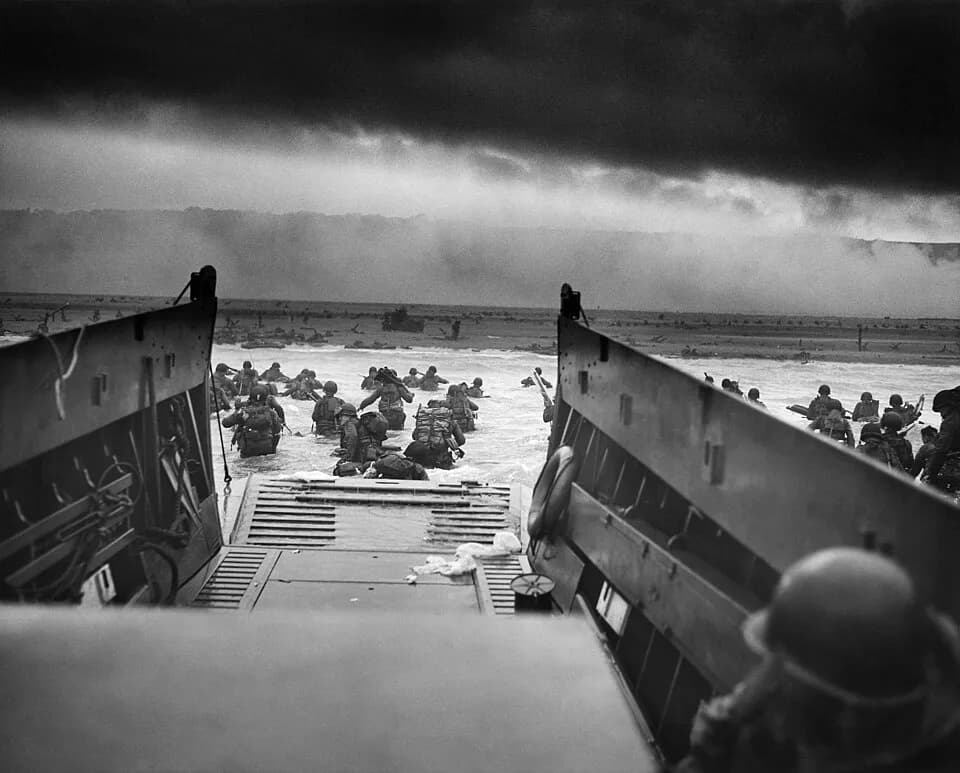
Normandy Landings
The Normandy landings, the largest amphibious operation in history, opened a second front in Western Europe on 6 June 1944, hastening the liberation of France and the defeat of Nazi Germany. Nearly 7,000 vessels put 156,000 men ashore on five beaches in a single day, under air cover and after months of deception meant to mislead the Wehrmacht.
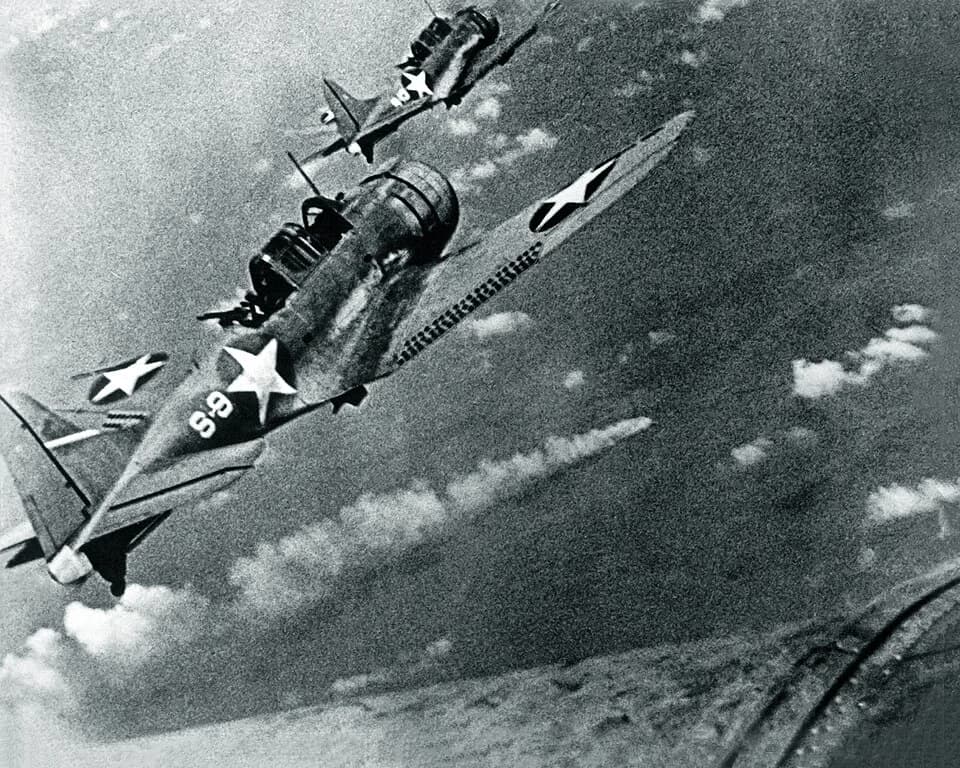
Battle of Midway
The Battle of Midway was the decisive turning point of the Pacific war, where the American navy inflicted a catastrophic defeat on the Japanese fleet by sinking four aircraft carriers, reversing the naval balance. From 4 to 7 June 1942, the decryption of Japanese communications allowed Admiral Nimitz to ambush a fleet that outnumbered his own.
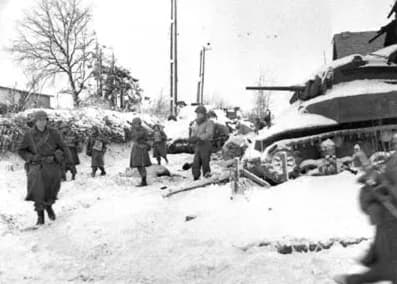
Battle of the Bulge
The Battle of the Bulge was the last major German offensive on the western front, a desperate attempt to break through Allied lines in the Belgian forests that failed against American resistance. Launched on 16 December 1944 under overcast skies that grounded Allied aircraft, it was broken by late January 1945.
