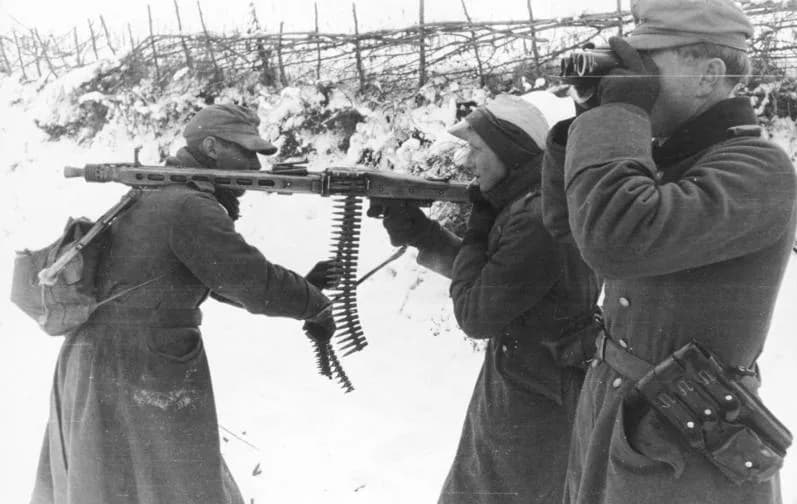
The MG 42 (Maschinengewehr 42) is the most feared machine gun of World War II. Nicknamed « Hitler's buzzsaw » for its distinctive sound, its rate of 1,200 rounds per minute unsettled Allied soldiers and reshaped automatic weapon design. Its barrel could be swapped in a few seconds.
The MG 42 was developed to solve a critical Wehrmacht problem: the MG 34, the German army's standard general-purpose machine gun, was too complex and expensive to produce. Each MG 34 required 150 man-hours of manufacturing with tight machining tolerances and high-quality materials — production could not keep up with frontline demand. The firm Metall und Lackierwarenfabrik Johannes Großfuß AG, specialized in sheet metal stamping rather than weapons, was tasked with designing an alternative. Engineer Werner Gruner devised a revolutionary roller-locking mechanism, simpler and faster than the MG 34's system, while extensively using stamped and welded sheet steel rather than precision machining. The result reduced manufacturing time to 75 man-hours per unit — a 50% decrease. Around 1,500 pre-production examples (MG 39/41) were combat-tested in late 1941. The final design was accepted in early 1942 and mass production began, distributed among Großfuß, Mauser-Werke, Gustloff-Werke, and Steyr. In total, 408,323 MG 42s were produced between 1942 and 1945.
The MG 42 fires the standard 7.92×57 mm Mauser cartridge at a rate of 1,200 rounds per minute (some examples reaching 1,500–1,600 rpm). This rate is so fast that the human ear cannot distinguish individual shots — the sound transforms into a continuous tearing noise, hence the nickname 'Hitler's buzzsaw.' The weapon measures 122.5 cm with the stock and weighs 11.57 kg with bipod, making it relatively portable for one man. Muzzle velocity reaches 755 m/s. Effective range is 1,100 meters in direct fire, extendable to 3,500 meters in indirect fire mounted on the Lafette 42 tripod with telescopic sight. Feeding is via 50 or 250-round belts. Barrel changes, necessary every 150–250 rounds during sustained fire due to overheating, can be performed in just 6 to 8 seconds thanks to an ingenious quick-release mechanism — a decisive advantage over Allied machine guns. The short-recoil operation with roller locking is remarkably reliable in mud, sand, and extreme cold.
The MG 42 entered combat in May 1942 with the Afrika Korps at the Battle of Gazala. It was rapidly deployed across all German fronts: Russia, Mediterranean, and Western Europe. Its combat impact was devastating. The most striking example is D-Day, June 6, 1944, on Omaha Beach: a single MG 42 nest with six men inflicted approximately 2,000 casualties on American troops landing ashore. The MG 42's terrifying rate of fire forced the US War Department to produce training films specifically to counter its psychological effect on soldiers. German tactical doctrine evolved around the MG 42: by autumn 1944, each 10-man combat squad was organized around one MG 42. This was a reversal of traditional doctrine — instead of using the machine gun in support of infantry, the infantry served to protect and feed the machine gun. Enemy snipers and artillery targeted MG 42 positions as a priority, testifying to the respect the weapon inspired. However, its enormous ammunition consumption (a 250-round belt lasts just 12 seconds of continuous fire) posed constant logistical challenges.
The MG 42 itself was relatively standardized during the war, but its postwar legacy is remarkable. In 1958, West Germany adopted the MG 1, an MG 42 rechambered in 7.62×51 mm NATO. The MG 1A1 (MG 42/58) added a chromed barrel and recalibrated sights. The MG 1A2 (MG 42/59) introduced a heavier bolt (950 g) reducing the rate of fire to 700–900 rpm, more manageable for gunners and logistics. In 1968, the MG 3 was adopted with an improved feed mechanism and anti-aircraft rear sight — it remained in service with the Bundeswehr into the early 21st century. The design is so effective that over twenty armies worldwide adopted the MG 3 or its derivatives. Italy produced it under license, and Turkey and Pakistan still manufacture it in the 21st century. All MG 3 variants maintain high parts interchangeability with the original 1942 MG 42 — a testament to the robustness of the initial design. The MG 42's influence can also be found in the American M60 machine gun, whose locking mechanism was directly inspired by the German roller system.
The MG 42 revolutionized automatic weapon design and its influence endures into the 21st century. Its wartime impact was disproportionate: a rate of fire double that of Allied machine guns (the Browning M1919 fired at 600 rpm, the Bren at 500) gave every German defensive position terrifying firepower. The Allies attempted to copy the weapon: the Americans developed the T24 project based on the MG 42, but conversion to .30-06 caliber proved problematic and the program was abandoned. The Soviets, despite their mass-production capabilities, also failed to replicate the MG 42's manufacturing quality during the war. The MG 42's production philosophy — using stamped sheet metal rather than precision machining — was as revolutionary as the weapon itself. It demonstrated that cheap industrial production techniques could create superior weapons, a principle that influences arms manufacturing to this day (seen in the AK-47 and HK G3). The MG 42's distinctive sound remains etched in collective memory and is instantly recognizable in war films.
The MG 42 fired at 1,200 rounds per minute, with some examples reaching 1,500-1,600 rpm. This rate was so fast that the human ear could not distinguish individual shots — the sound transformed into a continuous tearing noise, giving rise to the nickname 'Hitler's buzzsaw.' The US War Department produced special training films to psychologically prepare soldiers to face this weapon.
A total of 408,323 MG 42s were produced between 1942 and 1945. Engineer Werner Gruner's design reduced manufacturing time to 75 man-hours per unit, compared to 150 for the MG 34. This 50% reduction was achieved by extensively using stamped and welded sheet steel instead of precision machining — an industrial revolution in automatic weapon manufacturing.
On June 6, 1944 at Omaha Beach, a single MG 42 nest with six men inflicted approximately 2,000 casualties on American landing troops. Each 250-round belt lasted only 12 seconds of continuous fire. German tactical doctrine by autumn 1944 organized each 10-man combat squad around one MG 42, with infantry serving to protect and feed the machine gun rather than the reverse.
Information cross-checked against Wikipedia and reference historical works.
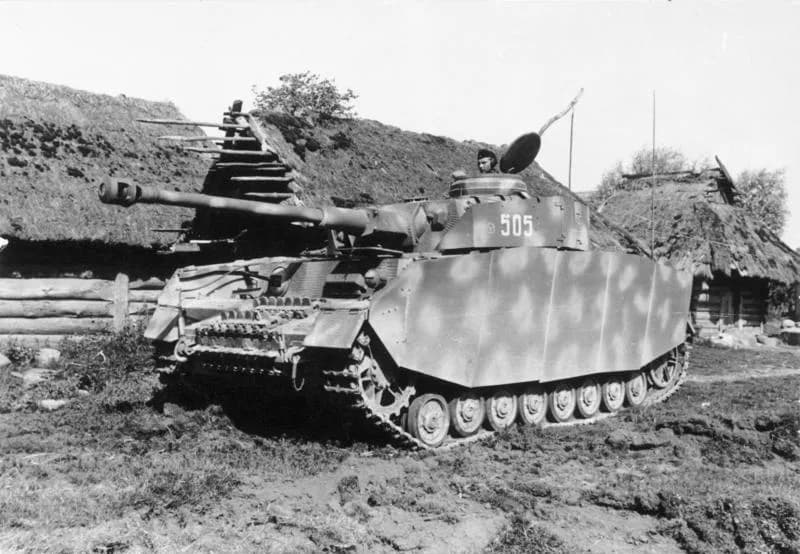
Panzer IV
The Panzerkampfwagen IV was the most produced German medium tank of World War II, with over 8,500 built. Originally designed as an infantry support tank, it evolved into the backbone of the Panzer divisions on every front. It is the only German tank in production from 1939 to 1945.
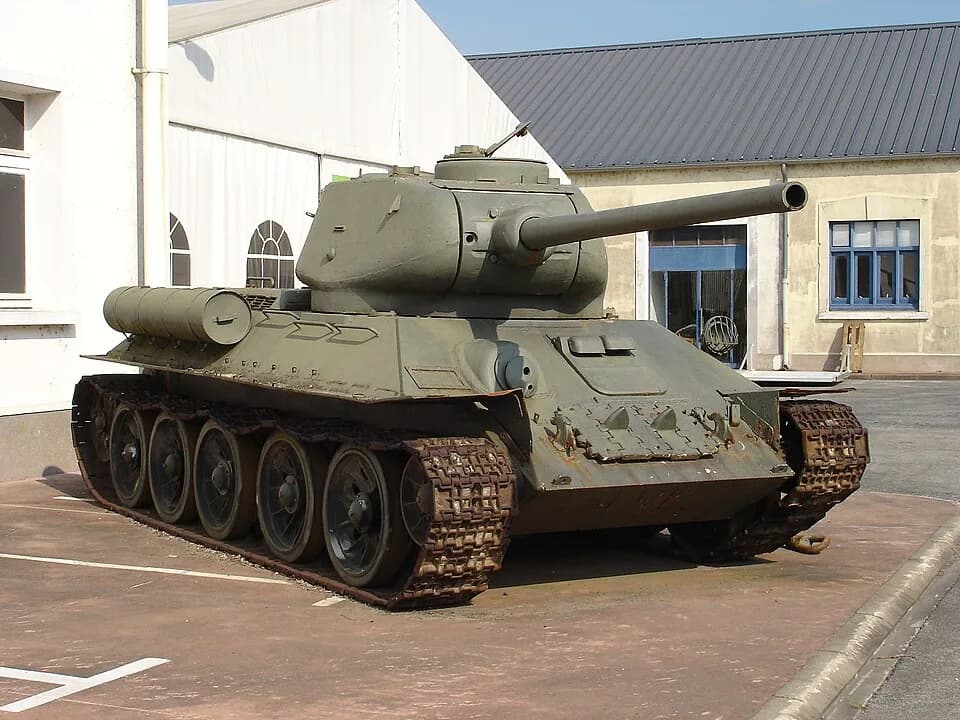
T-34
The T-34 is widely considered the best medium tank of World War II and one of the most influential in military history. Produced in over 84,000 units, its combination of sloped armor, mobility and firepower shocked the Germans in 1941 and shifted the balance of power on the Eastern Front.
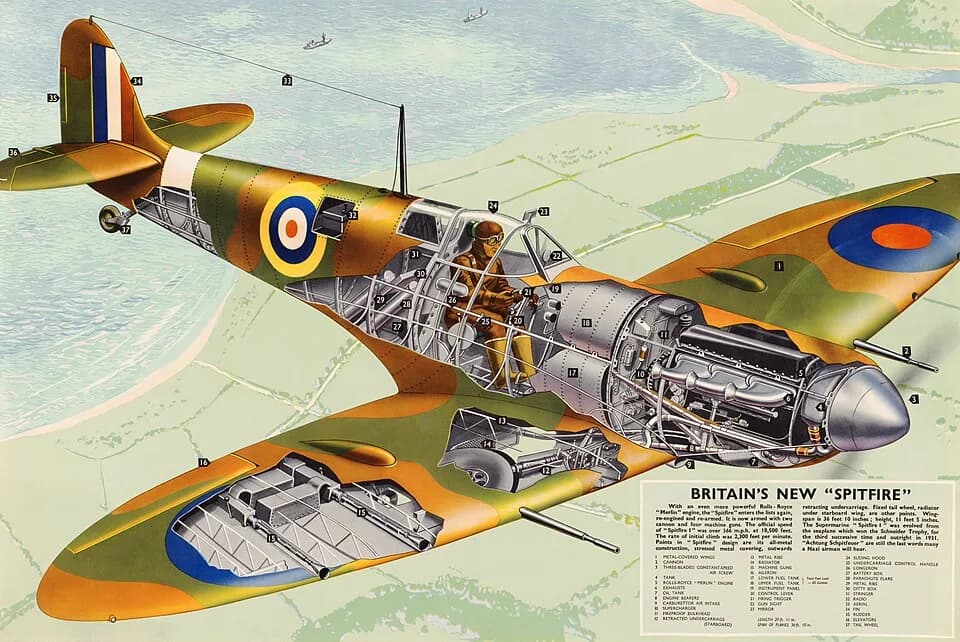
Supermarine Spitfire
The Supermarine Spitfire is the iconic fighter aircraft of the Royal Air Force and a symbol of British resistance during the Battle of Britain. Designed by R.J. Mitchell, its combination of elliptical wings, Rolls-Royce Merlin engine and exceptional agility made it one of the finest fighters of the war.
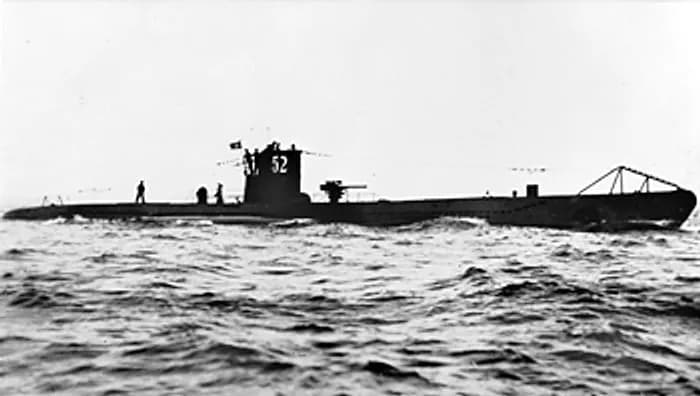
U-Boat Type VII
The Type VII U-boat is the most produced submarine in history with 703 built. The backbone of the Kriegsmarine during the Battle of the Atlantic, these vessels nearly severed the vital supply lines between America and Britain, threatening Great Britain's very survival.
