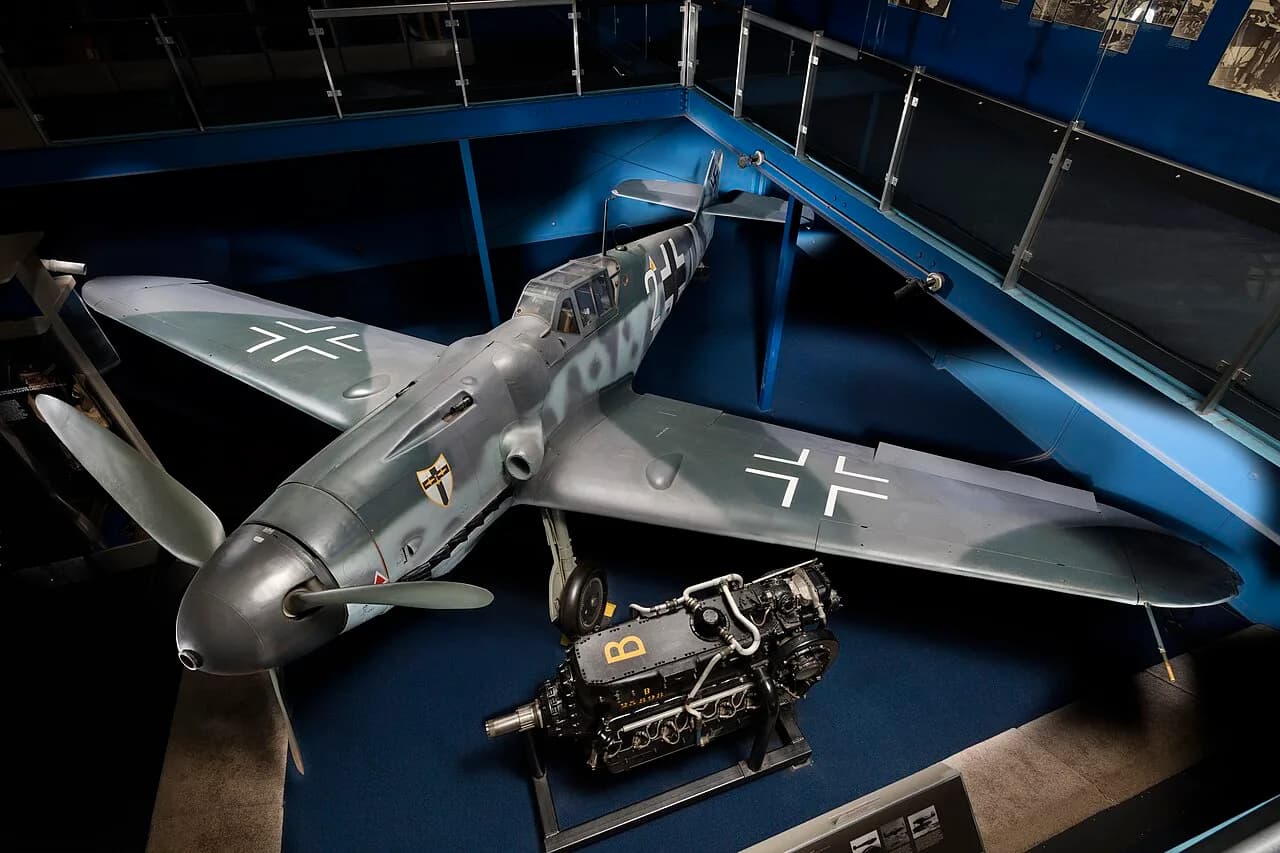
The Messerschmitt Bf 109 is the most produced fighter aircraft in history with over 35,000 built. The backbone of the Luftwaffe from start to finish, it fought on every front and remained competitive despite the arrival of increasingly capable Allied fighters.
The Bf 109 was designed by Willy Messerschmitt and Robert Lusser at Bayerische Flugzeugwerke (BFW) starting in March 1934, in response to a Reichsluftfahrtministerium specification for a modern monoplane fighter. The first prototype flew on May 29, 1935 — ironically powered by a British Rolls-Royce Kestrel engine, as German engines were not yet available. The Bf 109 won the competition against the Heinkel He 112, Focke-Wulf Fw 159, and Arado Ar 80. Its design was revolutionary for the era: all-metal construction, enclosed cockpit, retractable landing gear, and cantilever wing. The first production model (Bf 109B 'Berta') entered service in 1937 with the 670-horsepower Junkers Jumo 210D engine. The aircraft proved itself during the Spanish Civil War with the Condor Legion, where it outclassed Soviet-supplied Polikarpov I-16 fighters used by the Republicans. The E variant 'Emil' with the Daimler-Benz DB 601 featuring direct fuel injection — an advantage over the Spitfire's Merlin which stalled during negative-G dives — became the Luftwaffe's standard fighter at the war's outset.
The Bf 109G 'Gustav,' the most produced variant with over 23,500 units, was powered by a 1,475-horsepower Daimler-Benz DB 605A engine. Maximum speed: 625 km/h at 6,900 meters. Service ceiling: 12,000 m. Range: 660 km on internal fuel. Standard armament comprised two 13 mm MG 131 machine guns in the engine cowling and one 20 mm MG 151/20 cannon firing through the propeller hub. Optional underwing gondolas could add two additional 20 mm cannons or 210 mm rocket tubes for attacking bomber formations. The Bf 109 was a relatively compact (9.92 m wingspan) and light aircraft (2,247 kg empty weight), giving it an excellent rate of climb and dive speed superior to most opponents. Its main flaw was a narrow-track undercarriage attached to the fuselage rather than the wings, causing numerous takeoff and landing accidents — an estimated 5% of all Bf 109s produced were destroyed in ground handling mishaps. The cramped cockpit and limited rear visibility were other notable weaknesses.
The Bf 109 fought on absolutely every front of World War II. During the Blitzkrieg in Poland (1939) and France (1940), Bf 109Es secured air superiority that allowed Stukas and Panzers to operate freely. During the Battle of Britain (1940), the Bf 109 was superior to the Spitfire Mk I in dives and vertical combat, but inferior in tight turns. Its limited range — only 10 minutes of combat over London — was a major handicap that contributed to the Luftwaffe's failure. On the Eastern Front, the Bf 109 initially dominated obsolete Soviet fighters, allowing German aces to accumulate astronomical victory scores: Erich Hartmann, the most successful fighter pilot in history, shot down 352 enemy aircraft flying his Bf 109G. In the Mediterranean and North Africa, the Bf 109F 'Friedrich' — considered by many as the finest variant — reigned supreme. From 1943 onward, the Bf 109G faced increasingly formidable opponents (Spitfire Mk IX, P-47, P-51) but remained competitive through continuous improvements.
The Bf 109 went through eight major variants over ten years of production. The Bf 109B through D (1937–1940) were initial versions with Junkers Jumo engines. The Bf 109E 'Emil' (1939–1941) with the Daimler-Benz DB 601 was the Battle of Britain fighter. The Bf 109F 'Friedrich' (1941–1942) was an aerodynamically refined version, considered by many pilots as the best of the series — lighter and more agile. The Bf 109G 'Gustav' (1942–1945) was the mass-production version with the more powerful DB 605A engine, but also heavier with degraded maneuverability. The Bf 109G-6, the most produced sub-variant with 12,000 units, was sometimes criticized as an 'overburdened old racehorse.' The Bf 109H was a rare high-altitude version with extended wings. The Bf 109K 'Kurfürst' (1944–1945) was the ultimate version, reaching 727 km/h thanks to the DB 605D with water-methanol injection, but only about 1,500 were built. After the war, Czechoslovakia produced the Bf 109G under license as the Avia S-99 then S-199, and Spain produced the Hispano Aviación HA-1112 until 1958.
The Messerschmitt Bf 109 is one of the most important combat aircraft in aviation history. With over 35,000 units produced, it remains the most-produced fighter aircraft of all time, surpassing even the Spitfire (20,351) and P-51 (15,000). Its operational longevity is remarkable: designed in 1934, it remained the Luftwaffe's backbone until 1945, a feat matched only by the Spitfire among Allied fighters. The aces who flew the Bf 109 accumulated the highest scores in aviation history: the top 15 most successful fighter pilots of all time are all German and flew primarily the Bf 109, with totals ranging from 203 to 352 victories. Of course, these figures also reflect the unique conditions of the Eastern Front and the number of missions flown. The Bf 109 influenced postwar fighter design and remained in active service in several countries into the 1970s. It is a symbol of German aeronautical engineering excellence, but also of the limitations of a design pushed beyond its original parameters.
The Messerschmitt Bf 109 is the most produced fighter aircraft in history with over 35,000 units, surpassing the Spitfire (20,351) and P-51 Mustang (15,000). The most produced version was the Bf 109G 'Gustav' with over 23,500 units. Designed in 1934, it remained the Luftwaffe's backbone until 1945 — an operational longevity matched only by the Spitfire on the Allied side.
Erich Hartmann is the most successful fighter pilot in history with 352 aerial victories, all achieved on the Eastern Front flying a Bf 109G. The top 15 most successful fighter pilots of all time are all German and flew primarily the Bf 109. These exceptional scores reflect the conditions of the Eastern Front and the high number of missions — Hartmann flew 1,404 combat missions.
The main weakness of the Bf 109E 'Emil' during the Battle of Britain in 1940 was its limited range: the Daimler-Benz DB 601 engines allowed only 10 minutes of combat over London after crossing the Channel. This forced escorts to abandon bombers to return to France. The second weakness was the narrow-track undercarriage, which caused accidents in approximately 5% of all aircraft produced.
Information cross-checked against Wikipedia and reference historical works.
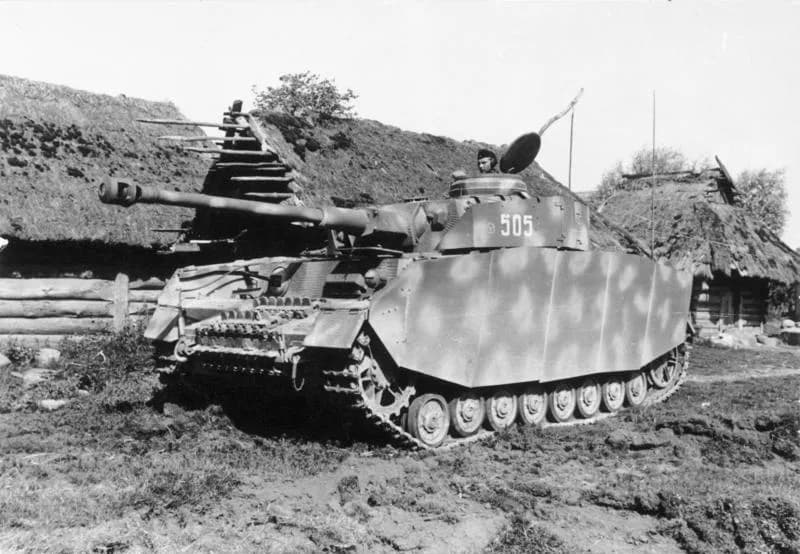
Panzer IV
The Panzerkampfwagen IV was the most produced German medium tank of World War II, with over 8,500 built. Originally designed as an infantry support tank, it evolved into the backbone of the Panzer divisions on every front. It is the only German tank in production from 1939 to 1945.
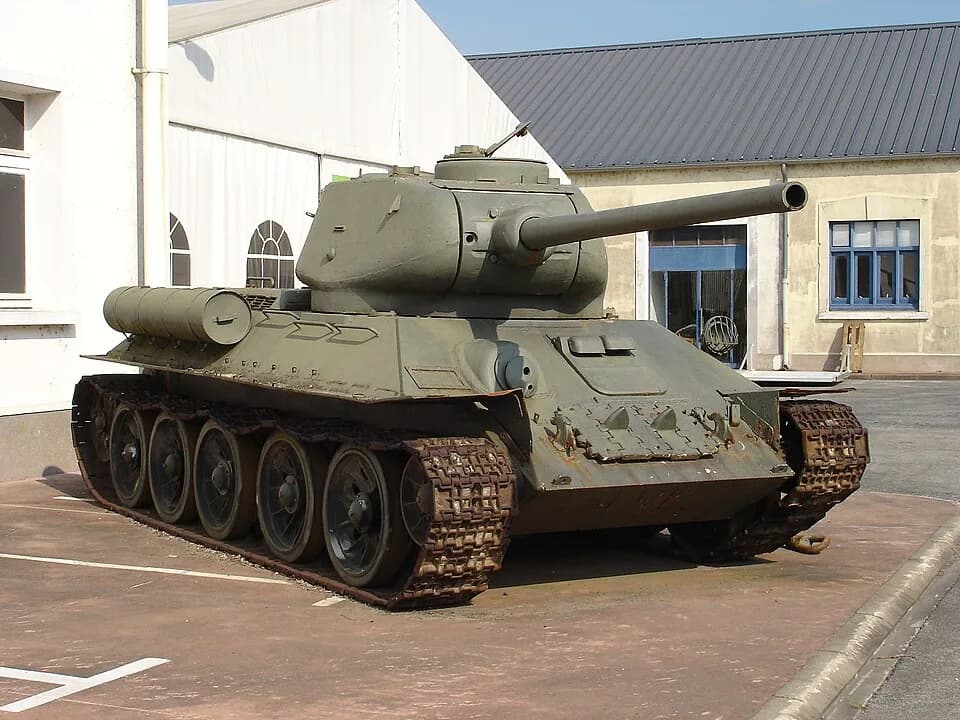
T-34
The T-34 is widely considered the best medium tank of World War II and one of the most influential in military history. Produced in over 84,000 units, its combination of sloped armor, mobility and firepower shocked the Germans in 1941 and shifted the balance of power on the Eastern Front.
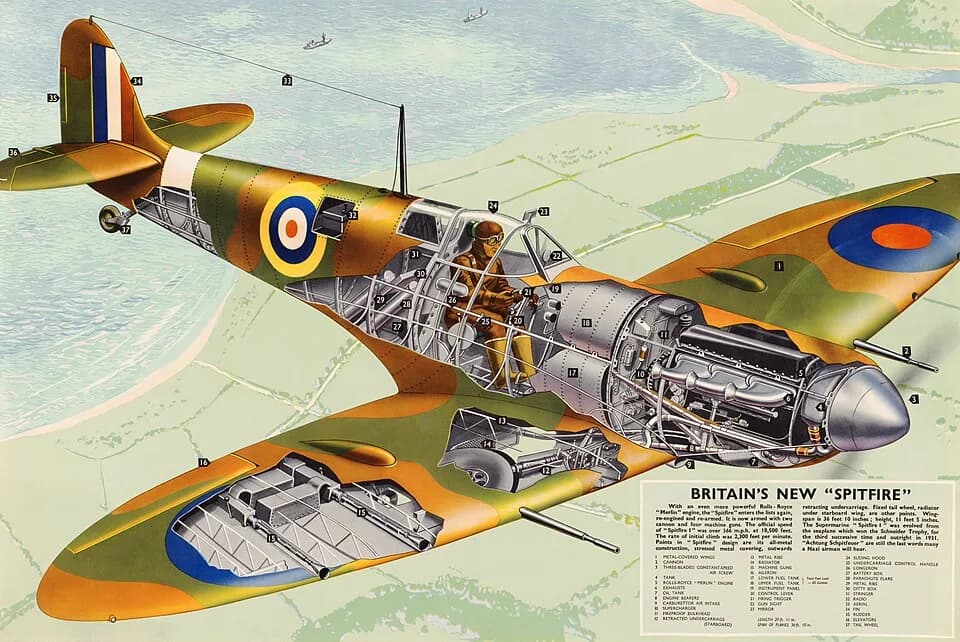
Supermarine Spitfire
The Supermarine Spitfire is the iconic fighter aircraft of the Royal Air Force and a symbol of British resistance during the Battle of Britain. Designed by R.J. Mitchell, its combination of elliptical wings, Rolls-Royce Merlin engine and exceptional agility made it one of the finest fighters of the war.
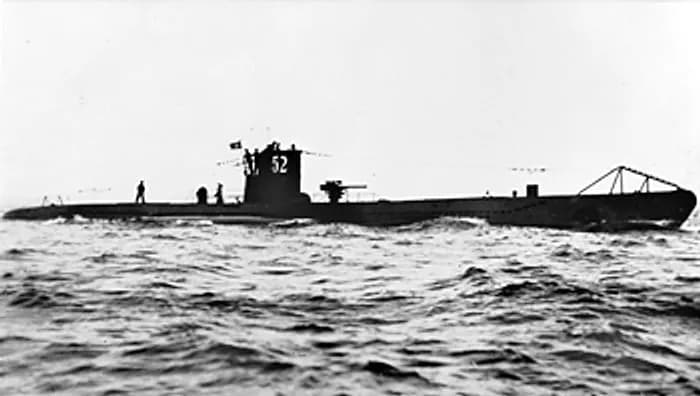
U-Boat Type VII
The Type VII U-boat is the most produced submarine in history with 703 built. The backbone of the Kriegsmarine during the Battle of the Atlantic, these vessels nearly severed the vital supply lines between America and Britain, threatening Great Britain's very survival.
