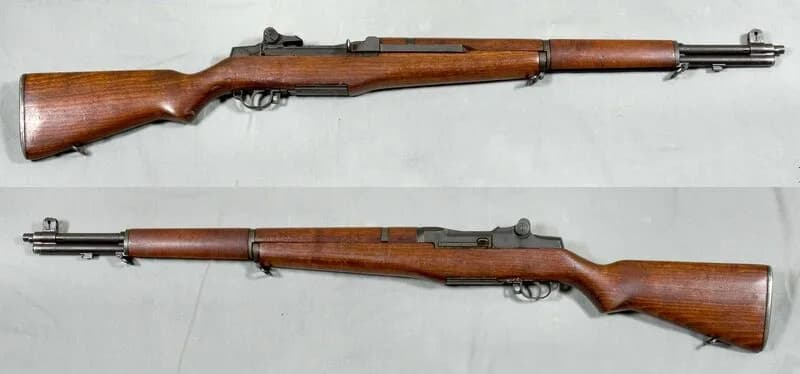
The M1 Garand is the first semi-automatic rifle adopted as standard issue by a major military power. Produced in over 5.4 million units, it gave American infantrymen a decisive firepower advantage on every theatre of World War II, against opponents still working bolt-action rifles by hand.
The M1 Garand was the work of Jean Cantius Garand, a French Canadian born in Quebec who emigrated to the United States and became an engineer at Springfield Armory. After World War I, he designed a revolutionary semi-automatic rifle using a gas-operated system. The design was patented in 1932 and officially adopted by the US Army on January 9, 1936, replacing the bolt-action Springfield M1903. The first production rifle was proofed on July 21, 1937. Mass production began in 1940, reaching 600 rifles per day by January 1941. At peak production in January 1944, 122,001 units rolled off assembly lines in a single month. Springfield Armory and Winchester shared manufacturing. Remarkably, John Garand never received royalties for his invention — he surrendered all his rights to the US government in 1936 and remained a consultant at Springfield until his retirement in 1953. His en-bloc clip system, allowing eight cartridges to be inserted in a single motion through the top of the receiver, was an innovation that considerably sped up reloading in combat.
The M1 Garand fires the .30-06 Springfield cartridge (7.62×63 mm), a powerful round with an effective combat range of approximately 300 meters and a maximum range of 1,200 meters. The weapon weighs 4.31 kg and measures 110 cm long with a 61 cm barrel. The gas-operated semi-automatic action allows firing as fast as the shooter can pull the trigger — between 16 and 24 aimed rounds per minute, and up to 40–50 accurate rounds per minute in the hands of a trained marksman at 300 meters. This is two to three times the rate of a bolt-action rifle like the German Kar 98k or Japanese Arisaka. The internal magazine holds eight cartridges fed by the en-bloc clip. When the last round is fired, the clip is ejected with a characteristic metallic 'ping' — a sound that has become iconic in popular culture. This ping is sometimes criticized as signaling to the enemy that the shooter is empty, but in practice the noise of battle renders it inaudible at distance. The Garand's mechanical robustness is exceptional: it functions in mud, sand, cold, and heat with remarkable reliability.
The M1 Garand entered combat at the attack on Pearl Harbor on December 7, 1941, and served on every American theater of operations until war's end. Its advantage was immediate and decisive: where a German soldier armed with a bolt-action Kar 98k fired 10–15 rounds per minute, a GI with his Garand fired 40–50. This superiority in individual firepower was multiplied by numbers — the United States was the only country to equip all its infantrymen with a semi-automatic rifle. In Europe, from the Normandy landings to the Battle of the Bulge and the Rhine crossing, the Garand was the weapon that accompanied every American soldier. In the Pacific, its effect on Japanese tactics was profound: traditional banzai charges became suicidal against the volume of fire that Garand-armed infantrymen could produce. General George S. Patton called the M1 Garand 'the greatest battle implement ever devised.' This quote, though sometimes disputed in its exact form, reflects the American military consensus on the superiority of their standard rifle.
The M1 Garand had two main sniper variants. The M1C mounted a commercial telescopic sight on the left side of the receiver via a Griffin & Howe base, compatible with M73, M81, M82, and M84 scopes. Its wartime production was limited. The M1D, designed by John Garand himself, used a scope base mounted on the barrel rather than the receiver — a simpler and faster solution to install. Officially adopted in September 1944 as a 'substitute standard,' the M1D was produced in greater quantity during the Korean War (21,380 units versus 4,796 M1Cs). Few sniper examples were available in time for combat in Europe. Beyond official variants, soldiers sometimes modified their Garands in the field with improvised accessories. After the war, the M1 Garand served as the basis for developing the M14, an automatic rifle adopted in 1958 that retained Garand's gas-operated system while adding selective fire capability and a detachable 20-round magazine in 7.62 NATO.
The M1 Garand revolutionized infantry combat by demonstrating the superiority of the semi-automatic rifle over the bolt-action rifle. Before it, armies considered semi-automatic fire a waste of ammunition. The Garand proved otherwise: the additional volume of fire it gave the individual infantryman was decisive in close engagements. The Germans, aware of their inferiority in individual firepower, developed the semi-automatic Gewehr 43 and the StG 44 partly to bridge this gap. After World War II, the Garand served in Korea (1950–1953) where it remained the standard infantry weapon. Hundreds of thousands of examples were distributed to allies via American military aid — South Korea, Denmark, Greece, Italy, and many others. The Civilian Marksmanship Program (CMP) began selling surplus rifles to civilians in the 1960s, making the Garand one of the most prized collector's rifles in the world. The distinctive 'ping' of the ejected clip has become an iconic sound, instantly recognizable in films like 'Saving Private Ryan' and video games like 'Call of Duty.'
The M1 Garand was designed by Jean Cantius Garand, a French Canadian born in Quebec and engineer at Springfield Armory. The rifle was officially adopted by the US Army on January 9, 1936, replacing the bolt-action Springfield M1903. John Garand never received royalties for his invention — he surrendered all rights to the US government in 1936 and remained a consultant at Springfield until 1953.
The M1 Garand allowed 40 to 50 accurate shots per minute in the hands of a trained marksman at 300 meters, compared to 10 to 15 rounds per minute for the bolt-action German Kar 98k. This two-to-three-times superiority in rate of fire gave American infantrymen a decisive advantage. The United States was the only country to equip all its infantrymen with a semi-automatic rifle during World War II.
Over 5.4 million M1 Garands were produced in total. Peak production was reached in January 1944 with 122,001 units in a single month. Springfield Armory and Winchester shared manufacturing. General Patton called the M1 'the greatest battle implement ever devised.' After the war, the rifle served in Korea (1950-1953) and was distributed to allies including South Korea, Greece, and Italy.
Information cross-checked against Wikipedia and reference historical works.
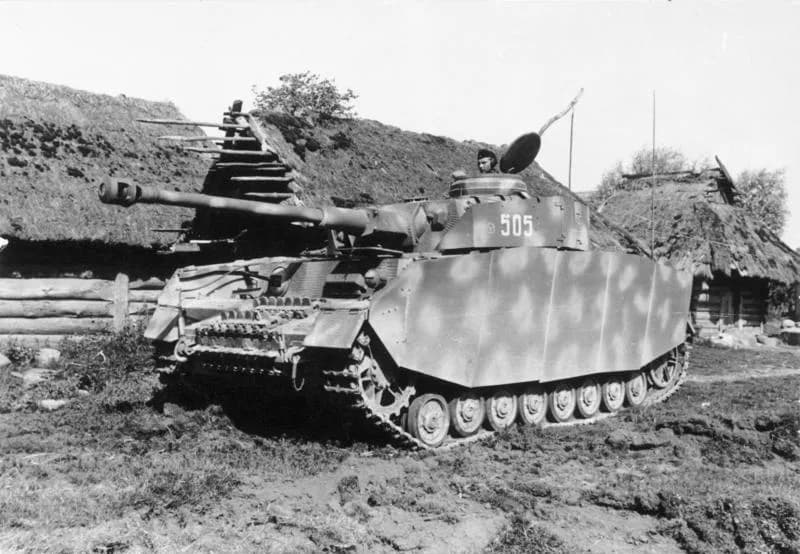
Panzer IV
The Panzerkampfwagen IV was the most produced German medium tank of World War II, with over 8,500 built. Originally designed as an infantry support tank, it evolved into the backbone of the Panzer divisions on every front. It is the only German tank in production from 1939 to 1945.
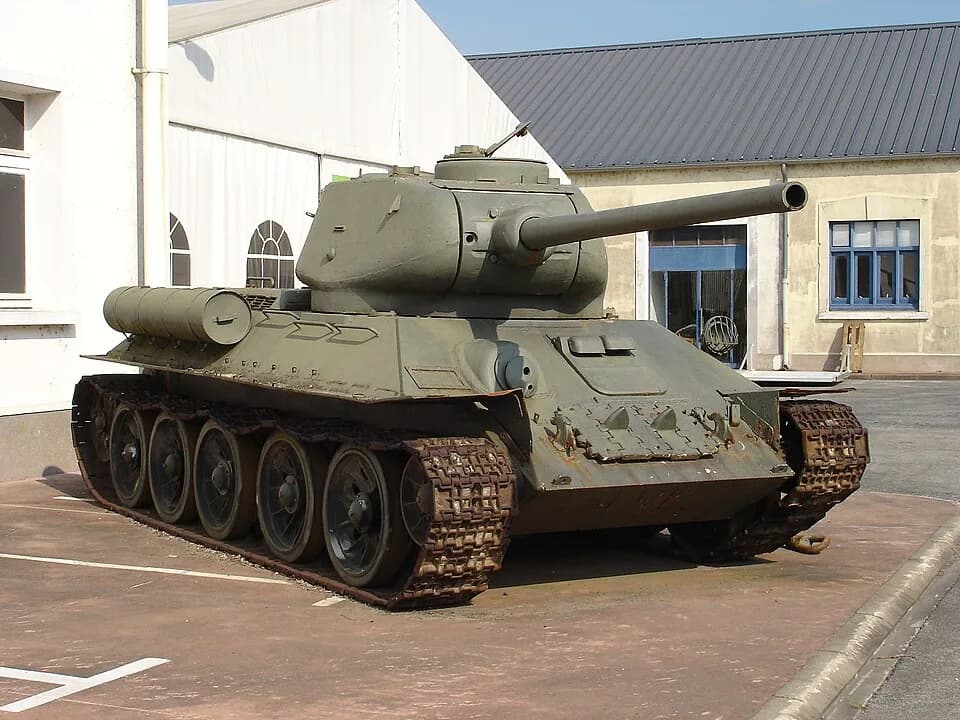
T-34
The T-34 is widely considered the best medium tank of World War II and one of the most influential in military history. Produced in over 84,000 units, its combination of sloped armor, mobility and firepower shocked the Germans in 1941 and shifted the balance of power on the Eastern Front.
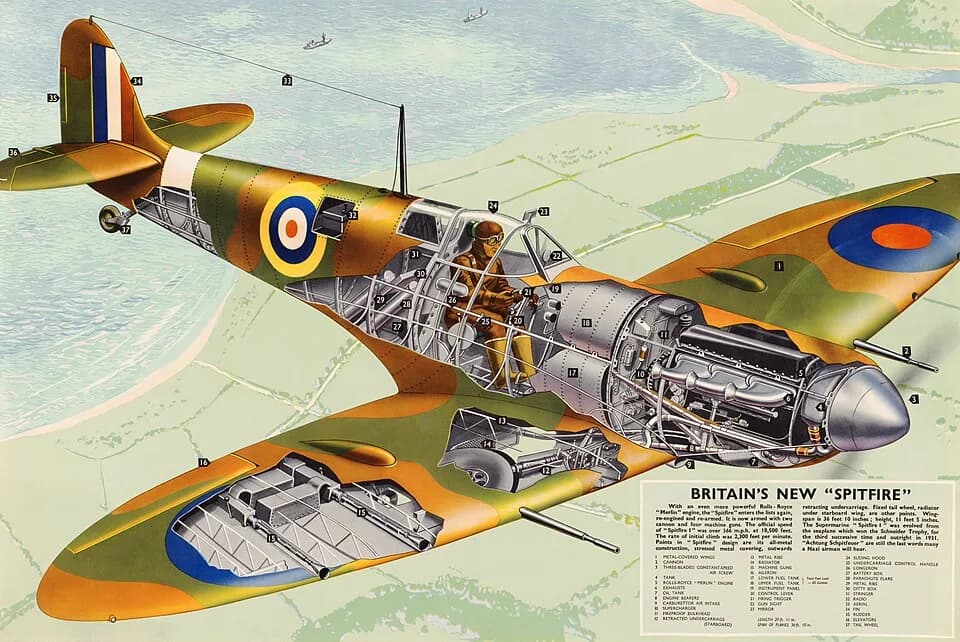
Supermarine Spitfire
The Supermarine Spitfire is the iconic fighter aircraft of the Royal Air Force and a symbol of British resistance during the Battle of Britain. Designed by R.J. Mitchell, its combination of elliptical wings, Rolls-Royce Merlin engine and exceptional agility made it one of the finest fighters of the war.
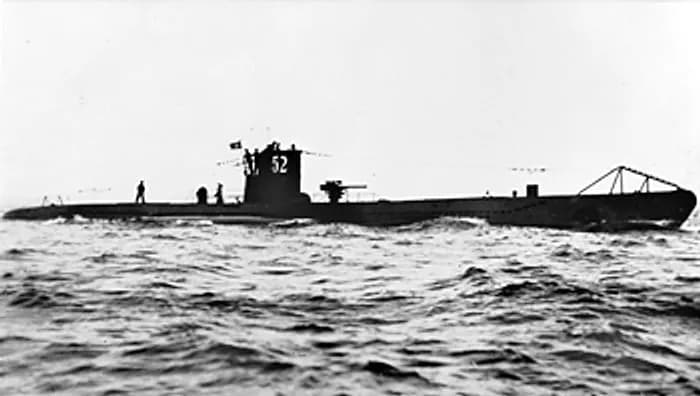
U-Boat Type VII
The Type VII U-boat is the most produced submarine in history with 703 built. The backbone of the Kriegsmarine during the Battle of the Atlantic, these vessels nearly severed the vital supply lines between America and Britain, threatening Great Britain's very survival.
