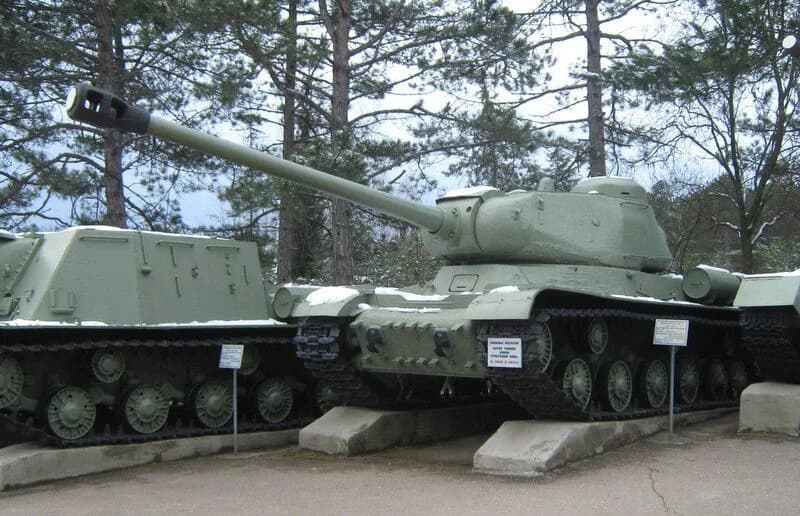
The IS-2, named after Joseph Stalin, was the most powerful Soviet heavy tank of World War II. Armed with a formidable 122mm gun, it was specifically designed to destroy German Tigers and breach enemy fortifications, becoming the spearhead of Soviet offensives from 1944 to 1945.
The IS-2's development was part of the evolution of Soviet heavy tanks against the growing threat of German armor. After the first encounters with Tiger Is near Leningrad in January 1943, Soviet high command demanded a tank capable of destroying the Tiger at all combat ranges. The design team at the Chelyabinsk design bureau, led by Joseph Kotin and Nikolai Shashmurin, worked from the lightened KV-1S chassis. The first model, the IS-1 (IS-85), armed with a D-5T 85mm gun, was deemed insufficient against the Tiger frontally. The decision was made to mount the powerful D-25T 122mm gun, derived from the 1931 A-19 corps gun. This gun, though originally designed for artillery, offered unmatched destructive power. The IS-122 prototype was tested in November 1943 and approved for serial production in December. The Chelyabinsk factory, nicknamed Tankograd (tank city), began production in February 1944. The main technical challenge was integrating the massive gun into a relatively compact turret, requiring two-piece ammunition loading (separate projectile and propellant charge).
The IS-2 model 1944 weighed 46 tons with a total length of 9.83m including the gun. Its V-2-IS V12 diesel engine producing 520 horsepower gave it a maximum speed of 37 km/h on road and 19 km/h off-road, with a range of 240 km. The four-man crew comprised the tank commander, gunner, loader, and driver. The D-25T 122mm gun fired 25 kg shells at a rate of 2-3 rounds per minute (compared to 6-8 for a Tiger), with a capacity of only 28 rounds. The BR-471B armor-piercing shell could penetrate 152mm of armor at 1,000m, sufficient to destroy any German tank, including the Tiger I frontally. The 25 kg OF-471 high-explosive shell was devastating against fortifications and infantry. The hull's frontal armor reached 120mm on the 1944 model (with the characteristic rounded nose replacing the stepped nose of the 1943 model). The turret featured 100mm sloped frontal armor. Secondary armament included a DShK 12.7mm anti-aircraft machine gun on the turret and a DT 7.62mm machine gun in the hull.
The IS-2 entered combat in spring 1944 and participated in all major Soviet offensives until the fall of Berlin. Guards Heavy Tank Regiments, elite formations attached directly to army fronts, received IS-2s as priority. Their primary mission was to breach fortified German defenses and engage enemy heavy tanks. During Operation Bagration (summer 1944), IS-2s served as armored battering rams to punch through Wehrmacht fortified lines in Belarus. At Sandomierz (August 1944), Lieutenant Ossokin's IS-2 destroyed a Tiger I and a Panther within minutes. The Germans quickly learned to fear the IS-2: a single 122mm shell could destroy a Tiger I even without penetrating the armor, through shock effect and internal spalling alone. Soviet tactics prescribed using IS-2s in pairs: while one tank fired, the other reloaded, compensating for the slow rate of fire. During the Battle of Berlin (April 1945), IS-2s were at the forefront of urban combat, using their high-explosive shells to destroy building after building in the advance toward the Reichstag.
The IS-2 had two main versions: the 1943 model with a stepped hull nose (angular welded armor) and the 1944 model with a cast rounded nose offering better ballistic protection. Approximately 3,385 IS-2s were produced in total. The IS-2 evolved into the IS-3, a revolutionary tank with its dome turret and pike nose (shchuka), unveiled at the Victory Parade in Berlin on September 7, 1945, which shocked Western observers and directly influenced the development of the British Conqueror heavy tank and the American M103. The ISU-122, a self-propelled tank destroyer on the IS chassis, mounted the same D-25S gun in a fixed superstructure. The ISU-152, nicknamed Zveroboi (beast killer), carried a 152mm ML-20S gun-howitzer capable of destroying any German tank through the brute force of its 48 kg shell. These heavy assault vehicles proved particularly effective in urban combat and fortification reduction. The modernized IS-2 (IS-2M) remained in service with the Red Army and its allies into the 1970s.
The IS-2 represents the culmination of the Soviet breakthrough heavy tank philosophy. With its 122mm gun, it was the most powerfully armed tank to see regular combat during World War II. Its psychological impact on German troops was considerable: crews of Panzer IVs and even Panthers received orders to avoid frontal combat with IS-2s. Marshal Zhukov's report to the Stavka noted that the presence of IS-2s in a sector often sufficed to accelerate German withdrawal. Tactically, the IS-2 changed the dynamics of armored combat on the Eastern Front: for the first time, the Soviets had a tank capable of dominating Tigers in a duel. However, its slow rate of fire and limited ammunition capacity required careful tactical employment. After the war, the IS-2 equipped the armies of numerous Soviet bloc countries and fought in Korea (1950-1953) as well as during the 1969 Sino-Soviet border conflict. The IS-2's legacy continued in the line of Soviet T-10 heavy tanks and in Russian armored doctrine, which still prioritizes maximum firepower.
The Soviet IS-2 heavy tank weighed 46 tons and was armed with a D-25T 122mm gun whose BR-471B armor-piercing shell could penetrate 152mm of armor at 1,000m. This gun could destroy any German tank, including the Tiger I frontally. Panzer IV and Panther crews received orders to avoid frontal combat with IS-2s. Approximately 3,385 units were produced between 1944 and 1945.
After the first encounters with German Tiger Is near Leningrad in January 1943, Soviet high command demanded a tank capable of destroying them at all ranges. The Chelyabinsk factory (Tankograd) team developed the IS-2, approved in December 1943. Production began in February 1944 and the tank entered combat in spring 1944, participating in Operation Bagration and all major offensives through Berlin.
The IS-2's main drawback was its slow rate of fire: only 2 to 3 rounds per minute, compared to 6 to 8 for a Tiger I, due to the two-piece ammunition loading (25 kg projectile plus propellant charge). Ammunition capacity was limited to 28 rounds. Soviet tactics compensated by using IS-2s in pairs: while one tank fired, the other reloaded, maintaining continuous pressure on the enemy.
Information cross-checked against Wikipedia and reference historical works.
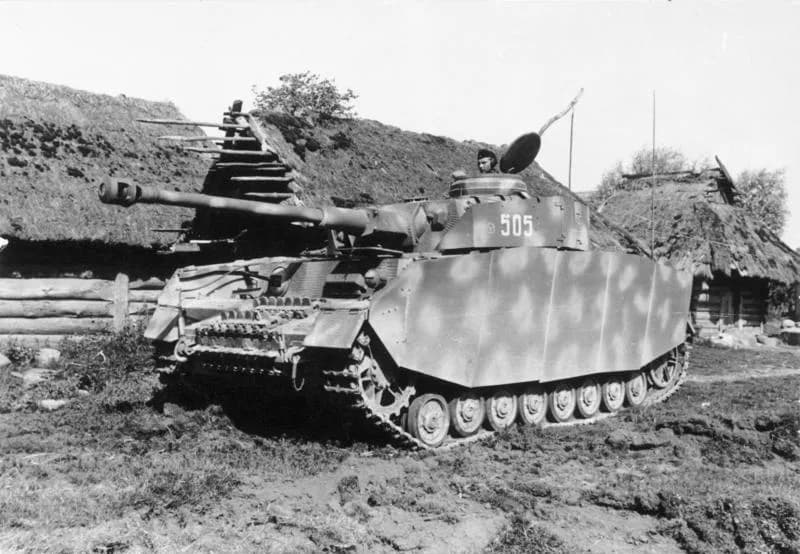
Panzer IV
The Panzerkampfwagen IV was the most produced German medium tank of World War II, with over 8,500 built. Originally designed as an infantry support tank, it evolved into the backbone of the Panzer divisions on every front. It is the only German tank in production from 1939 to 1945.
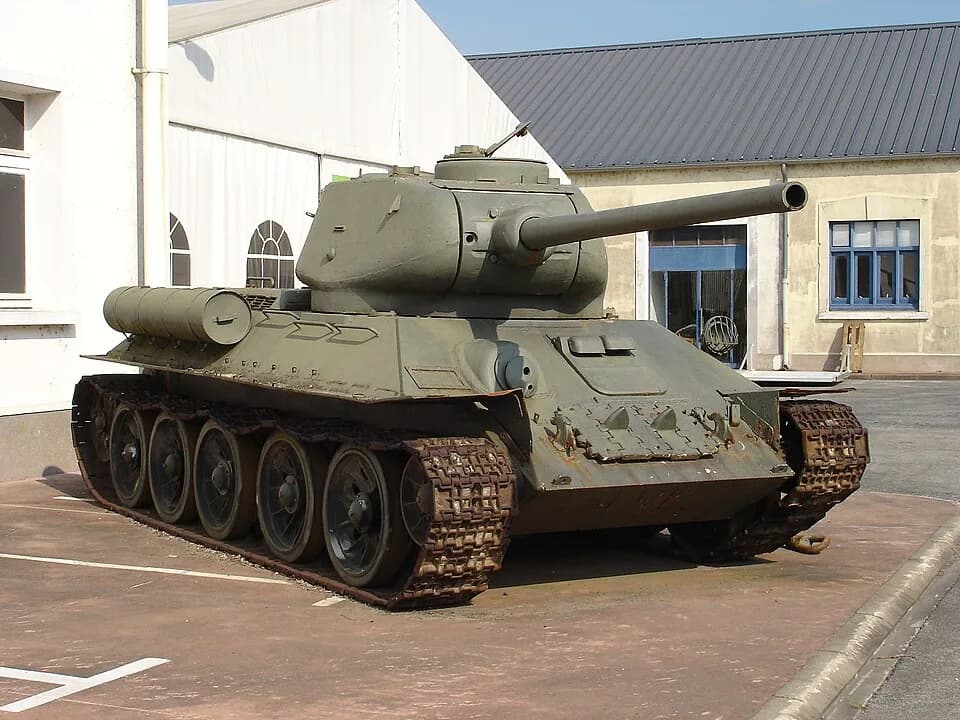
T-34
The T-34 is widely considered the best medium tank of World War II and one of the most influential in military history. Produced in over 84,000 units, its combination of sloped armor, mobility and firepower shocked the Germans in 1941 and shifted the balance of power on the Eastern Front.
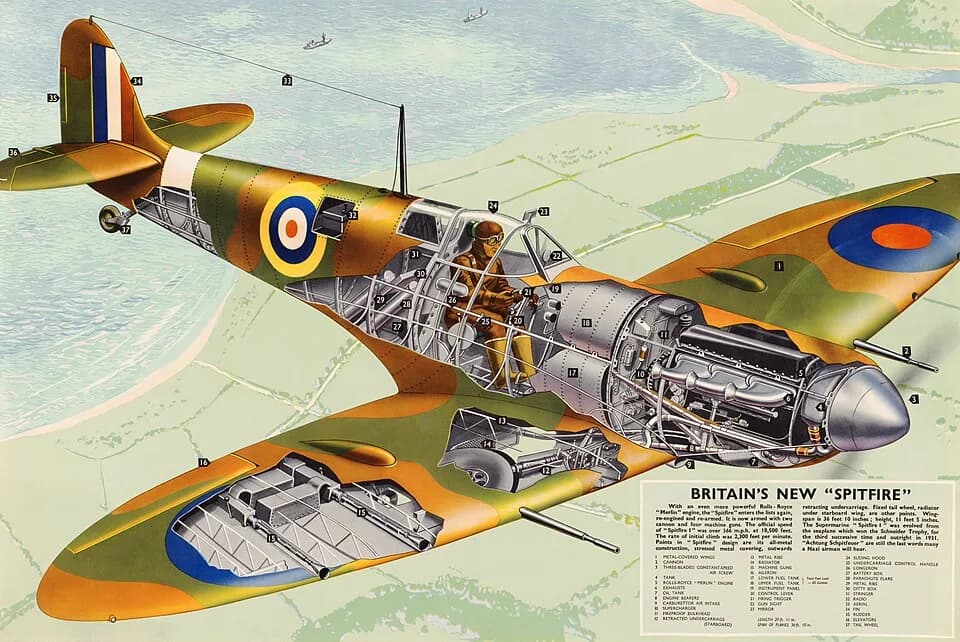
Supermarine Spitfire
The Supermarine Spitfire is the iconic fighter aircraft of the Royal Air Force and a symbol of British resistance during the Battle of Britain. Designed by R.J. Mitchell, its combination of elliptical wings, Rolls-Royce Merlin engine and exceptional agility made it one of the finest fighters of the war.
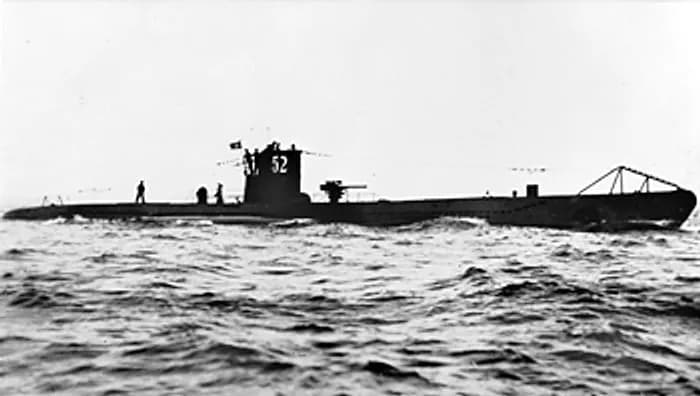
U-Boat Type VII
The Type VII U-boat is the most produced submarine in history with 703 built. The backbone of the Kriegsmarine during the Battle of the Atlantic, these vessels nearly severed the vital supply lines between America and Britain, threatening Great Britain's very survival.
