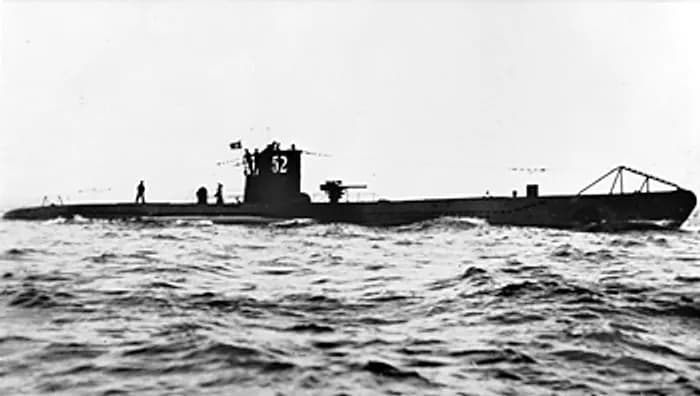
The German submarine war, waged by the Kriegsmarine's U-boats, aimed to cut Britain's transatlantic supply lines, threatening the island's very survival during the Battle of the Atlantic. The reversal came in 1943, with the breaking of Enigma, shipborne radar and long-range escort vessels.
The submarine warfare of World War II drew its origins from the experience of World War I, during which Imperial Germany had already attempted to subdue Great Britain through a submarine blockade. In 1917, the unrestricted submarine warfare campaign had nearly succeeded, reducing British food reserves to only six weeks before the introduction of the convoy system reversed the situation. This historical lesson was not forgotten by German strategists of the interwar period. Karl Dönitz, who had himself commanded a submarine during the Great War and had been taken prisoner by the British, became the principal architect of German submarine doctrine. Promoted to command the submarine fleet in 1935, Dönitz developed the wolfpack tactic, or Rudeltaktik, which would revolutionize submarine warfare. The principle consisted of gathering several submarines to simultaneously attack a convoy, overwhelming its escorts through numbers. Unlike World War I where submarines operated individually, the Rudeltaktik transformed U-boats into a coordinated and lethal force. The Treaty of Versailles had forbidden Germany from possessing submarines, but secret rearmament began as early as the 1920s, and the Anglo-German Naval Agreement of 1935 officially authorized construction of a submarine fleet. Dönitz estimated he needed a minimum of 300 operational submarines to impose an effective blockade on Great Britain. When war broke out in September 1939, he had only 57, of which only 22 were ocean-going Type VII boats capable of operating in the Atlantic. Despite this numerical insufficiency, Dönitz was convinced that the submarine, a relatively inexpensive weapon to produce, could be the decisive factor in the war by strangling Great Britain's vital imports. Geography favored Germany, as Great Britain depended almost entirely on maritime imports for its food, raw materials, and petroleum. Winston Churchill himself acknowledged after the war that the submarine threat had been the only thing that truly frightened him during the conflict.
The principles of German submarine warfare rested on a logic of economic attrition aimed at sinking more merchant ships than the Allies could build. Dönitz's calculation was simple and relentless: if his U-boats could sink 700,000 tons of merchant shipping per month, Allied shipyards would be unable to compensate for these losses, and Great Britain would gradually be starved into capitulation. The wolfpack tactic formed the heart of this strategy. A scouting submarine would spot a convoy and transmit its position, heading, and speed to U-boat headquarters at Lorient or Paris. Dönitz would then personally coordinate the gathering of all available submarines in the area, forming a patrol line across the convoy's probable route. The attack was launched at night, on the surface, with submarines penetrating inside the convoy itself to fire torpedoes at close range. This tactic of night surface attack made the submarines virtually undetectable by the escorts' ASDIC sonar, which only worked against submerged targets. Another fundamental principle was the tonnage war, or Tonnagekrieg. Dönitz did not necessarily seek to sink ships carrying specific cargoes but rather to reduce the total tonnage available to the Allies. Every ship sunk, regardless of its cargo, contributed to the war effort by diminishing Allied transport capacity. U-boats operated according to the principle of concentrating forces where convoys were least protected. At the beginning of the war, this meant the Western Approaches to the British Isles. Then, as escorts strengthened, operational zones shifted to the mid-Atlantic, the famous Black Gap, a zone beyond the range of Allied coastal patrol aircraft. Submarines also exploited American coastal waters after the United States entered the war, during the second Happy Time from January to August 1942, when merchant ships still sailed without escort and without blackout. Radio communication, while vital for wolfpack coordination, paradoxically constituted an exploitable weakness, as transmissions could be intercepted and located by radio direction-finding.
The application of submarine warfare went through several distinct phases during the conflict. The first phase, from September 1939 to June 1940, was characterized by limited operations due to the small number of available U-boats. Nevertheless, submarines achieved notable successes, including the torpedoing of the aircraft carrier HMS Courageous by U-29 on September 17, 1939, and Günther Prien's audacious raid into the Scapa Flow naval base on October 14, 1939, where he sank the battleship HMS Royal Oak. The fall of France in June 1940 radically changed the strategic situation. Submarine bases established on the French Atlantic coast at Lorient, Brest, Saint-Nazaire, La Rochelle, and Bordeaux considerably shortened U-boats' transit to Atlantic hunting grounds. This opened the first Happy Time, from October 1940 to March 1941, a period during which submarine aces like Otto Kretschmer, Joachim Schepke, and Günther Prien inflicted terrible losses on British convoys. U-boats often operated alone or in small groups, and British escorts were still insufficient and poorly equipped. The year 1941 saw a hardening of the battle. The British progressively improved their defenses with more numerous escorts, shipborne radar, and above all the decryption of German Navy Enigma communications by specialists at Bletchley Park. After the United States entered the war in December 1941, Operation Drumbeat sent five U-boats off the American East Coast, triggering the second Happy Time. Merchant ships, silhouetted against the lights of coastal cities, were torpedoed en masse. In six months, over 600 ships were sunk in American waters. The peak of the Battle of the Atlantic was reached in March 1943, when U-boats sank more than 600,000 tons in a single month. But this was the swan song of German submarine warfare, as the Allies simultaneously deployed additional escorts, very long-range aircraft, escort carriers, and hunter-killer groups that turned the situation around decisively.
The results of submarine warfare were considerable on both sides of the conflict. On the German side, U-boats sank a total of approximately 2,779 Allied merchant vessels, representing nearly 14.7 million gross register tons. They also sank 175 Allied warships, including two battleships, three aircraft carriers, and numerous cruisers, destroyers, and corvettes. These figures testify to the magnitude of the threat submarine warfare posed to the Allied war effort. At certain critical moments, particularly in spring 1943, the situation was genuinely dangerous for the Allies, who saw their strategic reserves diminish alarmingly. However, German losses were appalling. Of approximately 1,162 U-boats committed during the conflict, 785 were sunk, a loss rate of over 67 percent. Of the roughly 40,000 German submariners who served during the war, approximately 30,000 were killed and 5,000 taken prisoner, a mortality rate of about 75 percent, the highest of any branch of any armed forces in World War II. May 1943 marked the decisive turning point of the Battle of the Atlantic. In that single month, 43 U-boats were sunk, losses so catastrophic that Dönitz ordered the temporary withdrawal of his submarines from the North Atlantic. This Black May signified the strategic defeat of German submarine warfare, even though U-boats continued to operate until war's end. The Allies won the Battle of the Atlantic through a combination of factors. Ultra decryption of Enigma communications allowed convoys to be rerouted around submarine patrol lines. The introduction of centimetric radar made U-boats detectable even on the surface at night. Very long-range aircraft closed the Atlantic Black Gap. Escort carriers provided permanent air cover for convoys. And the massive production of American shipyards, notably Liberty ships, finally outpaced losses caused by U-boats. Submarine warfare profoundly influenced Cold War naval strategy, with nuclear submarines becoming the primary weapon of navies worldwide.
Analysis of submarine warfare during World War II reveals a technological and strategic confrontation of remarkable complexity, where each advance by one side prompted a response from the other in permanent escalation. On the strategic level, the decision to wage submarine warfare was fundamentally sound from the German perspective. Great Britain, an island nation dependent on imports, was vulnerable to a maritime blockade, and the submarine represented the most cost-effective weapon for a power lacking surface naval supremacy. Dönitz had correctly identified his adversary's weak point and the best weapon to exploit it. However, several strategic and tactical errors compromised German chances of success. The first and most fundamental was the failure to build sufficient submarines before the start of the conflict. Hitler's decision to prioritize construction of large surface vessels under Plan Z, at the expense of submarines, deprived Dönitz of necessary resources during the critical early years of the war, when Allied defenses were weakest. The second error was excessive confidence in the security of the Enigma encryption system. The Germans never truly believed their code had been broken, despite troubling indicators. This blind faith in Enigma allowed the Allies to read submarine communications for extended periods, routing convoys around ambushes and dispatching anti-submarine forces to exact U-boat positions. On the technological level, submarine warfare perfectly illustrates the arms race between offense and defense. The Germans developed better torpedoes, the schnorkel allowing battery recharging while submerged, and toward war's end, the Type XXI and Type XXIII submarines with improved electric propulsion. But the Allies constantly maintained the technological advantage with centimetric radar, the Leigh Light for night illumination, acoustic homing torpedoes, the Hedgehog and Squid for advanced depth charge projection, and above all operational research that systematically optimized employment of all these weapons. Ultimately, the Battle of the Atlantic was the longest campaign of World War II and one of the most decisive, as its loss by the Allies would have made any landing in Europe impossible and prolonged the war incalculably.
Karl Dönitz aimed to sink 700,000 tons of merchant shipping per month to starve Britain. The wolfpack tactic (Rudeltaktik) gathered several U-boats to simultaneously attack a convoy at night on the surface, making submarines undetectable by ASDIC sonar. The Battle of the Atlantic peaked in March 1943 with over 600,000 tons sunk in a single month.
Of approximately 1,162 U-boats committed during the conflict, 785 were sunk, a loss rate exceeding 67%. Of roughly 40,000 German submariners, approximately 30,000 were killed and 5,000 taken prisoner — a mortality rate of about 75%, the highest of any branch of any armed forces in World War II. May 1943 (Black May) alone saw 43 U-boats sunk.
In May 1943, the Allies simultaneously deployed centimetric radar (detecting surfaced U-boats at night), very long-range aircraft closing the Atlantic Black Gap, escort carriers, and hunter-killer groups. In that single month, 43 submarines were sunk — losses so catastrophic that Dönitz ordered the temporary withdrawal of his forces from the North Atlantic, marking the strategic defeat of German submarine warfare.
Information cross-checked against Wikipedia and reference historical works.
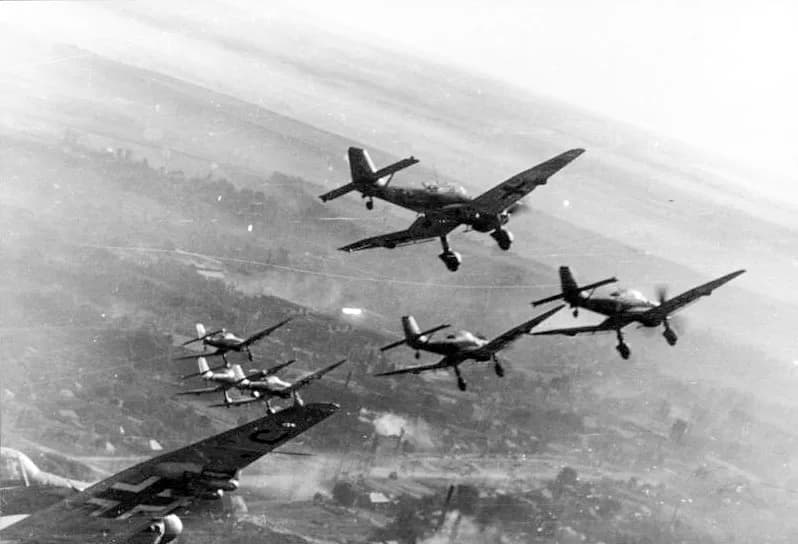
Blitzkrieg
Blitzkrieg, or lightning war, is a German military doctrine combining armour, aircraft and motorised infantry to break through enemy lines and rapidly encircle opposing forces. Applied in Poland in 1939 and then in France in 1940, it brought down a country in six weeks and reshaped modern warfare before stalling on the Eastern Front.
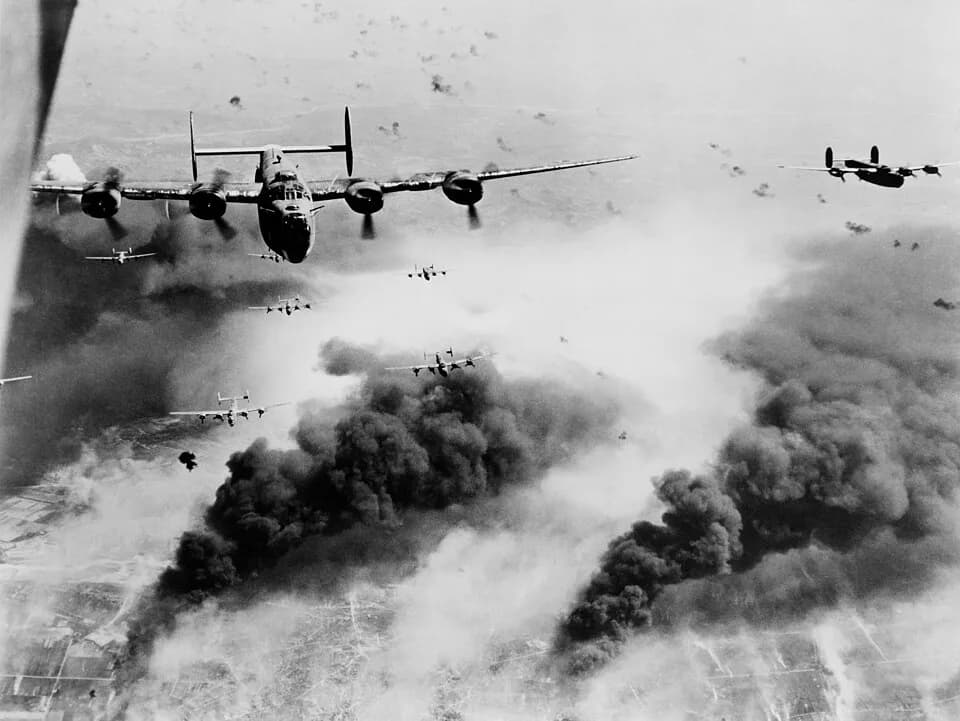
Strategic Bombing
Allied strategic bombing aimed to destroy the industrial and military apparatus of Nazi Germany through massive air raids, mixing American daylight precision bombing with British night-time area bombing. Waged from 1940 to 1945, it diverted a considerable share of German production toward air defence, at the cost of heavy civilian casualties.
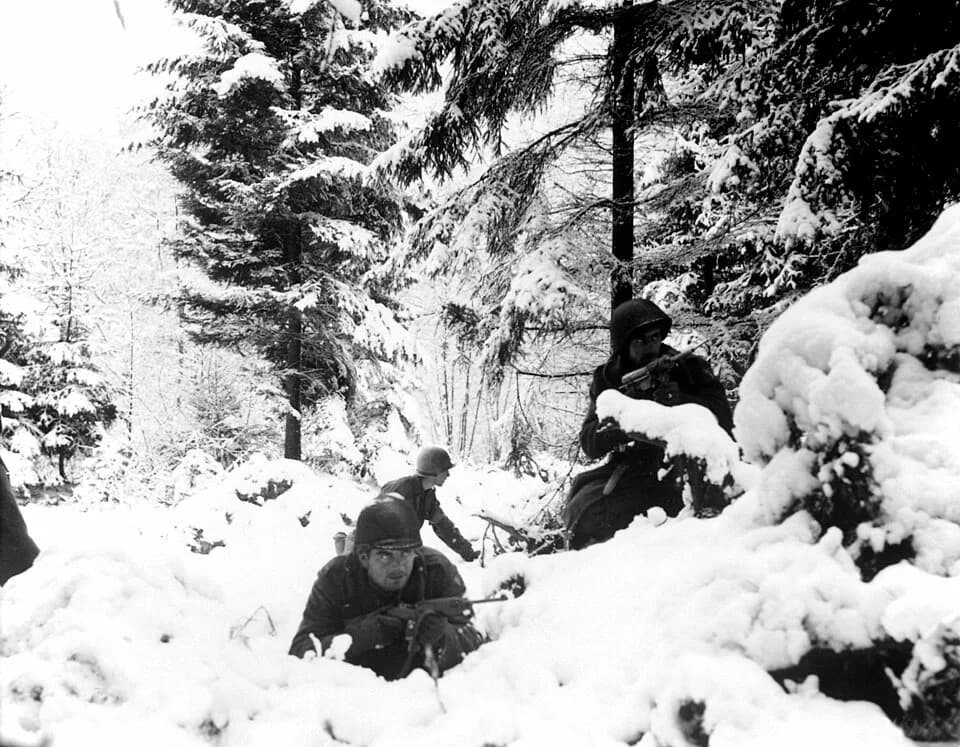
Defense in Depth
The Soviet defence in depth organised successive defensive zones across tens of kilometres, in order to absorb German armoured breakthroughs, exhaust the attacker and set up decisive counter-offensives. Applied at Kursk in 1943, it rested on minefield belts, anti-tank ditches and dug-in artillery, prepared months before the assault.
Island Hopping
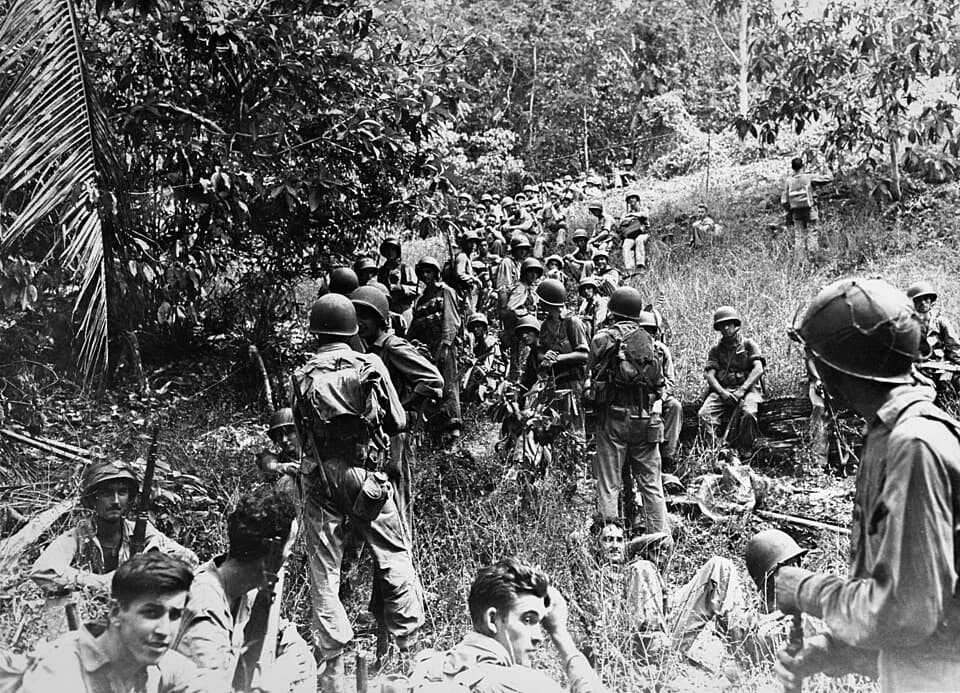
Island hopping was the American strategy of bypassing fortified Japanese garrisons to seize less defended islands, gradually bringing Allied forces closer to Japan. The strongholds left behind, cut off from all resupply, ceased to be a threat without ever having to be stormed.
