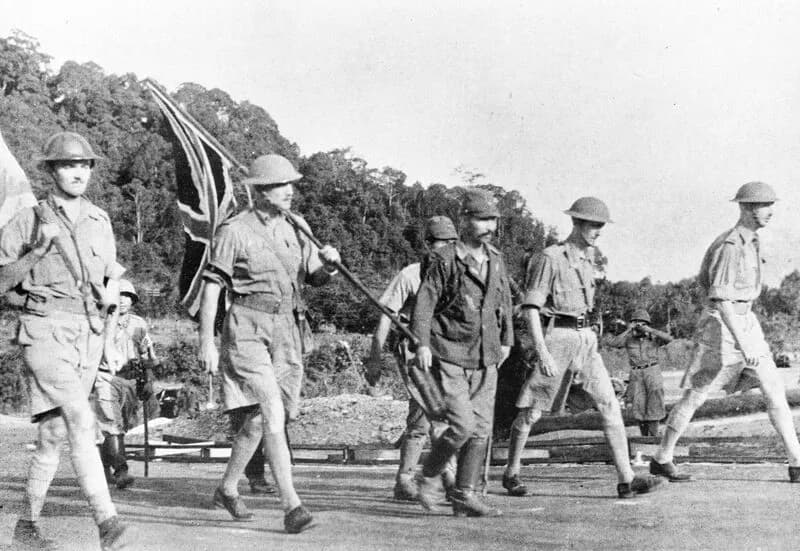
The Fall of Singapore constituted the largest surrender in British military history. In barely a week, General Yamashita's Japanese forces seized the supposedly impregnable fortress, capturing approximately 80,000 Allied soldiers and dealing a devastating blow to British Imperial prestige in Asia.
Singapore was considered the Gibraltar of the East, the cornerstone of British defense in Southeast Asia. Since the 1920s, the British had invested heavily in building a naval base capable of hosting the Royal Navy in the event of a Pacific conflict. The defensive strategy rested on the assumption that any attack would come from the sea to the south, and powerful coastal batteries were oriented accordingly. The idea that a land attack through the Malay Peninsula, across jungle deemed impassable, might be possible had not been seriously considered by British command. Lieutenant-General Arthur Percival, commanding British forces in Malaya and Singapore, had approximately 85,000 soldiers, comprising British, Australian, Indian, and Malay troops. However, these forces suffered from serious deficiencies: virtually nonexistent air cover following the destruction of Force Z — the battleship HMS Prince of Wales and battlecruiser HMS Repulse, sunk by Japanese aircraft on December 10, 1941 —, insufficient training for jungle combat, and fragile morale. Facing them, General Tomoyuki Yamashita, nicknamed the 'Tiger of Malaya,' commanded the Japanese 25th Army, approximately 36,000 strong at the campaign's outset. These troops, veterans of the war in China, were superbly trained in jungle warfare and perfectly mastered infiltration and encirclement tactics. The Malayan campaign, begun on December 8, 1941, had seen the Japanese sweep down the peninsula at astonishing speed, using bicycles to advance through jungle and rubber plantations.
After conquering the entire Malay Peninsula in just 54 days, Japanese forces reached the Strait of Johor, the narrow strip of water separating the mainland from Singapore Island, by late January 1942. Yamashita carefully prepared the amphibious assault by conducting reconnaissance and concentrating his forces opposite the island's northwest sector, the least defended area. On the night of February 8-9, the Japanese 5th and 18th Divisions crossed the strait on barges and rafts under cover of an intense artillery barrage. The Australian troops of the 22nd Brigade defending this sector were quickly overwhelmed by the attackers' numbers and aggressiveness. Communication confusion prevented a coordinated response, and reinforcements arrived too late. On February 10, the Japanese Imperial Guard crossed the strait further east, widening the bridgehead. The defenders, pushed back toward the island's south, attempted to organize a defensive perimeter around Singapore city itself, but the situation deteriorated rapidly. The island's water reservoirs, located in the center, fell into Japanese hands, threatening the water supply for one million civilians and tens of thousands of soldiers. Hospitals overflowed with wounded, fires raged, and morale collapsed. On February 15, 1942, Chinese New Year, Percival surrendered at Yamashita's headquarters at the Ford Factory in Bukit Timah. Yamashita, whose troops were low on ammunition and actually outnumbered, had conducted a masterful bluff by demanding immediate unconditional surrender, threatening a bloodbath. Percival, unaware of the enemy's actual weakness, accepted, delivering approximately 80,000 soldiers into captivity.
The asymmetry of forces engaged at Singapore makes the British defeat all the more humiliating. On the Allied side, Lieutenant-General Percival commanded approximately 85,000 soldiers, comprising the Indian III Corps (General Lewis Heath), the Australian corps (General Gordon Bennett), and various British and Malay units. The 18th British Infantry Division, freshly landed as reinforcement, did not even have time to deploy properly before the capitulation. Indian forces, the most numerous, included several divisions, but many soldiers were insufficiently trained recruits. The two Australian brigades, though combative, had been tested by the fighting retreat through Malaya. The Royal Air Force in Malaya initially had 158 aircraft, primarily obsolete Brewster Buffalo fighters and Blenheim bombers, vastly outclassed by Japanese Zeros. By the time of the assault on Singapore, Allied air cover had practically ceased to exist. On the Japanese side, General Yamashita's 25th Army numbered approximately 36,000 men for the initial assault, organized into three divisions: the 5th Division, the 18th Division, and the Imperial Guard. These troops were supported by approximately 200 light and medium tanks and by the 3rd Air Group, which had achieved total air superiority. Despite their numerical inferiority, the Japanese compensated with overwhelming qualitative superiority: battle-hardened elite troops, audacious offensive doctrine, effective combined-arms coordination, and dynamic leadership. The ratio of more than two to one in favor of the defenders should have guaranteed the island's defense, making the surrender all the more catastrophic in British military history.
The Fall of Singapore had devastating and lasting consequences. Winston Churchill called it 'the worst disaster and largest capitulation in British military history.' Approximately 80,000 Allied soldiers were captured, adding to the 50,000 already taken during the Malayan campaign. These prisoners suffered appalling conditions in Japanese camps, where malnutrition, tropical diseases, forced labor, and systematic brutality caused a mortality rate approaching 25 percent. Thousands were sent to the Burma Railway construction site, the infamous 'Death Railway.' The civilian population of Singapore, particularly the Chinese community, suffered Japanese reprisals during the Sook Ching massacre, where between 25,000 and 50,000 Chinese civilians were systematically executed. Geopolitically, the fall of Singapore dealt a fatal blow to British Imperial prestige in Asia. The demonstration that Europeans were not invincible against Asian armies stimulated nationalist and independence movements throughout Southeast Asia. After the war, Burma, Malaya, Indonesia, and other colonies gained independence, accelerating decolonization. For Australia, the fall of Singapore represented a national trauma that reoriented its defense policy toward the United States rather than Great Britain, a strategic alliance shift that endures today. The loss of the naval base deprived the Royal Navy of its main installation in the western Pacific and confirmed that Japan now dominated the seas of Southeast Asia.
The Fall of Singapore left a complex and multifaceted legacy in the collective memory of many countries. In Singapore itself, February 15 is commemorated as Total Defence Day, dedicated to the memory of the fall and to national defense awareness. The Fort Siloso museum and the surrender site at the Ford Factory in Bukit Timah are important places of remembrance, preserving the memory of this traumatic episode. The Civilian War Memorial, erected in 1967, commemorates the victims of the Sook Ching massacre and the years of Japanese occupation. For Australia, the Fall of Singapore is a founding event of postwar national identity. The capture of the 8th Australian Division and the suffering of prisoners of war, particularly on the Burma Railway, are deeply embedded in Australian memory. ANZAC Day, April 25, includes commemoration of these sacrifices. The fall of Singapore accelerated the process by which Australia turned to the United States as its principal strategic ally, leading to the ANZUS Treaty of 1951. Militarily, the battle is studied as a classic example of defeat resulting not from material inferiority but from command failure, poor assessment of the enemy, and defensive planning based on erroneous assumptions. The British inability to envision a land attack from the north, their disdain for Japanese military capabilities, and the lack of combined-arms cooperation constitute lessons that remain pertinent. The figure of Yamashita, the 'Tiger of Malaya,' still fascinates military historians for the audacity and speed of his campaign.
Singapore surrendered on February 15, 1942. Lieutenant-General Arthur Percival surrendered approximately 80,000 British, Australian, Indian, and Malay soldiers to Japanese General Tomoyuki Yamashita. Churchill called this capitulation the 'worst disaster and largest surrender in British military history.'
Yamashita's 25th Army had approximately 36,000 men against 85,000 Allied defenders. The Japanese crossed the Johor Strait on the night of February 8-9, 1942, striking the least-defended northwest sector. Yamashita imposed unconditional surrender through a bold bluff, as his troops were low on ammunition. The lack of Allied air cover and the capture of the water reservoirs accelerated the capitulation.
After Singapore's fall, the Japanese army conducted Operation Sook Ching against the Chinese community, perceived as hostile. Between 25,000 and 50,000 Chinese civilians were systematically executed between February and March 1942. This purge targeted men deemed anti-Japanese based on arbitrary criteria. The Civilian War Memorial in Singapore, inaugurated in 1967, commemorates these victims.
Information cross-checked against Wikipedia and reference historical works.
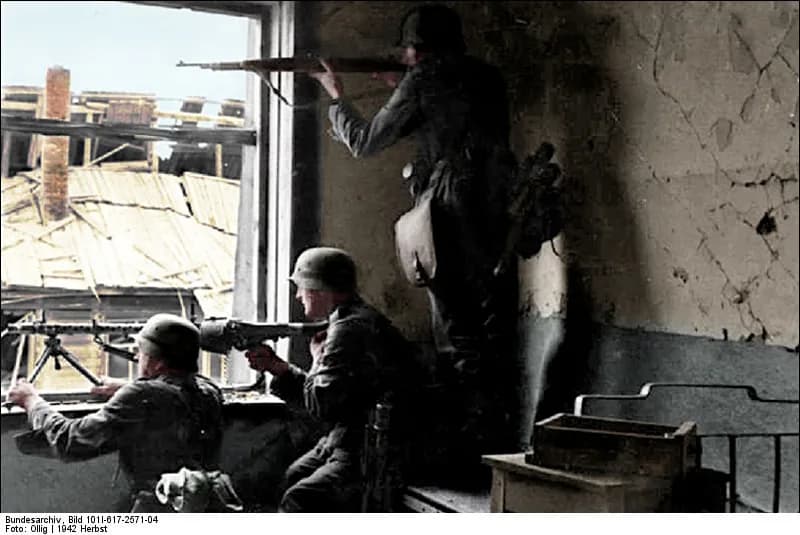
Battle of Stalingrad
The Battle of Stalingrad was among the deadliest clashes of World War II, pitting German and Soviet forces against each other in devastating urban combat that marked a decisive turning point on the Eastern Front. From 23 August 1942 to 2 February 1943, Operation Uranus encircled the German Sixth Army, whose roughly 91,000 survivors surrendered.
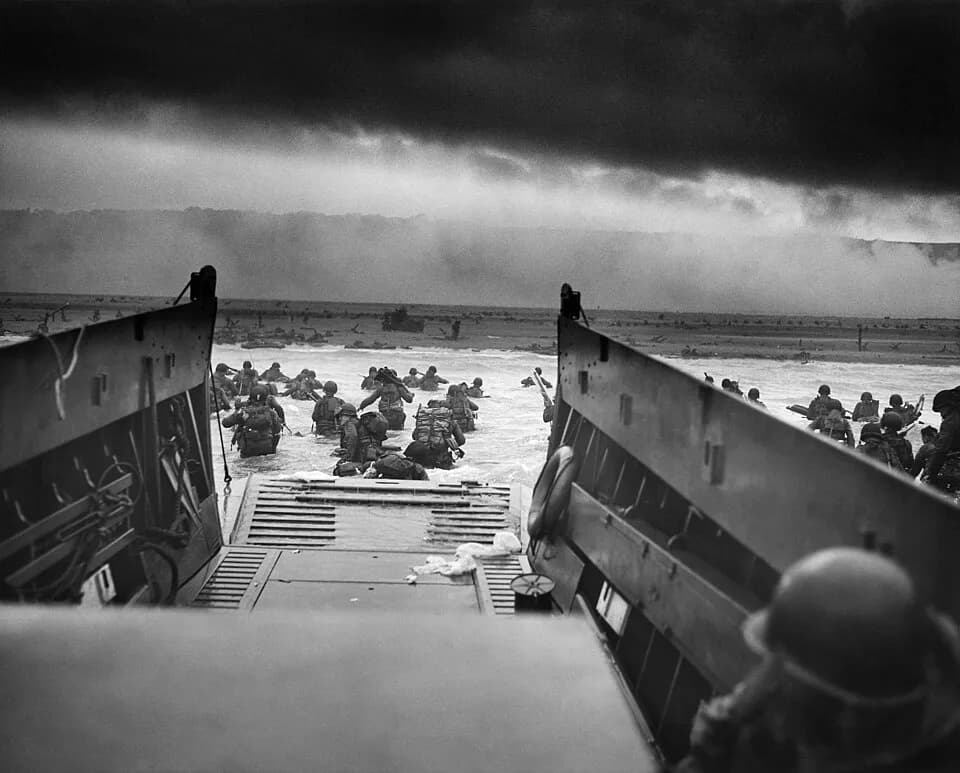
Normandy Landings
The Normandy landings, the largest amphibious operation in history, opened a second front in Western Europe on 6 June 1944, hastening the liberation of France and the defeat of Nazi Germany. Nearly 7,000 vessels put 156,000 men ashore on five beaches in a single day, under air cover and after months of deception meant to mislead the Wehrmacht.
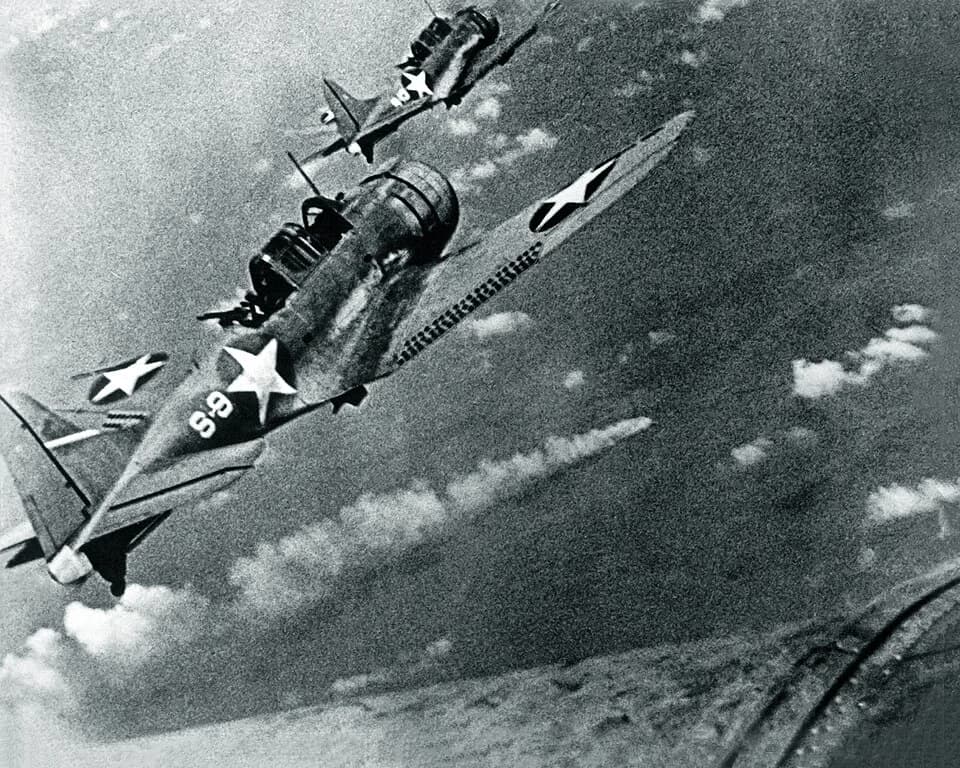
Battle of Midway
The Battle of Midway was the decisive turning point of the Pacific war, where the American navy inflicted a catastrophic defeat on the Japanese fleet by sinking four aircraft carriers, reversing the naval balance. From 4 to 7 June 1942, the decryption of Japanese communications allowed Admiral Nimitz to ambush a fleet that outnumbered his own.
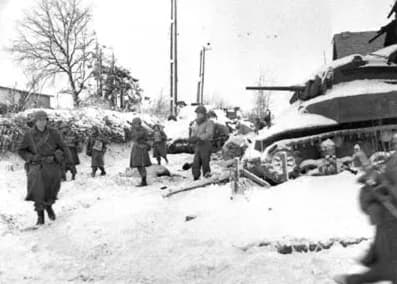
Battle of the Bulge
The Battle of the Bulge was the last major German offensive on the western front, a desperate attempt to break through Allied lines in the Belgian forests that failed against American resistance. Launched on 16 December 1944 under overcast skies that grounded Allied aircraft, it was broken by late January 1945.
