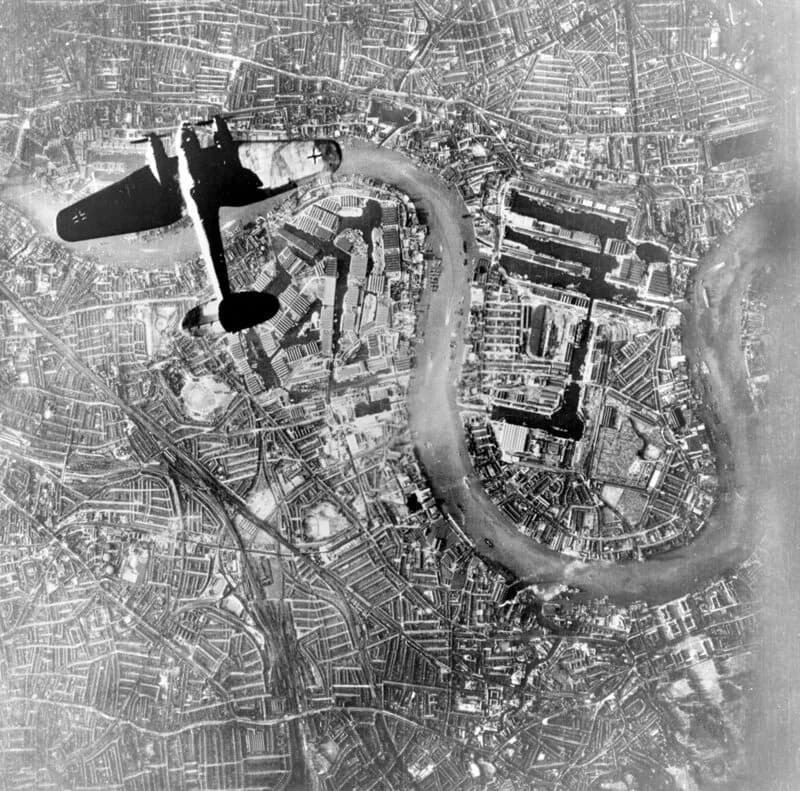
The Blitz refers to the strategic bombing campaign waged by the Luftwaffe against British cities from September 1940 to May 1941. London was the primary target, bombed for 57 consecutive nights, in an attempt to break British morale and force surrender.
After the Luftwaffe's failure to achieve air superiority during the Battle of Britain (July-September 1940), Hitler ordered a change in strategy. Instead of continuing to target RAF airfields, Göring redirected bombing toward British urban and industrial centers. This shift, partly motivated by a retaliatory RAF raid on Berlin on August 25, 1940, that had humiliated the Nazi regime, inadvertently saved the RAF by giving it time to reconstitute its forces. The first massive raid on London took place on September 7, 1940, known as Black Saturday, when 348 bombers escorted by 617 fighters struck the East End docks. The strategic objective of the Blitz was twofold: destroy British industrial capacity and break civilian morale to force Churchill to negotiate peace. The Germans relied on strategic bombing theories developed by Douhet and Mitchell, according to which massive city bombing could alone win a war.
The Blitz lasted eight months, from September 7, 1940, to May 11, 1941. London was bombed for 57 consecutive nights from September 7, then intermittently until May 1941. Nighttime raids typically mobilized between 150 and 400 Heinkel He 111, Dornier Do 17, and Junkers Ju 88 bombers. Incendiary bombs accompanied conventional explosives to create firestorms in residential and commercial neighborhoods. On December 29, 1940, the Second Great Fire of London set the City and the area around St Paul's Cathedral ablaze in a devastating conflagration. From November 1940, the Blitz expanded to other major cities: Coventry was devastated on November 14 (Operation Moonlight Sonata), destroying its medieval cathedral. Birmingham, Liverpool, Manchester, Sheffield, Bristol, Southampton, and Plymouth suffered devastating attacks. Glasgow, Belfast, and Cardiff were also hit. Londoners developed a survival culture: Underground stations became air raid shelters for thousands of people each night, despite risks of flooding and disease.
The Luftwaffe deployed approximately 1,300 bombers and 900 fighters for the Blitz, organized into two air fleets (Luftflotte 2 and Luftflotte 3) based in France, Belgium, and the Netherlands. The main bombers used were the Heinkel He 111, a twin-engine aircraft capable of carrying 2,000 kg of bombs, the Junkers Ju 88, the most versatile, and the lighter Dornier Do 17. Ordnance included conventional explosives from 50 to 1,800 kg and 1 kg magnesium incendiary bombs, dropped by the thousands. British defense relied on the RAF's Fighter Command, the anti-aircraft guns and searchlights of Anti-Aircraft Command, and the Chain Home radar network. Night fighters, initially ineffective, became progressively more capable thanks to the AI Mk IV airborne radar installed on Bristol Beaufighters from 1941. Anti-aircraft batteries, though inaccurate, forced bombers to fly higher, reducing their precision. Civil defense services, including the Auxiliary Fire Service firefighters and ARP wardens, played a crucial role in managing ground-level disasters.
The Blitz caused the deaths of approximately 43,000 British civilians and wounded 139,000 others. Over one million homes were damaged or destroyed in London alone. The city of Coventry was so devastated that the Germans coined the verb coventrieren to describe the total destruction of a city. However, the strategic objective of the Blitz was a complete failure. British morale did not break — on the contrary, the Blitz Spirit became a symbol of national resistance, embodied by Churchill's speeches and the British people's determination to keep calm and carry on. British industrial production, though disrupted, never collapsed, as factories were dispersed and repairs swift. The Luftwaffe suffered significant losses: approximately 600 bombers were destroyed, and the diversion of air forces from the Mediterranean front and from the preparation of Operation Barbarossa weakened the German war effort on those theaters. The Blitz ended in May 1941 when Hitler redeployed the Luftwaffe eastward for the invasion of the Soviet Union.
The Blitz left an indelible mark on British collective memory and on London's urban landscape. The Blitz Spirit — that capacity for stoic resistance in the face of adversity — became a founding myth of British national identity, still invoked today in moments of crisis. The iconic images of St Paul's Cathedral standing intact amid flames and smoke became universal symbols of resistance. Postwar reconstruction profoundly transformed the urban fabric of London and Coventry, where Basil Spence's new cathedral (1962), built alongside the ruins of the old one, symbolizes reconciliation and renewal. The Blitz also had lasting social consequences: the evacuation of 1.5 million children from cities to the countryside exposed the glaring social inequalities of British society and contributed to the movement toward the welfare state and the creation of the National Health Service in 1948. Militarily, the failure of strategic bombing to break British morale did not prevent the Allies from adopting the same strategy against Germany with infinitely greater means.
The Blitz (September 7, 1940 - May 11, 1941) killed approximately 43,000 British civilians and wounded 139,000 others. Over one million homes were damaged or destroyed in London alone. Despite 57 consecutive nights of bombing, British industrial production never collapsed. Londoners used Underground stations as shelters, developing the Blitz Spirit — a term that entered British national memory to describe stoic resistance in the face of adversity.
After the RAF conducted a retaliatory raid on Berlin on August 25, 1940 — humiliating the Nazi regime — Hitler ordered the Luftwaffe to shift from RAF airfields to urban centers. This target change inadvertently saved the RAF, giving it time to reconstitute its forces during the Battle of Britain. The first massive raid on London took place on September 7, 1940 (Black Saturday): 348 bombers escorted by 617 fighters struck the East End docks.
No. The Blitz's objective was twofold: destroy British industrial capacity and break civilian morale to force Churchill to negotiate. Both failed. The Luftwaffe lost approximately 600 bombers and the diversion of its forces weakened the German effort in the Mediterranean and the preparation of Operation Barbarossa. The Blitz ended in May 1941 when Hitler redeployed the Luftwaffe eastward for the invasion of the Soviet Union.
Information cross-checked against Wikipedia and reference historical works.
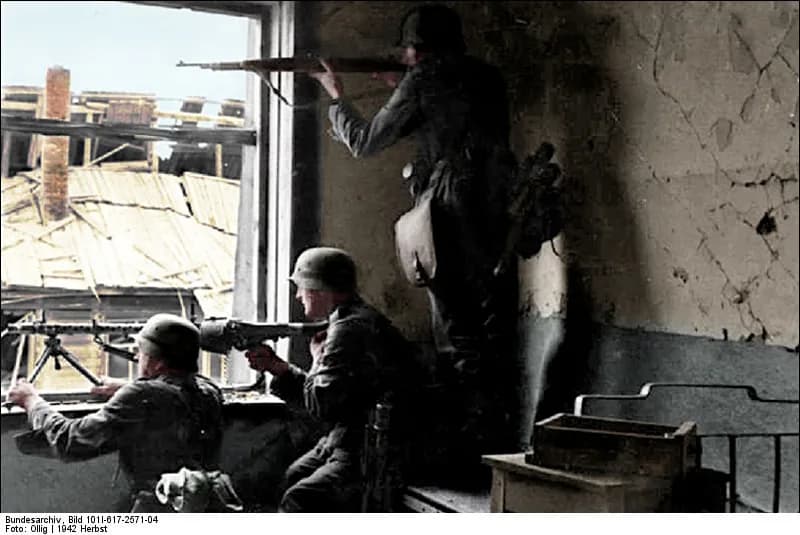
Battle of Stalingrad
The Battle of Stalingrad was among the deadliest clashes of World War II, pitting German and Soviet forces against each other in devastating urban combat that marked a decisive turning point on the Eastern Front. From 23 August 1942 to 2 February 1943, Operation Uranus encircled the German Sixth Army, whose roughly 91,000 survivors surrendered.
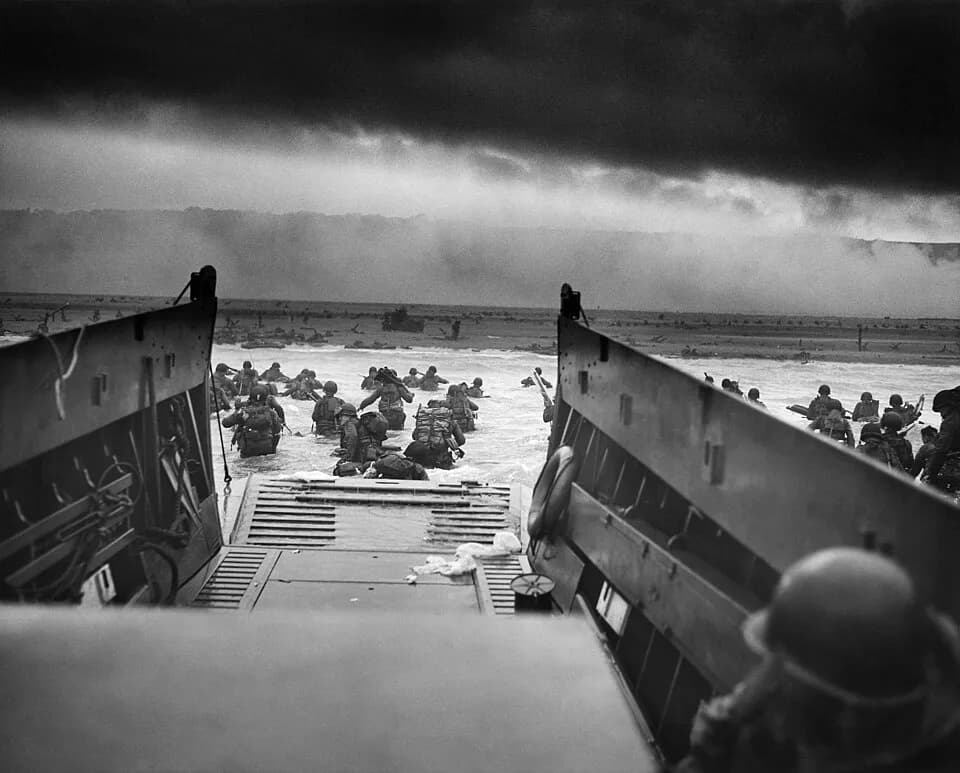
Normandy Landings
The Normandy landings, the largest amphibious operation in history, opened a second front in Western Europe on 6 June 1944, hastening the liberation of France and the defeat of Nazi Germany. Nearly 7,000 vessels put 156,000 men ashore on five beaches in a single day, under air cover and after months of deception meant to mislead the Wehrmacht.
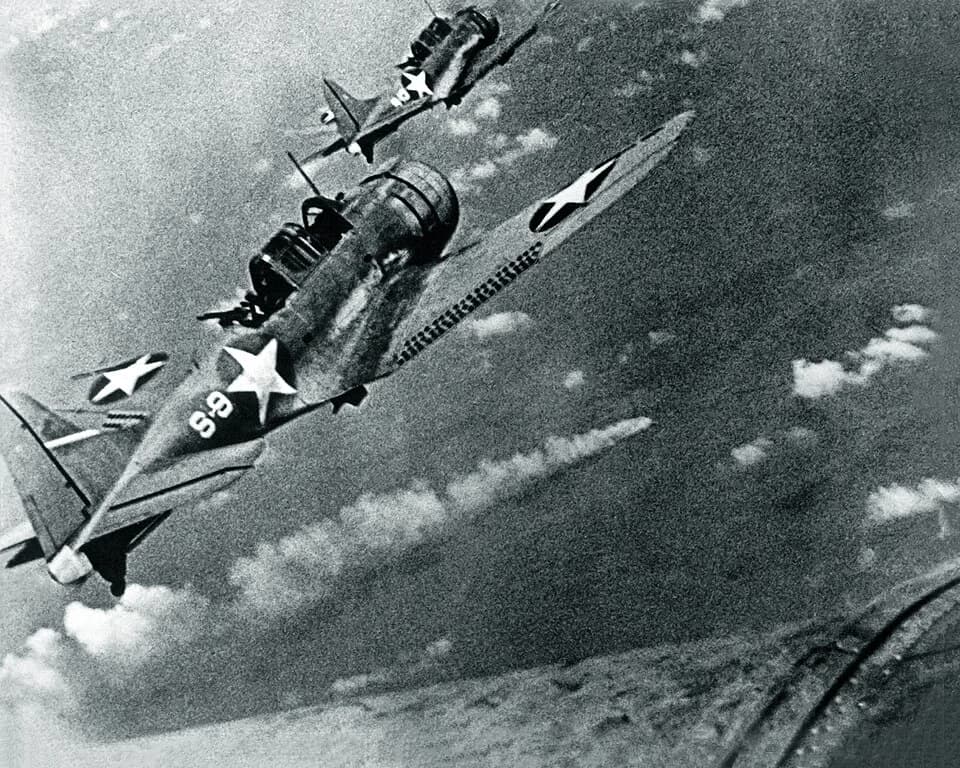
Battle of Midway
The Battle of Midway was the decisive turning point of the Pacific war, where the American navy inflicted a catastrophic defeat on the Japanese fleet by sinking four aircraft carriers, reversing the naval balance. From 4 to 7 June 1942, the decryption of Japanese communications allowed Admiral Nimitz to ambush a fleet that outnumbered his own.
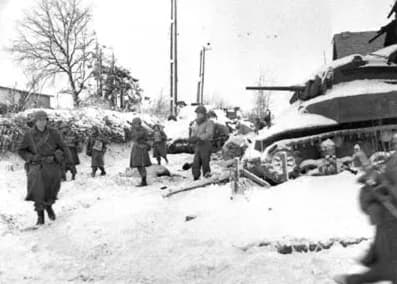
Battle of the Bulge
The Battle of the Bulge was the last major German offensive on the western front, a desperate attempt to break through Allied lines in the Belgian forests that failed against American resistance. Launched on 16 December 1944 under overcast skies that grounded Allied aircraft, it was broken by late January 1945.
