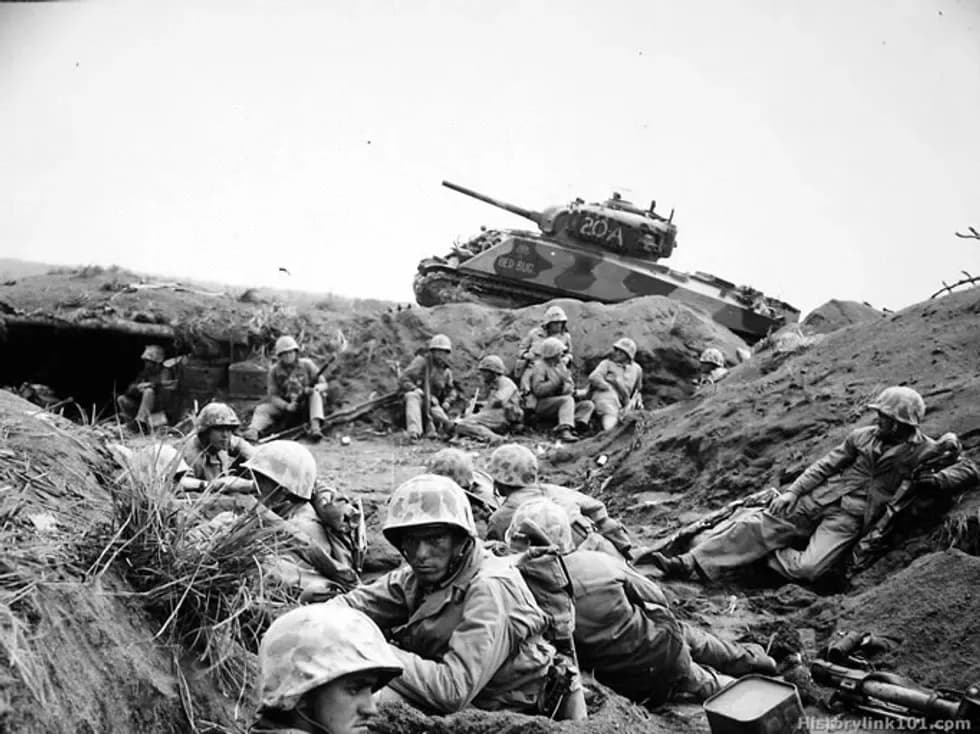
The Battle of Iwo Jima was among the bloodiest clashes of the Pacific theatre, pitting 70,000 US Marines against 21,000 Japanese defenders dug into an underground tunnel network on a small strategic volcanic island. From 19 February to 26 March 1945, the Japanese garrison fought almost to the last man: only a few hundred were taken prisoner.
By early 1945, the Pacific War was entering its final phase. American forces had recaptured the Philippines and the Mariana Islands, and B-29 bombers were already conducting raids on Japanese cities from bases on Saipan and Tinian. However, these bombers flew over 2,400 kilometers without fighter escort, suffering considerable losses against Japanese air defenses. Iwo Jima, a small volcanic island of only 21 square kilometers located midway between the Marianas and Tokyo, possessed three airfields that served as an advanced radar station warning Japan of imminent air raids and as a base for interceptor fighters. Capturing Iwo Jima would allow Americans to use these airfields as an escort base for P-51 Mustangs and as an emergency landing strip for damaged B-29s. Japanese General Tadamichi Kuribayashi, knowing no reinforcements would come, devised a revolutionary defense that abandoned the traditional banzai charge doctrine in favor of an extraordinary underground defensive system.
The American forces committed to Iwo Jima were substantial. The V Amphibious Corps, commanded by Major General Harry Schmidt, comprised three full Marine divisions: the 3rd, 4th, and 5th Marine Divisions, totaling approximately 70,000 men. This assault force was supported by one of the largest fleets ever assembled, including battleships, cruisers, and aircraft carriers that provided a three-day preliminary naval bombardment. Air support came from carrier-based aircraft and bombers from the Marianas. On the Japanese side, Lieutenant General Tadamichi Kuribayashi had approximately 21,000 defenders, including infantry troops, naval gunners, and engineering units. Kuribayashi had ordered the construction of a tunnel network stretching over 18 kilometers, connecting approximately 1,500 fortified positions, reinforced concrete pillboxes, buried bunkers, and converted natural caves. Mount Suribachi in the south and the northern plateau of the island were transformed into veritable underground fortresses with ventilation systems, water reserves, and ammunition stores for a prolonged siege.
On February 19, 1945, US Marines landed on the black volcanic sand beaches of Iwo Jima. Kuribayashi had ordered his troops to hold their fire during the first minutes of the landing, letting the Marines pile up on the narrow beaches before unleashing a devastating barrage of artillery and mortar fire. The loose volcanic sand made any movement extremely difficult; vehicles became mired and men struggled to dig foxholes that collapsed immediately. Casualties were horrific from the very first hours. Mount Suribachi, a dormant volcano dominating the southern beaches, became the first major objective. After four days of fierce fighting, a patrol from the 28th Marine Regiment reached the summit on February 23 and planted an American flag. A photograph of the second flag-raising, taken by Joe Rosenthal, became one of the most iconic images of the war. But the capture of Suribachi marked only the beginning of the most violent fighting. The island's northern plateau, riddled with fortified positions, required five additional weeks of combat using flamethrowers, grenades, and hand-to-hand fighting in the tunnels.
The turning point of the Battle of Iwo Jima was not a single event but rather a series of decisive moments that illustrated the relentless nature of this combat. The flag-raising on Mount Suribachi on February 23, 1945, constituted a major psychological turning point, not only for the Marines on the island but for the entire American nation. Joe Rosenthal's photograph, distributed worldwide, became a powerful symbol of American determination and galvanized public support for the war effort in the Pacific. On the ground, the true tactical turning point came when the Marines adapted their combat methods to Japanese underground defenses. The massive use of flamethrowers, both infantry-carried and mounted on modified Sherman tanks, proved to be the most effective weapon for neutralizing fortified positions. Demolition teams developed techniques for sealing tunnel entrances with explosives and napalm, progressively depriving the defenders of their underground communication lines. The capture of Airfield Number Two in the center of the island allowed the Americans to fragment the Japanese defense.
The consequences of the Battle of Iwo Jima were profound on both military and symbolic levels. In terms of casualties, the toll was terrifying: approximately 6,800 US Marines were killed and nearly 19,200 wounded, making it one of the costliest battles in Marine Corps history. On the Japanese side, of the 21,000 defenders, only 216 were captured alive; all others perished in combat or committed suicide rather than surrender. Twenty-seven Medals of Honor were awarded for Iwo Jima, the most for any single battle in American history. Strategically, the island fulfilled its intended role: before the war's end, 2,251 B-29 bombers made emergency landings on Iwo Jima, potentially saving the lives of some 24,000 crew members. P-51 fighters could now escort B-29s all the way to Japan. However, the horrific cost of the battle profoundly influenced planning for the invasion of Japan and contributed to the decision to use atomic bombs on Hiroshima and Nagasaki.
Approximately 70,000 US Marines from the V Amphibious Corps fought 21,000 Japanese defenders entrenched in a tunnel network stretching over 18 kilometers. The Marines suffered approximately 6,800 killed and 19,200 wounded. On the Japanese side, of 21,000 defenders, only 216 were captured alive; all others perished in combat or committed suicide. Twenty-seven Medals of Honor were awarded, the highest number for any single American battle.
Lieutenant General Tadamichi Kuribayashi commanded the Japanese garrison at Iwo Jima. Knowing no reinforcements would come, he abandoned traditional banzai charges in favor of a revolutionary underground defense: a network of 18 kilometers of tunnels connecting 1,500 fortified positions, reinforced concrete bunkers, and converted caves. This tactic forced the Marines to fight with flamethrowers and grenades for 36 days, from February 19 to March 26, 1945.
Iwo Jima, situated midway between the Mariana Islands and Tokyo, possessed three airfields the Japanese used as a radar warning station and interceptor base against B-29 raids. Controlling the island allowed P-51 Mustang fighters to escort B-29 bombers to Japan and provided an emergency landing strip. Before the war ended, 2,251 B-29s made emergency landings on Iwo Jima, potentially saving some 24,000 crew members.
Information cross-checked against Wikipedia and reference historical works.
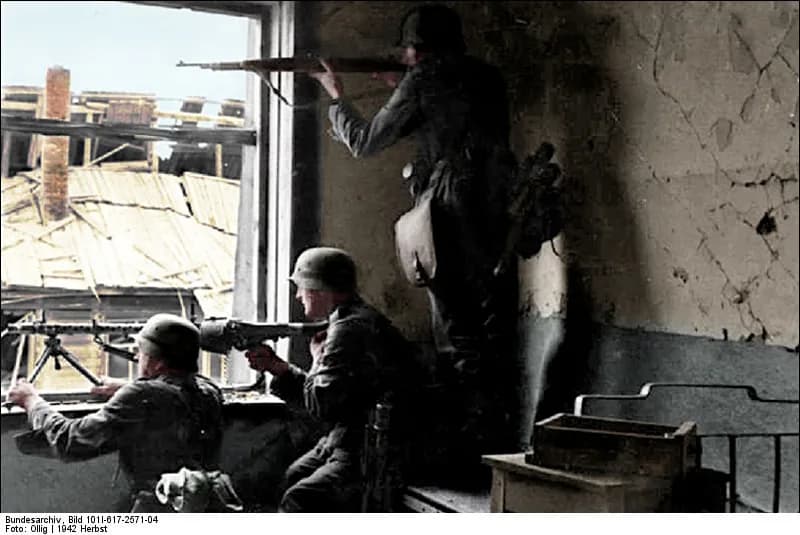
Battle of Stalingrad
The Battle of Stalingrad was among the deadliest clashes of World War II, pitting German and Soviet forces against each other in devastating urban combat that marked a decisive turning point on the Eastern Front. From 23 August 1942 to 2 February 1943, Operation Uranus encircled the German Sixth Army, whose roughly 91,000 survivors surrendered.
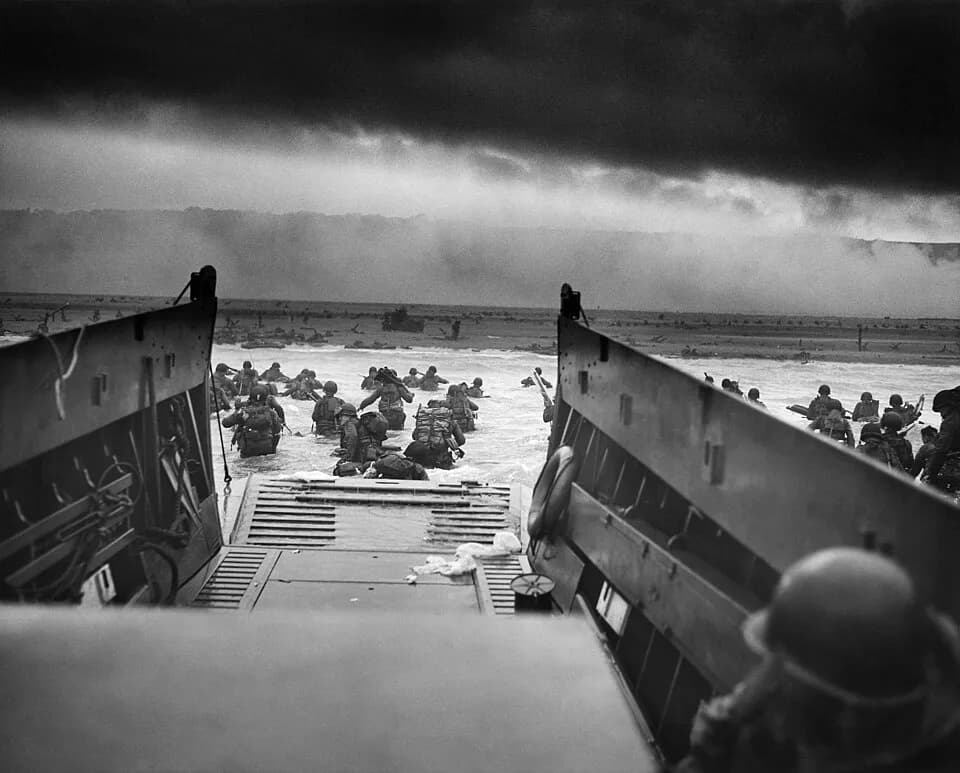
Normandy Landings
The Normandy landings, the largest amphibious operation in history, opened a second front in Western Europe on 6 June 1944, hastening the liberation of France and the defeat of Nazi Germany. Nearly 7,000 vessels put 156,000 men ashore on five beaches in a single day, under air cover and after months of deception meant to mislead the Wehrmacht.
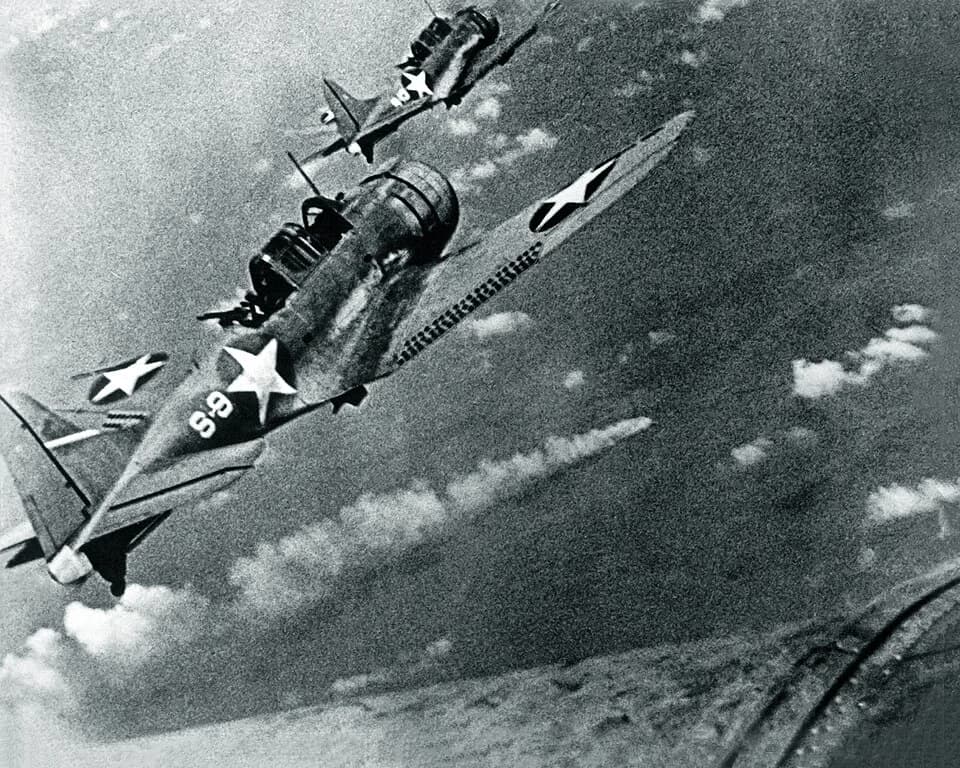
Battle of Midway
The Battle of Midway was the decisive turning point of the Pacific war, where the American navy inflicted a catastrophic defeat on the Japanese fleet by sinking four aircraft carriers, reversing the naval balance. From 4 to 7 June 1942, the decryption of Japanese communications allowed Admiral Nimitz to ambush a fleet that outnumbered his own.
Battle of the Bulge
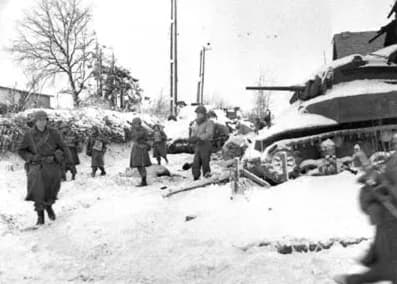
The Battle of the Bulge was the last major German offensive on the western front, a desperate attempt to break through Allied lines in the Belgian forests that failed against American resistance. Launched on 16 December 1944 under overcast skies that grounded Allied aircraft, it was broken by late January 1945.
