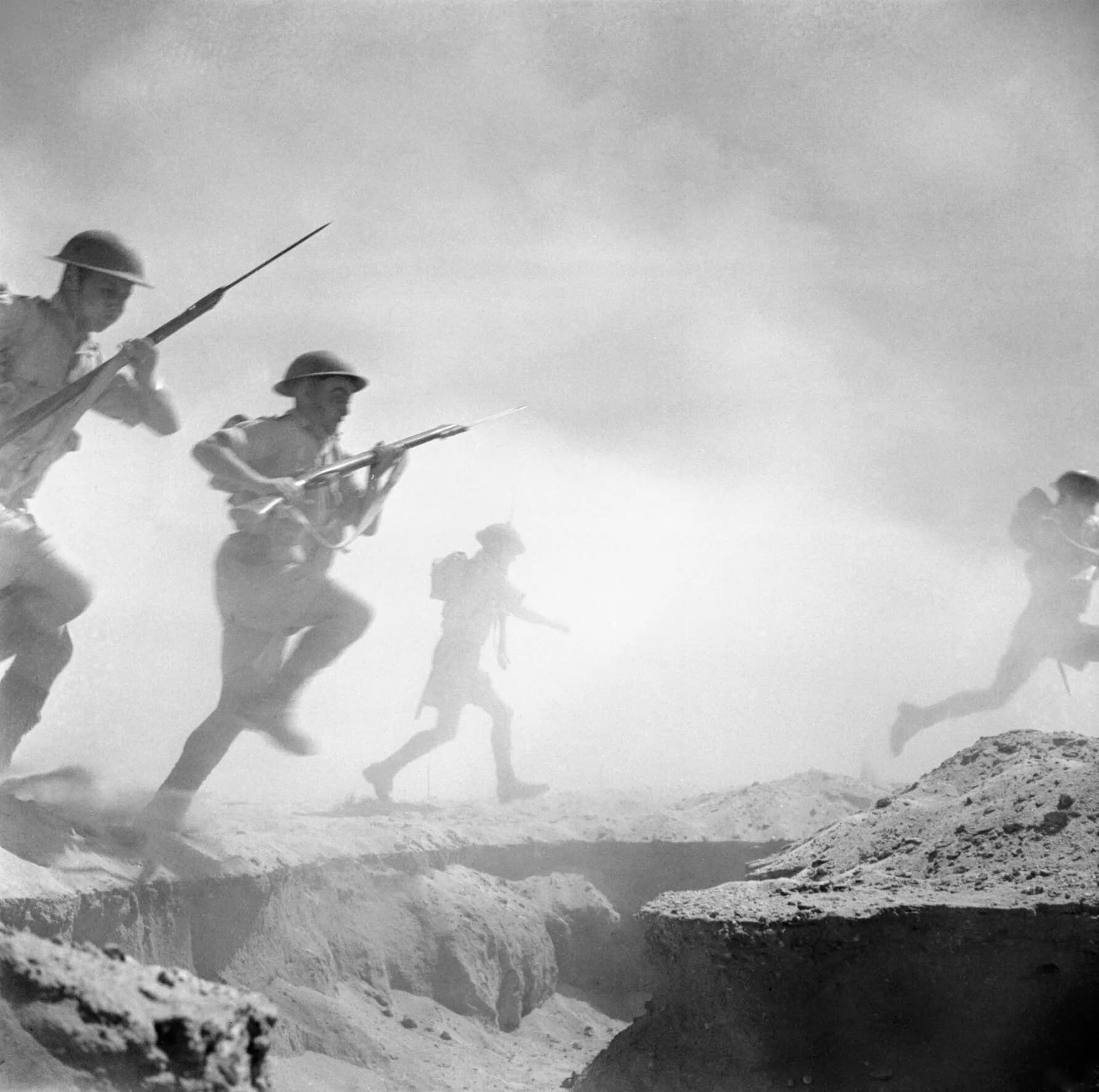
The second Battle of El Alamein was the decisive turning point of the North African campaign, where General Montgomery inflicted a major defeat on Rommel's Afrika Korps, opening the way to the liberation of North Africa. From 23 October to 11 November 1942, Allied superiority in tanks and fuel told on a front that could not be outflanked.
The Second Battle of El Alamein took place within the broader context of the North African campaign, which had been raging since Italy's entry into the war in June 1940. The Western Desert campaign had seen a dramatic series of advances and retreats across the Libyan and Egyptian deserts, with both sides suffering from the fundamental challenge of maintaining supply lines across vast stretches of inhospitable terrain. By the summer of 1942, Field Marshal Erwin Rommel's Afrika Korps and its Italian allies had pushed the British Eighth Army back to the El Alamein line, a narrow front of approximately 60 kilometers between the Mediterranean Sea to the north and the impassable Qattara Depression to the south. This geographic bottleneck prevented the kind of flanking maneuvers that had characterized earlier desert warfare and forced both sides into a more conventional positional battle. Rommel's advance had been spectacular but left his forces dangerously overextended, with supply lines stretching back over 1,500 kilometers to Tripoli. The Afrika Korps was chronically short of fuel, ammunition, and replacement vehicles, while the Royal Navy and Royal Air Force interdicted Axis supply convoys crossing the Mediterranean from Italy. In August 1942, Lieutenant General Bernard Montgomery was appointed commander of the Eighth Army, replacing the dismissed General Neil Ritchie. Montgomery was a meticulous planner and a master of set-piece battles, qualities ideally suited to the situation at El Alamein. He immediately set about rebuilding the morale and fighting capability of the Eighth Army, which had suffered a series of demoralizing defeats. Montgomery insisted that there would be no further retreats and began accumulating massive superiority in men, tanks, artillery, and supplies. Churchill pressured Montgomery for an early offensive, but Montgomery refused to attack until he was fully prepared, a decision that proved correct.
The forces engaged at the Second Battle of El Alamein reflected the growing Allied material superiority that would increasingly characterize the war from late 1942 onward. Montgomery's Eighth Army had been significantly reinforced and reorganized in the weeks preceding the battle. The British and Commonwealth forces numbered approximately 195,000 men organized into three corps. XXX Corps, the main assault force, comprised several infantry divisions including the veteran 51st Highland Division, the 2nd New Zealand Division, the 9th Australian Division, the 1st South African Division, and the 4th Indian Division. X Corps, the armored exploitation force, included the 1st and 10th Armoured Divisions. XIII Corps held the southern sector as a diversionary force. The Eighth Army possessed approximately 1,029 tanks, including 252 American-supplied M4 Sherman tanks that were superior to most Axis armor, along with hundreds of Crusader, Valentine, and Grant tanks. Artillery support was formidable, with approximately 900 field and medium guns capable of delivering devastating concentrated fire. The Desert Air Force provided approximately 530 operational aircraft, giving the Allies near-complete air superiority. On the Axis side, Rommel's Panzerarmee Afrika was significantly weaker in every category. The combined German and Italian forces numbered approximately 116,000 men, of whom roughly half were Italian troops whose equipment and motivation varied considerably. The Axis possessed approximately 547 tanks, but only about 211 were German models, including 30 Panzer IV Specials with the long-barreled 75mm gun capable of engaging Allied tanks at range. The remaining tanks were Italian M13/40 and M14/41 models, largely obsolete and mechanically unreliable. Axis artillery numbered approximately 552 guns, and air support comprised roughly 340 aircraft, many of which were Italian models of limited effectiveness. Critically, Rommel's forces suffered from severe fuel shortages, with supplies barely adequate for ten days of normal operations, severely limiting the mobility that had been the Afrika Korps' greatest tactical asset.
The Second Battle of El Alamein began on the night of October 23, 1942, with one of the most devastating artillery barrages of the North African campaign. At 9:40 PM, approximately 900 British guns opened fire simultaneously along the entire front, targeting known Axis positions, artillery batteries, and communication lines in a carefully planned bombardment that lasted over five hours. Under cover of this barrage, infantry of XXX Corps advanced into the deep Axis minefields, known as the Devil's Gardens, which Rommel had laid in elaborate defensive belts extending several kilometers in depth. Sappers worked under fire to clear paths through the mines, marking corridors for the following armor. The initial infantry assault achieved mixed results, with some divisions making good progress while others were held up by stubborn resistance and the sheer density of the minefields. The plan called for X Corps' armor to pass through the cleared corridors and break out into open desert beyond the minefields, but the armored advance was slowed by congestion, mines, and anti-tank fire. Rommel was not present at the start of the battle, having returned to Germany for medical treatment, and his temporary replacement, General Georg Stumme, died of a heart attack during the first day of fighting. Rommel hurried back to take command on October 25 and immediately launched counterattacks, but these were broken up by the overwhelming British artillery and air superiority. Montgomery adapted his plan in response to the initial difficulties, shifting the main axis of attack northward in a series of operations codenamed Supercharge, launched on November 2. This assault, spearheaded by the 2nd New Zealand Division and the 9th Armoured Brigade, broke through the final Axis defensive positions at a heavy cost, with the 9th Armoured Brigade losing 75 percent of its tanks. However, the breakthrough was achieved, and Rommel, recognizing that his forces faced annihilation, ordered a retreat on November 3 despite Hitler's famous order to stand and die. The Axis withdrawal became a long retreat westward across Libya and into Tunisia, with the Eighth Army pursuing but unable to cut off and destroy Rommel's forces due to heavy rains and logistical constraints.
The Second Battle of El Alamein constituted a fundamental turning point not only in the North African campaign but in the entire trajectory of the war. Winston Churchill famously declared that before El Alamein the Allies never had a victory, and after El Alamein they never had a defeat, a statement that while somewhat exaggerated captured the psychological and strategic significance of the battle. El Alamein was the first major land victory by British and Commonwealth forces over the Germans in the war, coming after years of setbacks that included the fall of France, the disasters in Greece and Crete, the loss of Singapore, and the humiliating defeats in the Western Desert at the hands of Rommel. The victory restored British military prestige and demonstrated that properly led, equipped, and prepared Commonwealth forces could defeat the Wehrmacht in a major engagement. Montgomery's methodical approach to battle, emphasizing overwhelming firepower, meticulous planning, and the refusal to attack until conditions were favorable, stood in contrast to the improvised and often reckless offensives that had characterized earlier British operations in the desert. The battle demonstrated the growing importance of material superiority in modern warfare, as the Eighth Army's advantages in tanks, artillery, aircraft, and supplies proved decisive against Rommel's tactical brilliance. The timing of El Alamein was particularly significant, coming just two weeks before the Allied landings in French North Africa, Operation Torch, on November 8, 1942. Together, these two operations created a strategic pincer that trapped Axis forces in Tunisia and led to the surrender of approximately 250,000 German and Italian soldiers in May 1943. The North African victory opened the way for the Allied invasion of Sicily and Italy, establishing a second front in the Mediterranean that diverted German resources from the Eastern Front and contributed to the overall Allied strategy of wearing down German strength before the cross-Channel invasion of France.
The consequences of the Second Battle of El Alamein extended far beyond the immediate military results in North Africa. The Axis defeat at El Alamein, combined with the Allied landings in Morocco and Algeria two weeks later, fundamentally altered the strategic balance in the Mediterranean and set in motion a chain of events that would lead to the collapse of Fascist Italy and the opening of a southern front in Europe. Rommel's retreat from El Alamein covered over 2,000 kilometers westward through Libya and into Tunisia, where Axis forces made a final stand before surrendering in May 1943. The total Axis losses in the North African campaign amounted to over 620,000 men killed, wounded, or captured, including the entire Afrika Korps and several Italian divisions. For the British Empire and Commonwealth, the victory at El Alamein was of immense psychological importance. Church bells were rung across Britain for the first time since the war began, and the victory provided a desperately needed boost to civilian and military morale. Montgomery became a national hero and one of the most recognized British military figures of the war. The battle also cemented the British partnership with Commonwealth nations, whose troops from Australia, New Zealand, South Africa, and India had played crucial roles in the fighting. The strategic consequences were equally significant. Control of North Africa secured the southern shore of the Mediterranean, protecting Allied shipping routes to the Suez Canal and beyond to India and the Far East. The elimination of the Axis threat to Egypt ensured the security of the vital Middle Eastern oil fields that fueled the Allied war machine. The North African victory also provided invaluable combat experience for Allied forces and commanders who would go on to fight in Sicily, Italy, and eventually Normandy. Lessons learned at El Alamein regarding combined arms coordination, mine clearing operations, and the integration of air power with ground operations directly influenced Allied operational doctrine for the remainder of the war.
This article draws on historical works, military archives and recognized academic publications.
The Second Battle of El Alamein took place from October 23 to November 11, 1942, in Egypt, along a front of approximately 60 kilometers between the Mediterranean Sea and the Qattara Depression. General Bernard Montgomery commanded the British Eighth Army against Erwin Rommel's Panzerarmee Afrika.
Montgomery's Eighth Army fielded approximately 195,000 men and 1,029 tanks (including 252 American Shermans), against 116,000 men and 547 tanks on the Axis side. The British won: Rommel ordered retreat on November 3 despite Hitler's stand-and-die order. Axis losses for the entire North African campaign exceeded 620,000 men killed, wounded, or captured.
El Alamein was the first major British land victory over the Germans in two years of war. It halted the Axis advance toward the Suez Canal and Middle Eastern oil fields. Combined with Allied landings in North Africa on November 8, 1942 (Operation Torch), it trapped Axis forces in Tunisia, leading to their surrender in May 1943 with 250,000 prisoners.
Information cross-checked against Wikipedia and reference historical works.
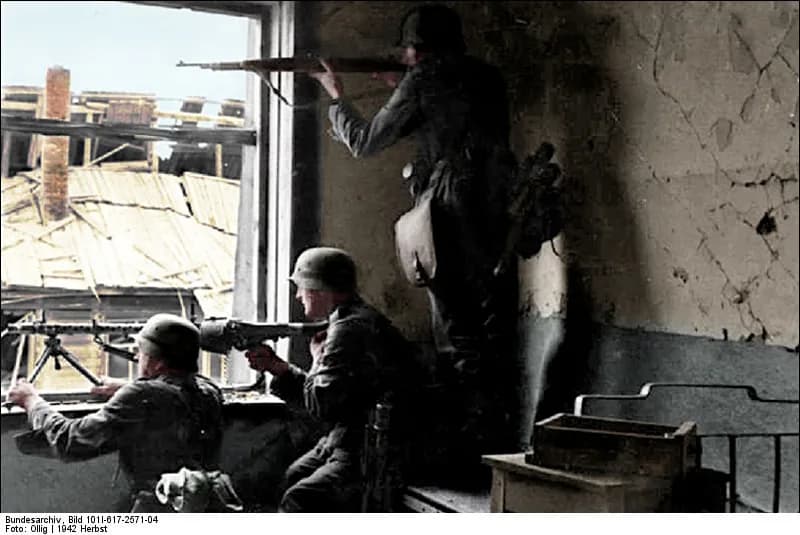
Battle of Stalingrad
The Battle of Stalingrad was among the deadliest clashes of World War II, pitting German and Soviet forces against each other in devastating urban combat that marked a decisive turning point on the Eastern Front. From 23 August 1942 to 2 February 1943, Operation Uranus encircled the German Sixth Army, whose roughly 91,000 survivors surrendered.
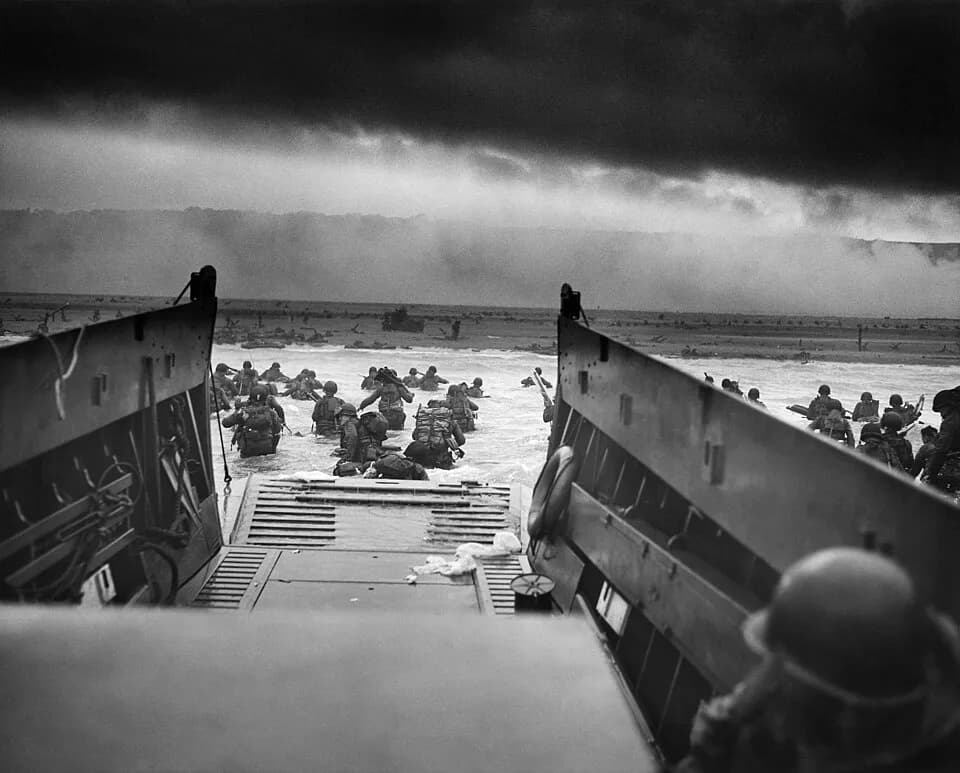
Normandy Landings
The Normandy landings, the largest amphibious operation in history, opened a second front in Western Europe on 6 June 1944, hastening the liberation of France and the defeat of Nazi Germany. Nearly 7,000 vessels put 156,000 men ashore on five beaches in a single day, under air cover and after months of deception meant to mislead the Wehrmacht.
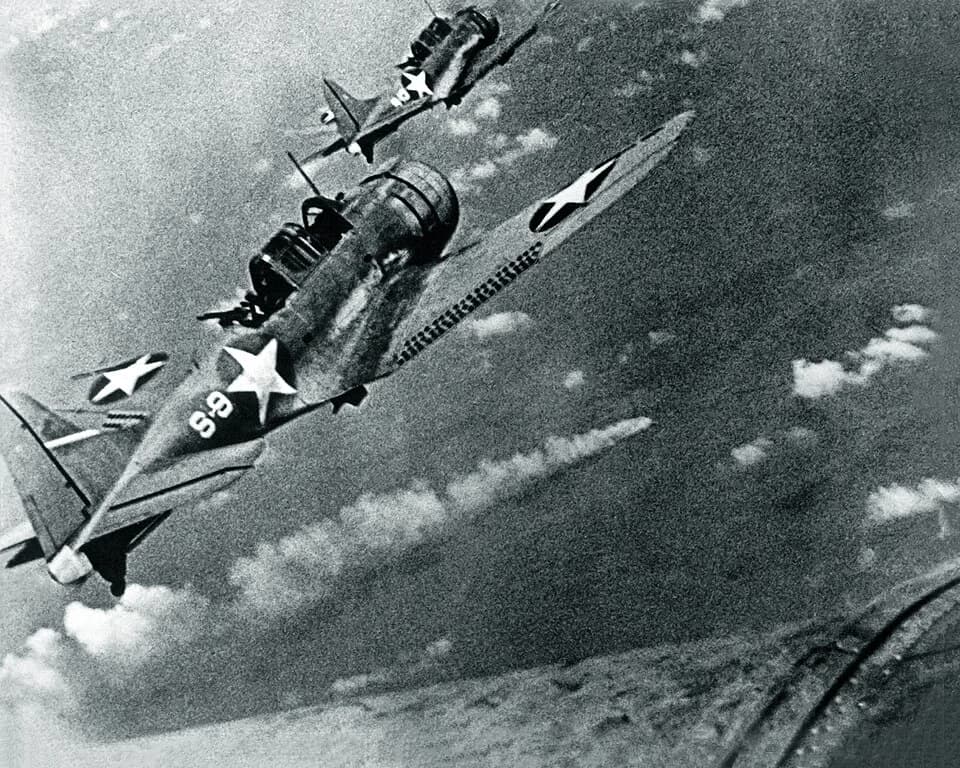
Battle of Midway
The Battle of Midway was the decisive turning point of the Pacific war, where the American navy inflicted a catastrophic defeat on the Japanese fleet by sinking four aircraft carriers, reversing the naval balance. From 4 to 7 June 1942, the decryption of Japanese communications allowed Admiral Nimitz to ambush a fleet that outnumbered his own.
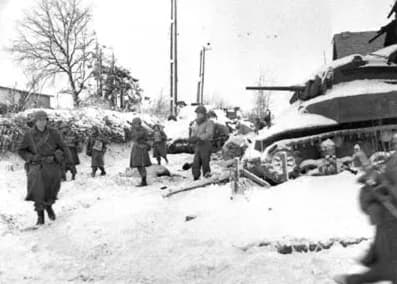
Battle of the Bulge
The Battle of the Bulge was the last major German offensive on the western front, a desperate attempt to break through Allied lines in the Belgian forests that failed against American resistance. Launched on 16 December 1944 under overcast skies that grounded Allied aircraft, it was broken by late January 1945.
