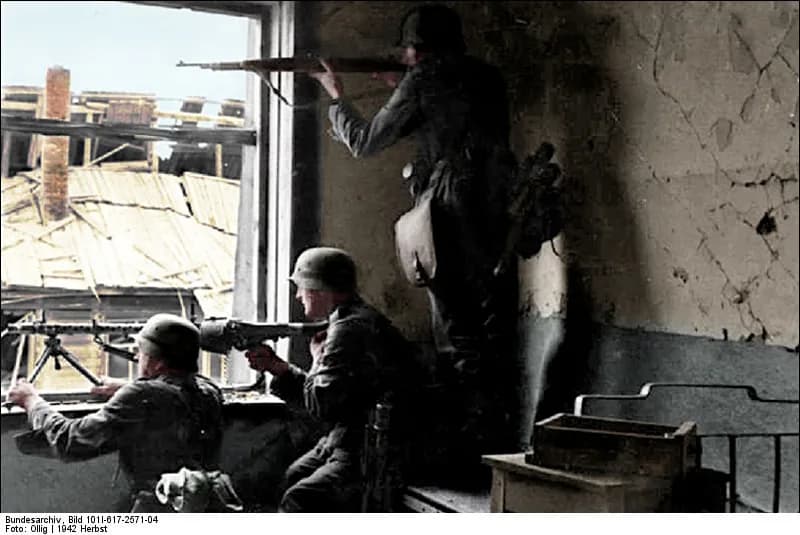
The Battle of Stalingrad was among the deadliest clashes of World War II, pitting German and Soviet forces against each other in devastating urban combat that marked a decisive turning point on the Eastern Front. From 23 August 1942 to 2 February 1943, Operation Uranus encircled the German Sixth Army, whose roughly 91,000 survivors surrendered.
The Battle of Stalingrad emerged from Germany's summer offensive of 1942, known as Case Blue (Fall Blau). Following the failure to capture Moscow during the winter of 1941-1942, Adolf Hitler redirected the Wehrmacht's strategy toward the southern Soviet Union. The primary objective was to seize the oil fields of the Caucasus, essential for the German war effort, while securing the flank along the Volga River. Stalingrad, a major industrial city bearing the name of Soviet leader Joseph Stalin, became both a strategic and symbolic objective. The city was a major center of armaments production and a vital communications hub on the Volga, the principal river route connecting southern and central Russia. For Stalin, losing the city that bore his name would have been a devastating blow to Soviet morale. For Hitler, capturing Stalingrad represented not only a considerable logistical advantage but also a major propaganda victory. The German Sixth Army, commanded by General Friedrich Paulus, was tasked with taking the city while the Fourth Panzer Army was to support the offensive from the south. Soviet forces, under the overall command of Vasily Chuikov for the city's defense, prepared for fierce resistance. The broader geopolitical context showed a Germany that needed rapid victories to maintain its dominance in Europe, while the Soviet Union was progressively mobilizing its immense human and industrial reserves, relocated east of the Urals. The Soviets had learned from the defeats of 1941 and were developing new defensive tactics that would be tested in the ruins of Stalingrad. The civilian population of the city, estimated at approximately 400,000 before the war, had only been partially evacuated, and tens of thousands of civilians would find themselves trapped in the inferno of urban combat.
The fighting for Stalingrad truly began on August 23, 1942, when the Luftwaffe launched a massive bombardment that transformed the city into a landscape of ruins. The air raids killed thousands of civilians and destroyed much of the urban infrastructure, but paradoxically, the rubble created terrain favorable to Soviet defenders. The German Sixth Army penetrated the city's outskirts in early September and engaged in what would become one of the fiercest urban battles in military history. The Soviets adopted close-quarters combat tactics, dubbed the Rattenkrieg or war of the rats by the Germans, keeping front lines as close as possible to the enemy to neutralize German air and artillery superiority. Every building, every floor, every room became a battlefield. Pavlov's House, an apartment building defended by a small group of Soviet soldiers for 60 days, became the symbol of this fierce resistance. The city's factories, particularly the Tractor Factory, the Barricades Factory, and the Red October Factory, were the scene of unprecedented violence. Workers sometimes continued producing T-34 tanks that rolled directly off the assembly lines into combat. Soviet reinforcements crossed the Volga at night under enemy fire, suffering heavy losses. General Chuikov established his headquarters on the western bank of the Volga, a few hundred meters from German lines, refusing to yield an inch of ground. Soviet snipers, including the famous Vasily Zaitsev, inflicted considerable casualties on the Germans and undermined their morale. Over the weeks, the Germans advanced slowly, at one point controlling more than 90 percent of the city, but could never completely eliminate Soviet resistance along the Volga. Meanwhile, the Soviet high command, under the direction of Georgy Zhukov and Alexander Vasilevsky, was secretly preparing a massive counteroffensive.
The forces engaged in the Battle of Stalingrad were considerable on both sides. On the German side, General Friedrich Paulus's Sixth Army constituted the spearhead of the offensive. This army initially numbered approximately 270,000 men, organized into several corps comprising infantry divisions and armored units. General Hermann Hoth's Fourth Panzer Army supported the offensive from the south. Added to these German forces were Axis allied contingents, notably the Third Romanian Army to the north and the Fourth Romanian Army to the south, as well as Italian and Hungarian units. These allied armies, less well-equipped and less motivated than German troops, held the flanks of the penetration toward Stalingrad, a weakness the Soviets would exploit decisively. The Luftwaffe committed Fliegerkorps VIII under General Wolfram von Richthofen, which had approximately 1,000 aircraft at the beginning of the offensive. On the Soviet side, General Vasily Chuikov's 62nd Army was the main defensive force inside the city. Sometimes reduced to a few thousand effective combatants, it received constant reinforcements across the Volga. General Mikhail Shumilov's 64th Army defended the southern sector of the city. For the counteroffensive, codenamed Operation Uranus and launched on November 19, 1942, the Soviets assembled more than one million men, 13,500 guns, 894 tanks, and 1,115 aircraft, organized into three fronts commanded by Generals Nikolai Vatutin, Andrei Yeremenko, and Konstantin Rokossovsky. In total, it is estimated that more than two million combatants participated in the overall battle, making Stalingrad one of the most massive military engagements in history. Material losses were also astronomical, with thousands of tanks, guns, and aircraft destroyed on both sides.
The consequences of the Battle of Stalingrad were immense on military, political, and psychological levels. Militarily, the destruction of the German Sixth Army represented the greatest defeat suffered by the Wehrmacht since the beginning of the war. Approximately 91,000 German and allied soldiers were captured during the capitulation of February 2, 1943, including Field Marshal Friedrich Paulus himself, the first German field marshal in history to surrender to the enemy. Of the 91,000 prisoners, only approximately 5,000 survived captivity and returned to Germany after the war, most succumbing to disease, malnutrition, and detention conditions in Soviet camps. Total German and allied losses for the entire battle are estimated between 700,000 and 800,000 men, including killed, wounded, captured, and missing. Soviet losses were even higher, with estimates varying between 1.1 and 1.5 million military casualties, plus tens of thousands of civilians killed. The city itself was almost entirely destroyed, leaving only smoking ruins. Strategically, Stalingrad marked the beginning of the German retreat on the Eastern Front. Strategic initiative passed definitively into Soviet hands, and they never relinquished it until the fall of Berlin in 1945. The battle forced Germany to mobilize considerable resources to stabilize the front, weakening its capabilities on other theaters of operation. Politically, the Soviet victory considerably strengthened the Soviet Union's prestige among the Allies and resistance movements in occupied Europe. It demonstrated that the Wehrmacht was not invincible and gave immense hope to peoples under Nazi occupation. In Germany, despite Goebbels's propaganda attempting to transform the defeat into a heroic sacrifice, the shock ran deep among the population and marked the beginning of growing doubt about the war's outcome.
The legacy of the Battle of Stalingrad extends far beyond military history to become part of the collective world memory. In Russia, Stalingrad holds a central place in the national narrative of the Great Patriotic War. The city, renamed Volgograd in 1961 during Khrushchev's de-Stalinization campaign, houses the monumental Mamayev Kurgan memorial complex, a hill that was one of the most contested points of the battle. The Motherland Calls statue, standing 85 meters tall, dominates this memorial and constitutes one of the most impressive monuments in the world dedicated to World War II. Every year, commemorative ceremonies bring together thousands of people, and February 2 is a solemn date in the Russian calendar. In terms of military art, Stalingrad has become an essential case study in all military academies worldwide. The battle illustrates the dangers of logistical overextension, the importance of flank protection, the value of defense in depth, and the possibilities offered by large-scale encirclement operations. Operation Uranus is considered a masterpiece of Soviet operational planning, demonstrating the Red Army's capacity to conduct complex and coordinated offensive operations. The urban combat tactics developed by the Soviets at Stalingrad influenced modern military doctrine, particularly regarding operations in urban environments. In popular culture, Stalingrad has inspired numerous literary, cinematic, and gaming works. Vasily Grossman's novel Life and Fate offers a masterful account of the battle. Films such as Joseph Vilsmaier's Stalingrad in 1993 and Jean-Jacques Annaud's Enemy at the Gates in 2001 have helped keep alive the memory of this titanic confrontation. The battle has also become a universal metaphor for fierce combat, a point of no return, or total commitment. The expression a Stalingrad has entered the common vocabulary of many languages to evoke a catastrophic defeat or a fight to the last breath.
This article draws on historical works, military archives and recognized academic publications.
On February 2, 1943, approximately 91,000 German and allied soldiers surrendered at Stalingrad, including Field Marshal Friedrich Paulus — the first German field marshal in history to surrender. Of these 91,000 prisoners, only approximately 5,000 survived Soviet captivity and returned to Germany after the war. Total German losses for the entire Battle of Stalingrad are estimated at between 700,000 and 800,000 men.
Operation Uranus, launched November 19, 1942, by Generals Vatutin, Yeremenko, and Rokossovsky, committed over one million Soviet soldiers, 13,500 guns, and 894 tanks. It struck the weak flanks held by Romanian armies north and south of Stalingrad. Within four days, the Soviet pincers met at Kalach-on-Don, completely encircling Paulus's 6th Army (approximately 300,000 men) in what the Germans called the Kessel (cauldron).
The Battle of Stalingrad (August 23, 1942 - February 2, 1943) was the turning point because, for the first time, a major German army was completely destroyed. Strategic initiative passed permanently to the Soviets — they never relinquished it until the fall of Berlin in 1945. Psychologically in Germany, the shock ran deep: Goebbels tried to present the defeat as a heroic sacrifice, but confidence in final victory began to collapse.
Information cross-checked against Wikipedia and reference historical works.
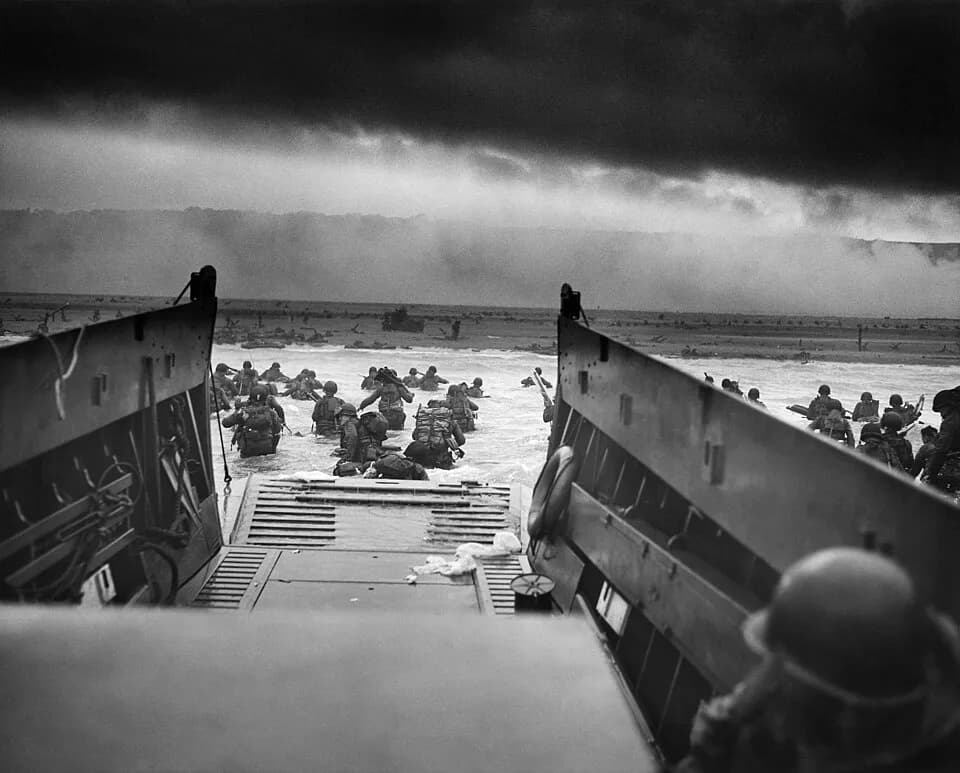
Normandy Landings
The Normandy landings, the largest amphibious operation in history, opened a second front in Western Europe on 6 June 1944, hastening the liberation of France and the defeat of Nazi Germany. Nearly 7,000 vessels put 156,000 men ashore on five beaches in a single day, under air cover and after months of deception meant to mislead the Wehrmacht.
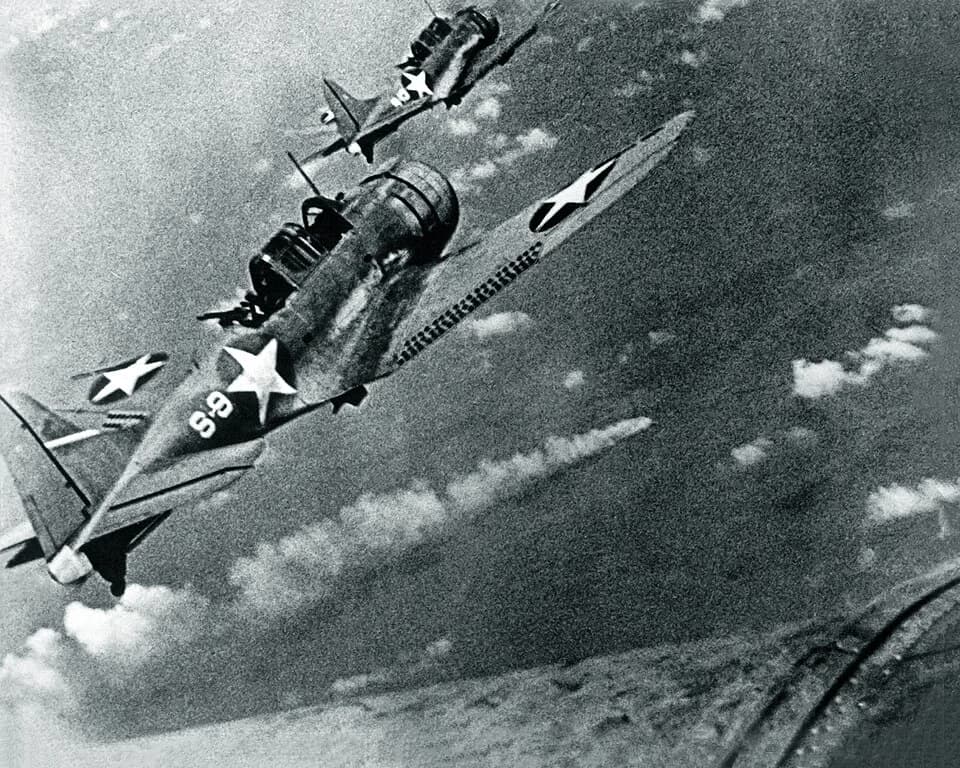
Battle of Midway
The Battle of Midway was the decisive turning point of the Pacific war, where the American navy inflicted a catastrophic defeat on the Japanese fleet by sinking four aircraft carriers, reversing the naval balance. From 4 to 7 June 1942, the decryption of Japanese communications allowed Admiral Nimitz to ambush a fleet that outnumbered his own.
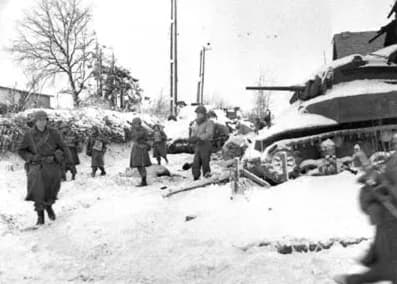
Battle of the Bulge
The Battle of the Bulge was the last major German offensive on the western front, a desperate attempt to break through Allied lines in the Belgian forests that failed against American resistance. Launched on 16 December 1944 under overcast skies that grounded Allied aircraft, it was broken by late January 1945.
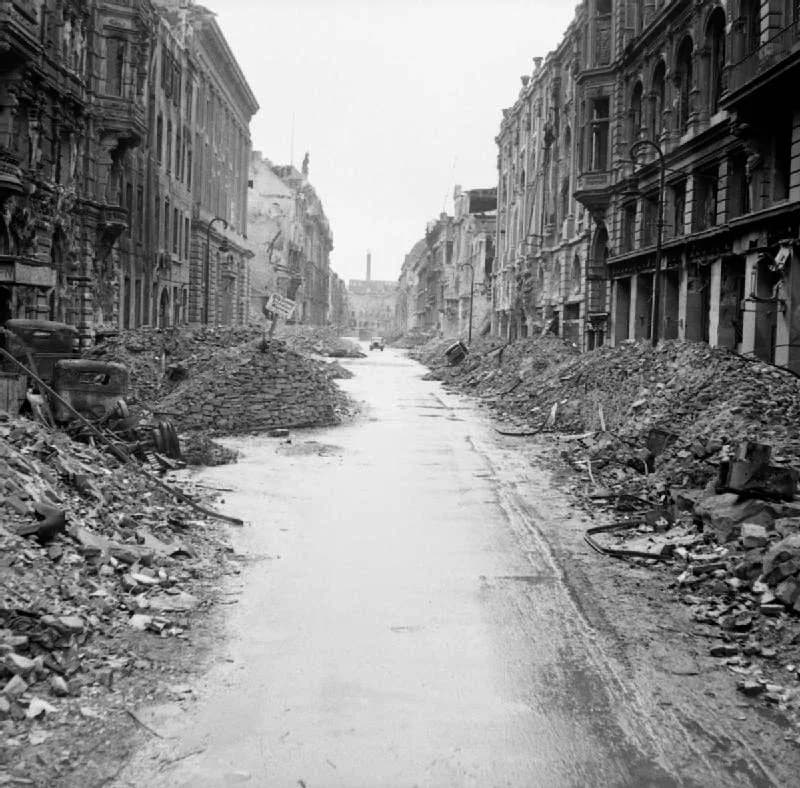
Battle of Berlin
The Battle of Berlin was the final Soviet assault on the capital of the Third Reich, a massive operation involving over two million soldiers that ended the war in Europe with the fall of the Nazi regime. From 16 April to 2 May 1945, the Red Army encircled and then reduced the city street by street; Hitler took his own life in his bunker on 30 April.
