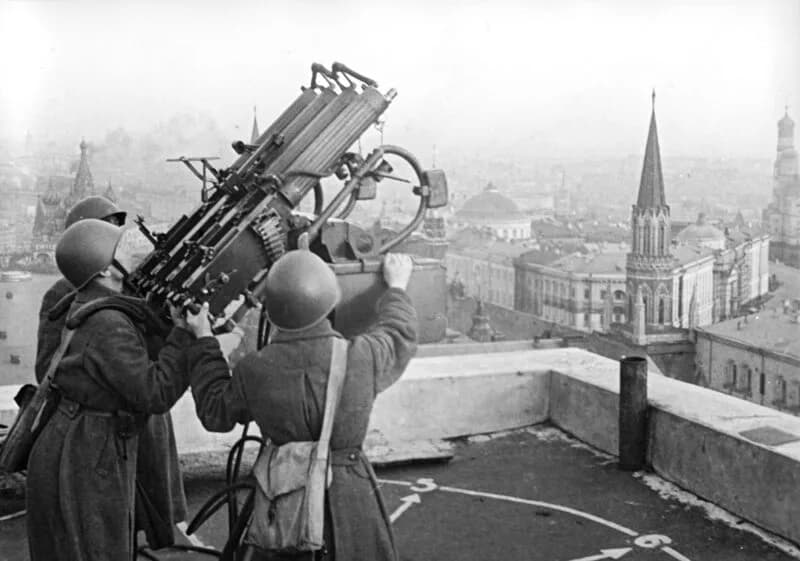
The Battle of Moscow marked the Wehrmacht's first major strategic failure of World War II. Operation Typhoon, launched to take the Soviet capital before winter, ended with a devastating Soviet counteroffensive that pushed the Germans back over 100 kilometres. It ended the myth of an invincible German army.
Operation Typhoon was an extension of Operation Barbarossa, the invasion of the Soviet Union launched on June 22, 1941. After lightning advances during the summer, German forces had destroyed immense Soviet armies in the encirclement battles of Bialystok-Minsk, Smolensk, and Kiev. However, these tactical victories had consumed precious time. Hitler had ordered a diversion of forces southward in August to capture Kiev and Ukraine, delaying the offensive on Moscow by several weeks. This delay would prove fatal. When Operation Typhoon was finally launched on October 2, 1941, the Russian autumn had begun, bringing the torrential rains of the rasputitsa, that period of mud which transformed unpaved Russian roads into impassable swamps. Army Group Center, commanded by Field Marshal Fedor von Bock, had considerable forces at its disposal: three panzer armies and three infantry armies totaling approximately 1.9 million men, 1,700 tanks, and 14,000 guns. Facing them, the Soviet Western, Reserve, and Bryansk Fronts, under the command of several generals including Ivan Konev and Semyon Budyonny, fielded approximately 1.25 million soldiers, though many were poorly trained reservists. Stalin, long incredulous in the face of warnings from his intelligence services, notably those from the famous spy Richard Sorge in Japan, was only beginning to organize the defense in depth of the capital. Moscow, the nerve center of the Soviet rail network and the country's administrative heart, represented an objective whose fall could have been decisive.
The first weeks of Operation Typhoon were catastrophic for the Soviets. The encirclement battles of Vyazma and Bryansk in early October captured over 660,000 Soviet soldiers and seemed to open the road to Moscow. Panic briefly seized the capital on October 16, 1941, when government offices began evacuating and rumors of imminent fall spread. However, Stalin decided to remain in Moscow, a decision that galvanized resistance. General Georgy Zhukov, recalled from the Leningrad front, took command of Moscow's defense on October 10. The autumn rasputitsa considerably slowed the German advance in October and early November, turning roads into quagmires where tanks and trucks became mired. When the freeze arrived in mid-November, hardening the ground and allowing the advance to resume, temperatures plunged well below zero. German soldiers, equipped for a summer campaign because the general staff had planned for victory before winter, suffered terribly from the cold. Tank and vehicle engines refused to start, weapons jammed, and frostbite decimated the ranks. Despite these conditions, German forces reached Moscow's outskirts by late November, approaching within 30 kilometers of the Kremlin. Reconnaissance patrols from the 2nd Panzer Division reportedly even glimpsed the Kremlin towers through their binoculars. But the troops were exhausted, supply lines stretched over hundreds of kilometers, and reserves nonexistent. On December 5, 1941, Zhukov launched his counteroffensive with fresh divisions, including battle-hardened Siberian troops transferred from the Far Eastern front after Sorge confirmed that Japan would not attack the USSR. This counteroffensive struck the Germans along a 1,000-kilometer front, pushing them back 100 to 250 kilometers from Moscow.
The forces engaged in the Battle of Moscow were colossal. The German Army Group Center, the Wehrmacht's most powerful formation, comprised General Heinz Guderian's 2nd Panzer Army, General Hermann Hoth's 3rd Panzer Army, General Erich Hoepner's 4th Panzer Army, as well as the 4th and 9th Infantry Armies. In total, approximately 1.9 million German soldiers, supported by 1,700 tanks, 14,000 artillery pieces, and approximately 1,390 aircraft of Luftflotte 2, participated in the initial offensive. These forces, though impressive on paper, were considerably weakened by four months of uninterrupted combat since the start of Barbarossa. Many infantry divisions had lost a third of their strength, and panzer divisions often had only half their tanks operational. On the Soviet side, the initial defense relied on the Western Front (General Konev, then Zhukov), Reserve Front (Marshal Budyonny), and Bryansk Front (General Yeremenko), totaling approximately 1.25 million men. After the disasters at Vyazma and Bryansk, Zhukov reconstituted the defense with strategic reserves, Moscow people's militia (opolchenie), and units transferred from Siberia and the Far East. For the December counteroffensive, the Soviets assembled approximately 1.1 million soldiers, 774 tanks, and 1,370 aircraft. The Siberian divisions, trained in winter combat and equipped with clothing suited to extreme cold, played a decisive role. In total, the Battle of Moscow mobilized over three million combatants on both sides, making this engagement one of the largest in military history to that date.
The Battle of Moscow had major strategic and psychological consequences. For the first time since the war began, the Wehrmacht suffered a setback of strategic proportions. The myth of German invincibility, forged by lightning victories in Poland, France, and during the first months of Barbarossa, shattered before Moscow. Hitler, furious, dismissed approximately thirty generals, including von Bock, Guderian, and Hoepner, personally assuming command of the army. This decision excessively centralized the conduct of operations and deprived the Wehrmacht of the tactical flexibility that had been its strength. Losses were considerable on both sides. The Germans lost approximately 248,000 men (killed, wounded, and missing) during Operation Typhoon, plus losses during the Soviet counteroffensive. The Soviets suffered even heavier losses, estimated at approximately 650,000 to 1 million military casualties for the entire battle. Strategically, the failure before Moscow meant that the war on the Eastern Front would not be a quick campaign but a prolonged war of attrition, a type of war that Germany, with its limited resources compared to the Soviet vastness, could not hope to win in the long term. Zhukov's counteroffensive, although it did not destroy Army Group Center, proved that the Red Army could conduct successful offensive operations and gave hope to all peoples fighting the Axis. The battle also strengthened Stalin's position, who gained confidence in his abilities as a war leader.
The Battle of Moscow holds a fundamental place in Russian collective memory and in the historiography of World War II. In Russia, it is commemorated as the moment when the existential threat facing the nation was repelled, and when the courage of the Soviet people triumphed over the Nazi war machine. The military parade of November 7, 1941 on Red Square, organized by Stalin while the Germans were less than 100 kilometers away, became one of the most powerful symbols of Soviet resistance. Soldiers paraded before Lenin's mausoleum before heading directly to the front, in a gesture of defiance that galvanized national morale. The title of 'Hero City' was bestowed upon Moscow, and numerous monuments commemorate the capital's defenders, notably the anti-tank hedgehog memorial at Khimki, marking the most advanced point reached by German forces. In military history, the Battle of Moscow is studied as a classic example of logistical overextension and the dangers of underestimating an adversary. The Wehrmacht's inability to prepare its troops for the Russian winter, combined with Hitler's strategic rigidity and Soviet resilience, offers enduring lessons. The figure of Zhukov, 'savior of Moscow,' acquired a legendary stature that only grew as the war progressed. The battle also demonstrated the importance of strategic reserves and territorial depth in modern warfare, confirming theories of attrition warfare that German planners had chosen to ignore.
This article draws on historical works, military archives and recognized academic publications.
Operation Typhoon failed for several combined reasons. The Kiev detour in August 1941, ordered by Hitler, delayed the offensive by several weeks, exposing troops to Russian winter without proper equipment. The rasputitsa (autumn mud) paralyzed armor in October. When the freeze arrived in mid-November, German soldiers — planned for a summer campaign — suffered frostbite and mechanical failures, while Zhukov launched his counteroffensive with Siberian divisions hardened to cold.
Siberian divisions transferred from the Far East were decisive in Zhukov's December 5, 1941 counteroffensive. Trained in winter combat and equipped for extreme cold, they struck along a 1,000 km front, pushing the Germans back 100 to 250 km from Moscow. The transfer was made possible by spy Richard Sorge's reports from Japan, confirming that Tokyo would not attack the USSR.
The failure before Moscow was the Wehrmacht's first major strategic setback. Hitler dismissed approximately thirty generals, including von Bock, Guderian, and Hoepner, and personally assumed command of the army. This excessive centralization deprived the Wehrmacht of its tactical flexibility. Psychologically, the myth of German invincibility shattered. Strategically, it became clear that the war in the East would be a prolonged war of attrition that Germany could not hope to win.
Information cross-checked against Wikipedia and reference historical works.
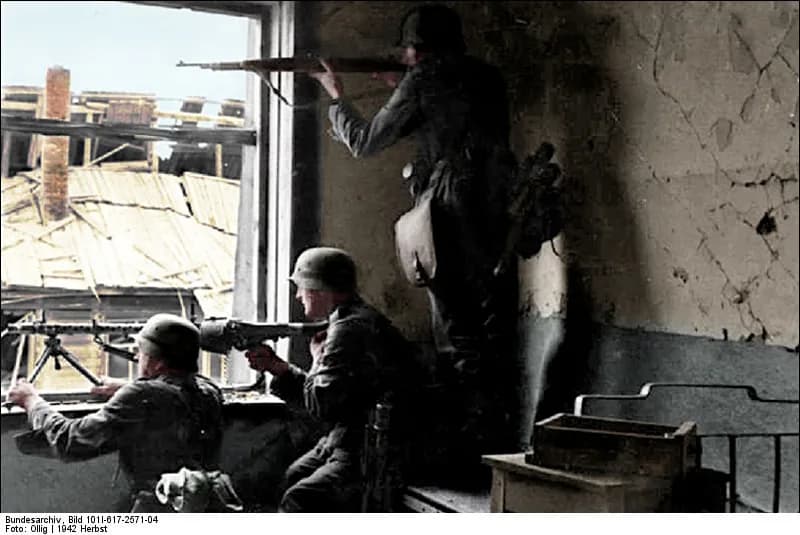
Battle of Stalingrad
The Battle of Stalingrad was among the deadliest clashes of World War II, pitting German and Soviet forces against each other in devastating urban combat that marked a decisive turning point on the Eastern Front. From 23 August 1942 to 2 February 1943, Operation Uranus encircled the German Sixth Army, whose roughly 91,000 survivors surrendered.
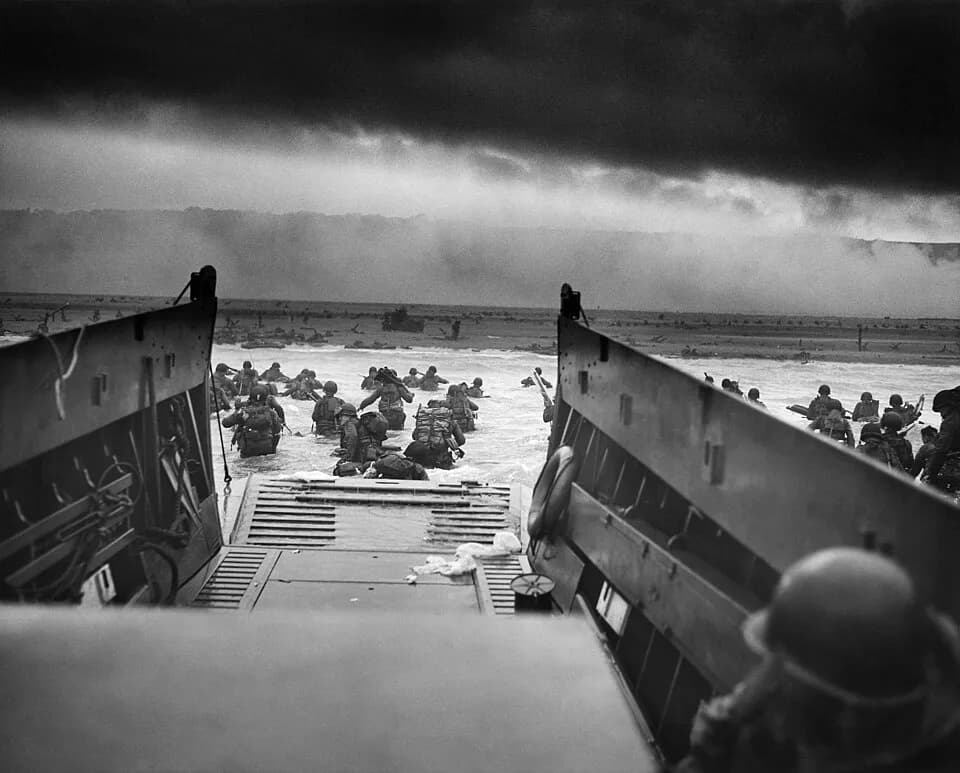
Normandy Landings
The Normandy landings, the largest amphibious operation in history, opened a second front in Western Europe on 6 June 1944, hastening the liberation of France and the defeat of Nazi Germany. Nearly 7,000 vessels put 156,000 men ashore on five beaches in a single day, under air cover and after months of deception meant to mislead the Wehrmacht.
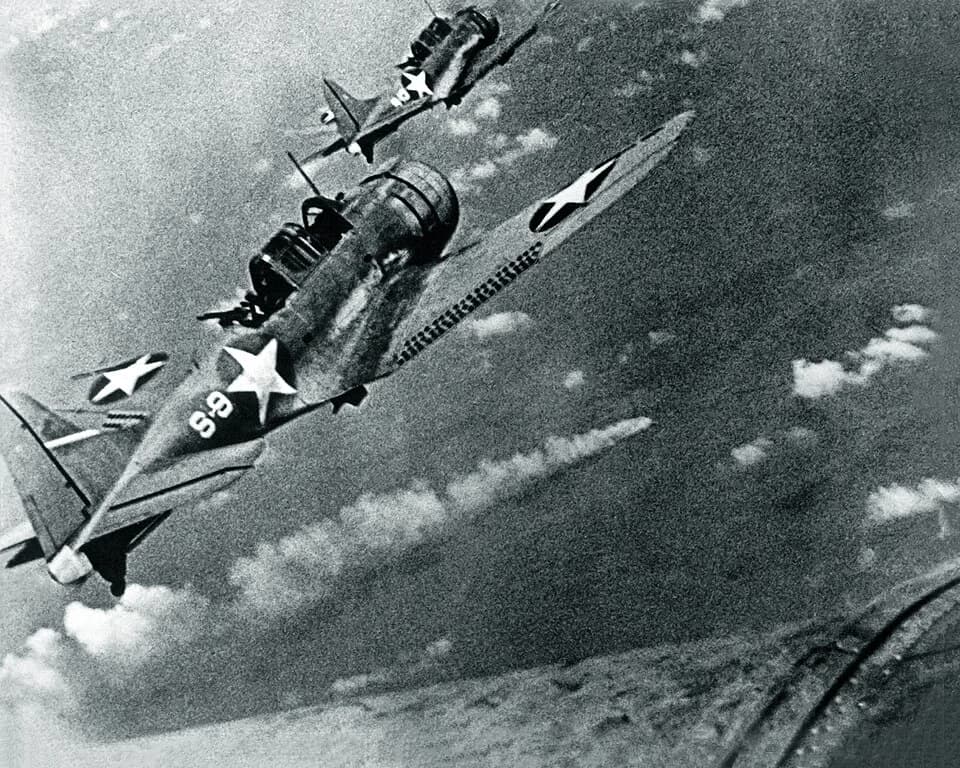
Battle of Midway
The Battle of Midway was the decisive turning point of the Pacific war, where the American navy inflicted a catastrophic defeat on the Japanese fleet by sinking four aircraft carriers, reversing the naval balance. From 4 to 7 June 1942, the decryption of Japanese communications allowed Admiral Nimitz to ambush a fleet that outnumbered his own.
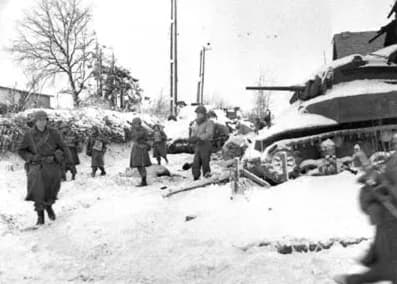
Battle of the Bulge
The Battle of the Bulge was the last major German offensive on the western front, a desperate attempt to break through Allied lines in the Belgian forests that failed against American resistance. Launched on 16 December 1944 under overcast skies that grounded Allied aircraft, it was broken by late January 1945.
