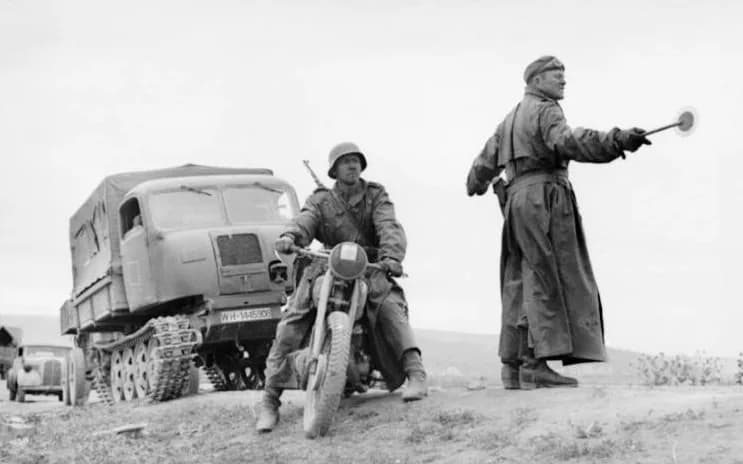
The Battle of Kursk was the largest tank battle in history, pitting German and Soviet armoured forces in a clash that sealed the loss of German strategic initiative on the Eastern Front. From 5 July to 23 August 1943, the Red Army absorbed the German offensive in a defence in depth prepared months in advance, then counter-attacked.
The Battle of Kursk arose from the strategic situation on the Eastern Front following the German defeat at Stalingrad in February 1943. After the catastrophic loss of the Sixth Army, the Wehrmacht managed to stabilize the front through a brilliant counteroffensive led by Field Marshal Erich von Manstein, which recaptured Kharkov in March 1943. However, this series of operations left a massive Soviet salient bulging westward around the city of Kursk, approximately 250 kilometers wide and 150 kilometers deep. This salient presented both an opportunity and a vulnerability. Hitler and the German high command saw in the Kursk salient a chance to regain the initiative by launching a pincer attack from the north and south to cut off and destroy the Soviet forces within the bulge. This operation, codenamed Citadel (Zitadelle), was conceived as a limited but decisive offensive that would shorten the German front line and inflict massive casualties on the Red Army. However, the planning of Operation Citadel was plagued by delays and disagreements within the German command. Manstein favored an early attack in May before the Soviets could fortify the salient, while Hitler insisted on waiting for the delivery of new Tiger and Panther tanks, postponing the offensive until July. These delays proved fatal, as the Soviets used every available day to construct the most elaborate system of defensive fortifications ever seen in warfare.
The forces assembled for the Battle of Kursk were staggering in their scale, making it one of the largest military engagements in history. On the German side, Operation Citadel concentrated the finest armored formations remaining to the Wehrmacht. The northern pincer was entrusted to Colonel General Walter Model's Ninth Army, part of Army Group Center, comprising approximately 335,000 men, 590 tanks and assault guns, and over 3,000 artillery pieces. The southern pincer fell to Colonel General Hermann Hoth's Fourth Panzer Army and Army Detachment Kempf, under Manstein's Army Group South, totaling approximately 350,000 men with around 1,000 tanks and assault guns including the elite SS Panzer divisions Leibstandarte, Das Reich, and Totenkopf. The Germans deployed their newest and most powerful armored vehicles, including approximately 200 Tiger I heavy tanks, 200 Panther medium tanks making their combat debut, and 90 Ferdinand heavy tank destroyers. In total, the German forces committed to Citadel numbered approximately 780,000 men and over 2,900 tanks and assault guns supported by approximately 2,000 aircraft of the Luftwaffe. The Soviet forces defending the Kursk salient were even more formidable. Marshal Georgy Zhukov and the Stavka had been forewarned of the German plans through multiple intelligence sources, including the Lucy spy ring in Switzerland and decoded German communications. The Central Front under General Konstantin Rokossovsky defended the northern face of the salient with approximately 510,000 men and 1,785 tanks, while the Voronezh Front under General Nikolai Vatutin held the southern face with approximately 625,000 men and 1,704 tanks. Behind these two fronts stood the powerful Steppe Front under General Ivan Konev, a strategic reserve of approximately 573,000 men and 1,551 tanks ready to counterattack or contain any German breakthrough. The total Soviet forces in and around the salient exceeded 1.9 million men, over 5,000 tanks, 25,000 artillery pieces, and 2,800 aircraft.
Operation Citadel was launched on July 5, 1943, with simultaneous attacks from the north and south of the Kursk salient. In the north, Model's Ninth Army advanced against Rokossovsky's Central Front but immediately encountered the full depth of Soviet defensive preparations. The Soviets had constructed up to eight successive defensive lines extending to a depth of nearly 300 kilometers, incorporating over 400,000 mines, thousands of kilometers of trenches, anti-tank ditches, and fortified strong points connected by an elaborate system of communications trenches. The Soviet defenders also employed a tactic of preemptive artillery bombardment, striking German assembly areas just before the attack commenced, disrupting formations and timetables. In the north, Model's forces managed to penetrate only about 12 kilometers into the Soviet defenses over several days of brutal fighting before being halted. The Ferdinand tank destroyers, while formidable in direct combat, proved vulnerable to Soviet infantry due to their lack of machine guns, and many were destroyed by close-assault teams. In the south, Hoth's Fourth Panzer Army achieved greater initial success, advancing up to 35 kilometers into the Soviet lines. The elite SS divisions spearheaded the assault, their Tiger tanks proving devastating against Soviet T-34s at range. The climax of the southern battle came on July 12 at Prokhorovka, where the 5th Guards Tank Army under General Pavel Rotmistrov launched a massive counterattack against the advancing II SS Panzer Corps. The resulting engagement at Prokhorovka involved hundreds of tanks on both sides in close-range combat, with Soviet T-34s closing rapidly to negate the range advantage of German Tigers. While the exact scale and outcome of Prokhorovka remain debated by historians, the engagement effectively halted the German advance in the south. On July 12, the Soviets also launched Operation Kutuzov against the German-held Orel salient north of Kursk, threatening Model's rear and forcing the diversion of German reserves. On July 13, Hitler summoned his commanders and announced the cancellation of Citadel, partly due to the Allied invasion of Sicily which demanded the transfer of forces to the Mediterranean. The German withdrawal marked the beginning of the Soviet summer counteroffensive, Operation Polkovodets Rumyantsev in the south, which liberated Belgorod on August 5 and Kharkov on August 23, completing the Soviet victory in the Battle of Kursk.
The Battle of Kursk represented a decisive and irreversible turning point on the Eastern Front and in the broader course of World War II. For the first time, a major German summer offensive had been not merely halted but comprehensively defeated, and the Wehrmacht never again possessed the strength to launch a strategic offensive in the East. The failure of Operation Citadel shattered the myth that the German army could recover from setbacks through superior tactical skill and the concentrated application of armored power. The elaborate Soviet defensive preparations demonstrated that the Red Army had developed a sophisticated understanding of modern defensive warfare, incorporating defense in depth, mobile reserves, and coordinated combined arms operations. The battle also marked a psychological turning point for both armies. German soldiers and officers, many of whom had fought on the Eastern Front since 1941, recognized that the tide had turned irrevocably. The confidence and offensive spirit that had characterized the Wehrmacht since the invasion of Poland in 1939 gave way to a growing sense of futility and defensive mindset. For the Soviet forces, Kursk confirmed the lessons learned at Stalingrad and demonstrated that they could defeat the best German formations in open battle, not merely in the unique conditions of urban warfare. The Steppe Front's successful deployment as a strategic reserve showed the maturity of Soviet operational planning and the Stavka's ability to manage enormous forces across vast distances. The tank battle at Prokhorovka, regardless of the precise casualty figures which historians continue to debate, became a powerful symbol of Soviet armored might and determination. The battle also had significant implications for the German war effort beyond the Eastern Front, as the diversion of elite formations weakened German defenses in Italy and contributed to the eventual Allied success in the Mediterranean theater.
The consequences of the Battle of Kursk were far-reaching and profoundly shaped the remainder of the war on the Eastern Front. The most immediate consequence was the permanent transfer of strategic initiative to the Soviet Union. Following Kursk, the Red Army launched a series of massive offensives that would continue virtually uninterrupted until the fall of Berlin in May 1945. The German forces on the Eastern Front were pushed into a continuous retreat, fighting desperate defensive battles but unable to halt the Soviet steamroller. The losses suffered by the Wehrmacht at Kursk were severe and largely irreplaceable. German casualties during the entire Kursk operation amounted to approximately 200,000 killed, wounded, and missing, along with the destruction or severe damage of approximately 720 tanks and assault guns and over 680 aircraft. While Soviet losses were even heavier in absolute terms, with estimates ranging from 250,000 to 860,000 casualties and over 6,000 tanks destroyed or damaged, the critical difference was that the Soviet Union possessed the industrial capacity and manpower reserves to absorb and replace these losses, while Germany could not. The battle also demonstrated the effectiveness of Soviet military industry, which had been relocated beyond the Urals and was now producing tanks, aircraft, and artillery in quantities that far exceeded German production. The T-34, while individually inferior to the Tiger in certain respects, was produced in such numbers that it overwhelmed German armored formations. The liberation of Orel, Belgorod, and Kharkov during the Soviet counteroffensives that followed Citadel represented the beginning of the systematic liberation of Soviet territory that would continue through 1944. The Soviet victories at Kursk also had important diplomatic consequences, strengthening Stalin's position in negotiations with the Western Allies and influencing decisions made at the Tehran Conference in November 1943 regarding the opening of a second front in Western Europe.
This article draws on historical works, military archives and recognized academic publications.
Operation Citadel failed because the Soviets knew the German plans in advance via the Lucy spy ring and decoded Enigma messages. They built up to eight defensive lines over 300 km deep, with over 400,000 mines. The delays imposed by Hitler — waiting for Tiger and Panther tanks — gave the Soviets months to fortify the Kursk salient. On July 13, 1943, Hitler cancelled the offensive.
The Battle of Kursk was the largest tank battle in history. Germany lost approximately 200,000 men (killed, wounded, missing) and 720 tanks during Operation Citadel. Soviet losses were heavier: 250,000 to 860,000 casualties and over 6,000 tanks destroyed. However, the USSR could replace these losses through its industry relocated beyond the Urals; Germany could not.
On July 12, 1943, General Rotmistrov's Soviet 5th Guards Tank Army launched a massive counterattack against the German II SS Panzer Corps at Prokhorovka, in the southern Kursk salient. Hundreds of tanks clashed at close range — Soviet T-34s seeking to neutralize the range advantage of German Tigers. This engagement effectively halted Manstein's Army Group South advance and marked the end of the German offensive in the southern sector.
Information cross-checked against Wikipedia and reference historical works.
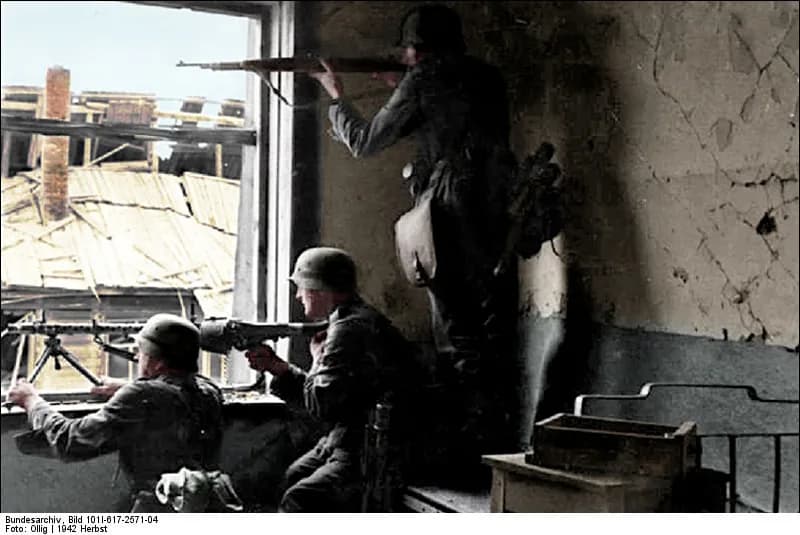
Battle of Stalingrad
The Battle of Stalingrad was among the deadliest clashes of World War II, pitting German and Soviet forces against each other in devastating urban combat that marked a decisive turning point on the Eastern Front. From 23 August 1942 to 2 February 1943, Operation Uranus encircled the German Sixth Army, whose roughly 91,000 survivors surrendered.
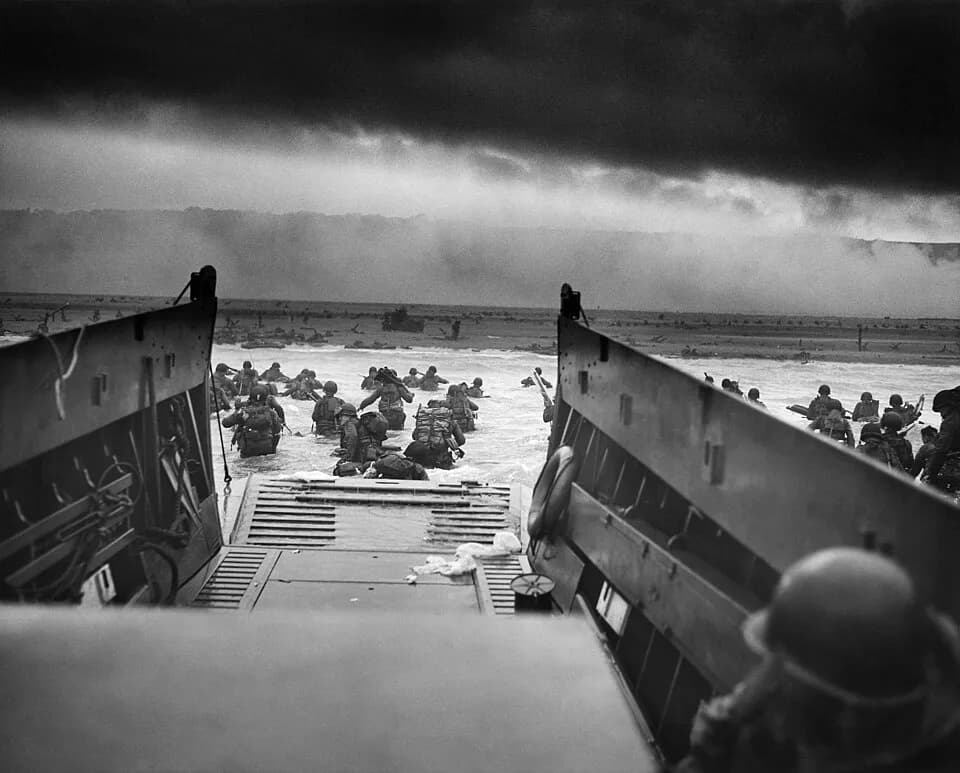
Normandy Landings
The Normandy landings, the largest amphibious operation in history, opened a second front in Western Europe on 6 June 1944, hastening the liberation of France and the defeat of Nazi Germany. Nearly 7,000 vessels put 156,000 men ashore on five beaches in a single day, under air cover and after months of deception meant to mislead the Wehrmacht.
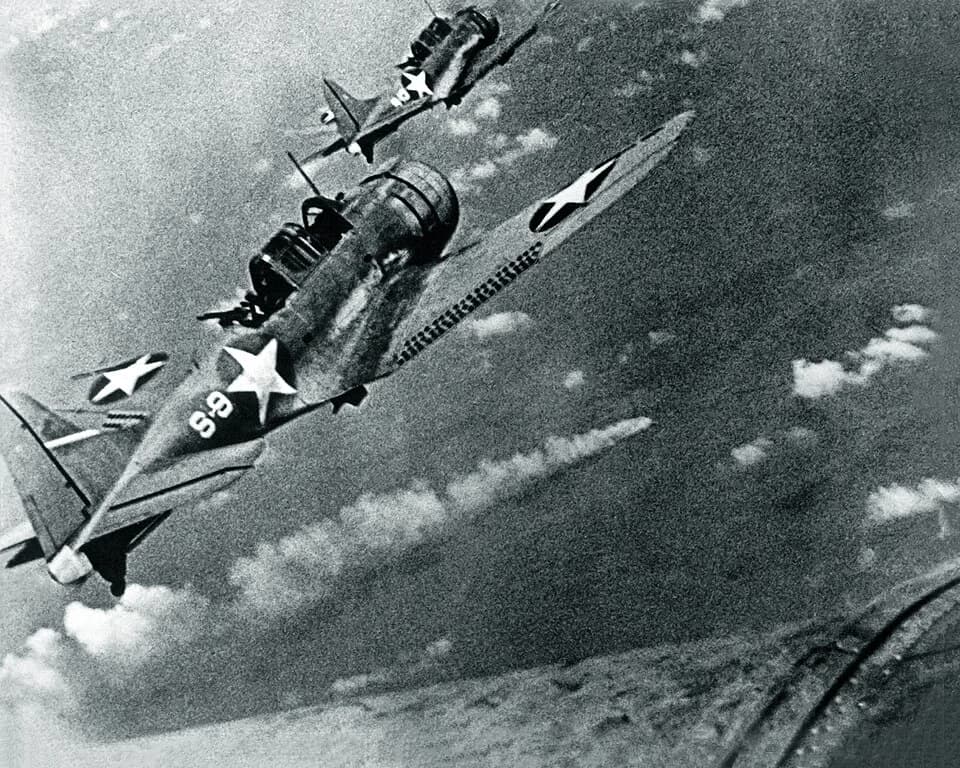
Battle of Midway
The Battle of Midway was the decisive turning point of the Pacific war, where the American navy inflicted a catastrophic defeat on the Japanese fleet by sinking four aircraft carriers, reversing the naval balance. From 4 to 7 June 1942, the decryption of Japanese communications allowed Admiral Nimitz to ambush a fleet that outnumbered his own.
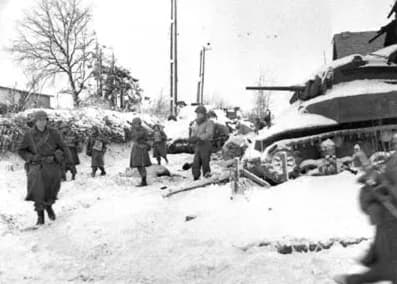
Battle of the Bulge
The Battle of the Bulge was the last major German offensive on the western front, a desperate attempt to break through Allied lines in the Belgian forests that failed against American resistance. Launched on 16 December 1944 under overcast skies that grounded Allied aircraft, it was broken by late January 1945.
