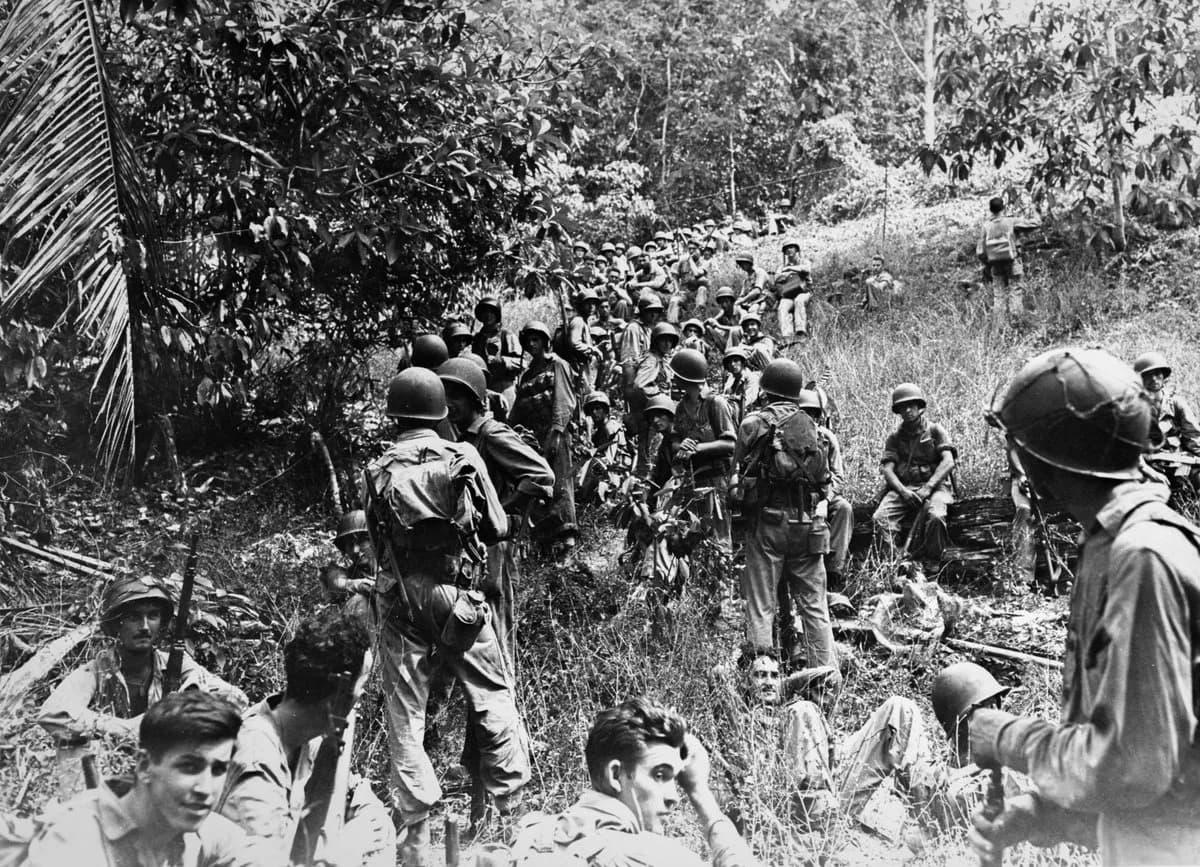
The Battle of Guadalcanal was the first major Allied land offensive in the Pacific, marking the beginning of the Japanese rollback through an exhausting campaign in the jungle of the Solomon Islands. From 7 August 1942 to 9 February 1943, six months of land, naval and air fighting drained Japanese reserves of pilots and ships, which were never rebuilt.
The Guadalcanal campaign emerged from the strategic situation in the South Pacific in mid-1942, a period when the war's outcome remained deeply uncertain despite the American victory at Midway in June. Japanese forces had been expanding southward through the Solomon Islands chain, establishing bases that threatened the vital supply lines between the United States and Australia. In early July 1942, Allied reconnaissance discovered that the Japanese were constructing an airfield on the northern coast of Guadalcanal, a large tropical island in the southern Solomons. This airfield, once operational, would allow Japanese land-based aircraft to dominate the surrounding seas and air space, potentially cutting the supply route to Australia and providing a staging point for further Japanese advances toward New Caledonia, Fiji, and Samoa. The Allied command, led by Admiral Ernest King, the Chief of Naval Operations who was a fierce advocate for offensive action in the Pacific, decided that the Japanese airfield must be captured before it became operational. The resulting operation, codenamed Watchtower, was planned and launched with remarkable speed but also with inadequate preparation, earning it the sardonic nickname Operation Shoestring among the participating Marines. The 1st Marine Division under Major General Alexander Vandegrift was assigned the assault, despite being understrength and having incomplete training for amphibious operations. The Marines had only five weeks to prepare for the landing, with limited intelligence about the island's terrain, Japanese strength, and available supply. The operation was considered extremely risky, as it would place American forces at the extreme limit of their logistical reach, dependent on naval supply lines that would be contested by the powerful Japanese Combined Fleet. The Joint Chiefs of Staff were divided on the wisdom of the operation, but Admiral King's insistence prevailed, and the decision was made to strike before the Japanese could consolidate their position.
The forces committed to the Guadalcanal campaign on both sides grew substantially over the six months of fighting, as the battle evolved from a limited operation into a major strategic confrontation. The initial American landing force consisted of approximately 16,000 Marines of the 1st Marine Division, reinforced by elements of the 2nd Marine Division and the 1st Marine Raider Battalion. These troops were supported by a naval task force under Vice Admiral Frank Jack Fletcher that included three aircraft carriers, the Saratoga, Enterprise, and Wasp, along with a screening force of battleships, cruisers, and destroyers under Rear Admiral Richmond Kelly Turner. As the campaign progressed, the Marines were reinforced and eventually replaced by Army units, including the Americal Division and the 25th Infantry Division, bringing total American ground forces to approximately 60,000 men by the campaign's end. The naval forces engaged were equally substantial, with the United States committing a significant portion of its Pacific Fleet to supporting and supplying the garrison on Guadalcanal. On the Japanese side, the initial garrison on Guadalcanal was relatively small, consisting of approximately 2,800 construction troops and a small naval infantry detachment. However, the Japanese high command, recognizing the strategic importance of the island, committed increasingly large forces to recapture it. Japanese reinforcements were delivered primarily by fast destroyer runs down the passage through the Solomon Islands that became known as the Tokyo Express. Over the course of the campaign, Japan committed approximately 36,000 troops to Guadalcanal, including elite units such as the Ichiki Detachment, the Kawaguchi Brigade, and the 2nd Sendai Division. The Imperial Japanese Navy devoted enormous resources to the campaign, including battleships, carriers, cruisers, and submarines, fighting no fewer than six major naval battles in the waters around Guadalcanal. Japanese air power was based primarily at Rabaul on New Britain, approximately 1,000 kilometers to the northwest, requiring long-range flights that limited time over the target area and resulted in heavy attrition of experienced pilots.
The Guadalcanal campaign began on August 7, 1942, when the 1st Marine Division landed on Guadalcanal and the nearby islands of Tulagi, Gavutu, and Tanambogo. The landings on Guadalcanal itself met little resistance, as the Japanese construction troops fled into the jungle, and the Marines quickly captured the nearly completed airfield, which they renamed Henderson Field in honor of a Marine aviator killed at Midway. However, the situation deteriorated rapidly. On the night of August 8-9, a Japanese cruiser force under Vice Admiral Gunichi Mikawa surprised and devastated the Allied naval screening force at the Battle of Savo Island, sinking four heavy cruisers and killing over 1,000 sailors in one of the worst naval defeats in American history. This disaster, combined with Fletcher's controversial decision to withdraw his carriers, forced Turner to pull his transport ships out before unloading was complete, leaving the Marines critically short of supplies, ammunition, and heavy equipment. For the next several weeks, the Marines on Guadalcanal fought in increasingly desperate conditions. Henderson Field became operational on August 20 when the first Marine fighter and dive bomber squadrons, collectively known as the Cactus Air Force, arrived. These aircraft proved crucial to the campaign's outcome, providing air cover for the garrison and attacking Japanese ships and reinforcement attempts. The Japanese launched their first major ground counterattack on August 21, when Colonel Kiyonao Ichiki's detachment of approximately 900 elite troops attacked the Marine perimeter at the Tenaru River in a nighttime banzai charge. The attack was annihilated, with Ichiki's force virtually destroyed. Undeterred, the Japanese sent larger forces under Major General Kiyotake Kawaguchi, who attacked the Marine perimeter at Edson's Ridge on September 12-14 in fierce fighting that came close to overrunning Henderson Field. The Marines held, largely thanks to the leadership of Colonel Merritt Edson and the desperate courage of his Raiders and Paramarines. Throughout October and November, the Japanese continued to reinforce their forces and launched increasingly large attacks, culminating in a three-day assault in late October by the 2nd Sendai Division that was repulsed with heavy Japanese losses. Meanwhile, the naval campaign raged with extraordinary ferocity, with major engagements at the Eastern Solomons on August 24, Cape Esperance on October 11, the Naval Battle of Guadalcanal on November 12-15, and Tassafaronga on November 30. By December, Japanese forces on the island were starving and ravaged by tropical diseases, receiving only trickle supplies via submarine and destroyer runs. In early February 1943, the Japanese high command made the difficult decision to evacuate the remaining troops, and approximately 10,600 emaciated survivors were rescued by destroyers in a skillfully executed withdrawal between February 1-7, ending the campaign.
The Battle of Guadalcanal marked a pivotal turning point in the Pacific War, representing the moment when the strategic initiative began shifting from Japan to the United States. Before Guadalcanal, the Japanese military had been on the offensive across the Pacific and Southeast Asia, capturing territory with apparent ease and projecting an image of invincibility. After Guadalcanal, Japan was forced permanently onto the defensive, never again launching a major offensive operation in the Pacific theater. The campaign demonstrated that American forces could not only halt Japanese expansion but could seize and hold territory against determined Japanese counterattacks, a crucial psychological and military revelation. The jungle fighting on Guadalcanal shattered the myth of Japanese invincibility in close combat and jungle warfare, proving that American Marines and soldiers could match Japanese troops in determination, endurance, and fighting skill under the most brutal conditions. The campaign also revealed critical weaknesses in Japanese military doctrine. The Japanese command repeatedly underestimated American strength and resolve, launching piecemeal attacks with insufficient forces rather than concentrating overwhelming strength for a single decisive blow. This tendency to commit forces in increments, known as feeding reinforcements in piecemeal, allowed the Americans to defeat each Japanese attack in turn while building up their own strength. The Japanese logistical system proved inadequate for sustaining a major campaign far from their bases, and the Imperial Japanese Navy's reluctance to risk its capital ships in close support of ground operations left the army increasingly isolated and unsupported. The naval battles around Guadalcanal, while costly for both sides, demonstrated the growing effectiveness of American naval forces and the unsustainable attrition rate being imposed on Japanese pilots, ships, and submarines. The loss of hundreds of experienced naval aviators at Guadalcanal, combined with losses at Midway and the Coral Sea, created a pilot shortage that Japan was never able to overcome, as its training system could not produce replacements of comparable quality in sufficient numbers.
The consequences of the Guadalcanal campaign were profound and far-reaching, reshaping the strategic landscape of the Pacific War. The most immediate consequence was the establishment of a firm Allied foothold in the Solomon Islands, which became the springboard for the island-hopping campaign that would eventually bring American forces to the doorstep of Japan. Henderson Field, the objective that had triggered the entire campaign, became a major Allied air base that supported subsequent operations up the Solomon chain toward Rabaul, Japan's main bastion in the South Pacific. The human cost of the campaign was staggering on both sides. The United States suffered approximately 1,600 killed and 4,245 wounded on land, while the Navy lost approximately 4,900 sailors killed in the naval engagements around the island. Japanese losses were catastrophic, with approximately 21,000 killed on Guadalcanal from combat, and an estimated 9,000 dead from disease, malnutrition, and starvation, earning the island the grim Japanese nickname of Starvation Island. The Japanese Navy lost approximately 3,500 men in the naval battles, along with two battleships, a light carrier, three heavy cruisers, and numerous destroyers and submarines. Perhaps even more damaging than the material losses was the attrition of irreplaceable experienced personnel. Japanese naval aviation lost hundreds of veteran pilots whose skill and experience could never be adequately replaced, accelerating the qualitative decline that would become increasingly apparent at the Philippine Sea and Leyte Gulf. The campaign also had important implications for Allied strategy and doctrine. It validated the concept of amphibious offensive operations in the Pacific and provided invaluable lessons about jungle warfare, logistics in remote tropical environments, and the coordination of air, naval, and ground forces in island campaigns. The experience gained at Guadalcanal directly influenced the training, equipment, and tactics used in subsequent Pacific operations at Tarawa, Saipan, Peleliu, Iwo Jima, and Okinawa. The campaign demonstrated the critical importance of air superiority and naval logistics in island warfare, lessons that shaped American operational planning for the remainder of the Pacific War. On the Japanese side, the failure at Guadalcanal forced a fundamental reassessment of strategy, leading to the adoption of a defensive perimeter strategy that attempted to delay the Allied advance long enough to exhaust American willingness to continue fighting.
Guadalcanal marks the moment when strategic initiative shifted from Japan to the United States. After six months of fighting (August 7, 1942 - February 9, 1943), Japan was permanently forced onto the defensive and never again launched a major offensive in the Pacific. The campaign proved that American Marines could hold ground and repel elite Japanese assaults, shattering the myth of Japanese invincibility in jungle warfare.
The United States suffered approximately 1,600 killed and 4,245 wounded on land, plus 4,900 sailors killed in naval engagements. Japanese losses were catastrophic: approximately 21,000 killed in combat on Guadalcanal and 9,000 dead from disease and starvation — hence the Japanese nickname 'Starvation Island.' The Japanese Navy lost two battleships, a light carrier, three heavy cruisers, and hundreds of irreplaceable experienced pilots.
Henderson Field was the airfield captured by American Marines on August 7, 1942, on Guadalcanal's northern coast, named after a Marine aviator killed at Midway. Operational by August 20, it hosted the 'Cactus Air Force' (Marine fighters and dive bombers) that provided air cover and attacked Japanese reinforcement attempts via the 'Tokyo Express.' It was the central objective of the entire campaign for both sides.
Information cross-checked against Wikipedia and reference historical works.
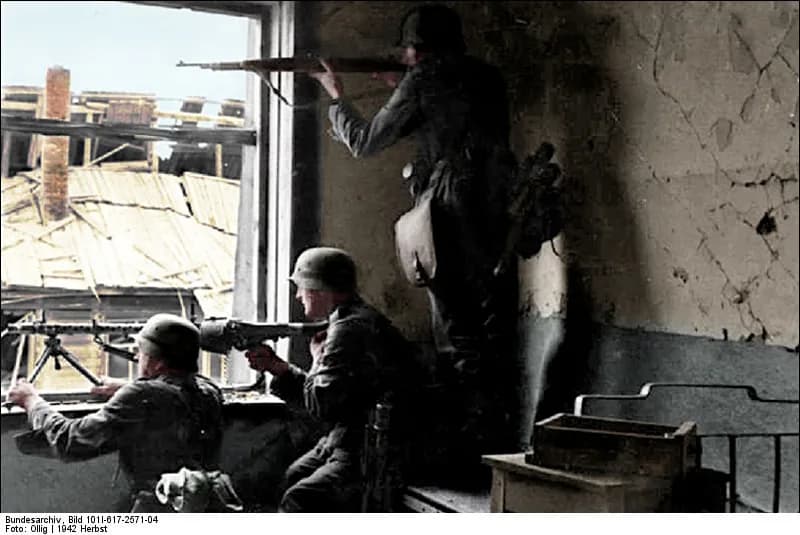
Battle of Stalingrad
The Battle of Stalingrad was among the deadliest clashes of World War II, pitting German and Soviet forces against each other in devastating urban combat that marked a decisive turning point on the Eastern Front. From 23 August 1942 to 2 February 1943, Operation Uranus encircled the German Sixth Army, whose roughly 91,000 survivors surrendered.
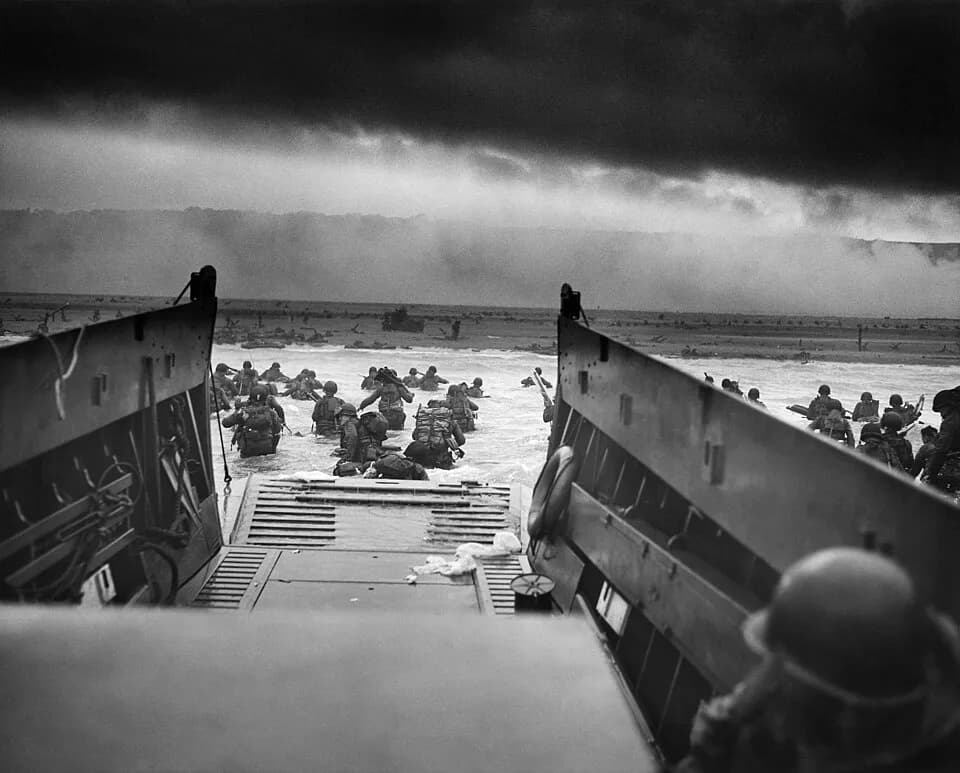
Normandy Landings
The Normandy landings, the largest amphibious operation in history, opened a second front in Western Europe on 6 June 1944, hastening the liberation of France and the defeat of Nazi Germany. Nearly 7,000 vessels put 156,000 men ashore on five beaches in a single day, under air cover and after months of deception meant to mislead the Wehrmacht.
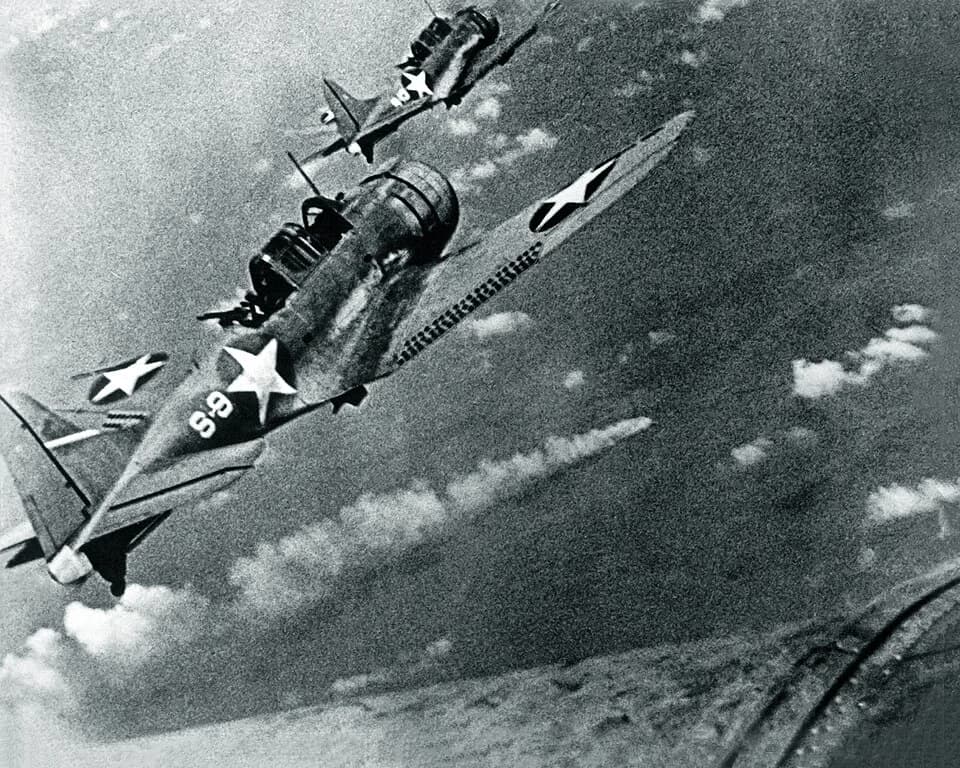
Battle of Midway
The Battle of Midway was the decisive turning point of the Pacific war, where the American navy inflicted a catastrophic defeat on the Japanese fleet by sinking four aircraft carriers, reversing the naval balance. From 4 to 7 June 1942, the decryption of Japanese communications allowed Admiral Nimitz to ambush a fleet that outnumbered his own.
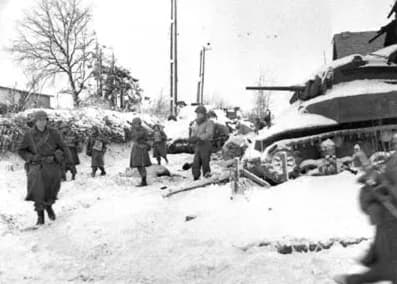
Battle of the Bulge
The Battle of the Bulge was the last major German offensive on the western front, a desperate attempt to break through Allied lines in the Belgian forests that failed against American resistance. Launched on 16 December 1944 under overcast skies that grounded Allied aircraft, it was broken by late January 1945.
