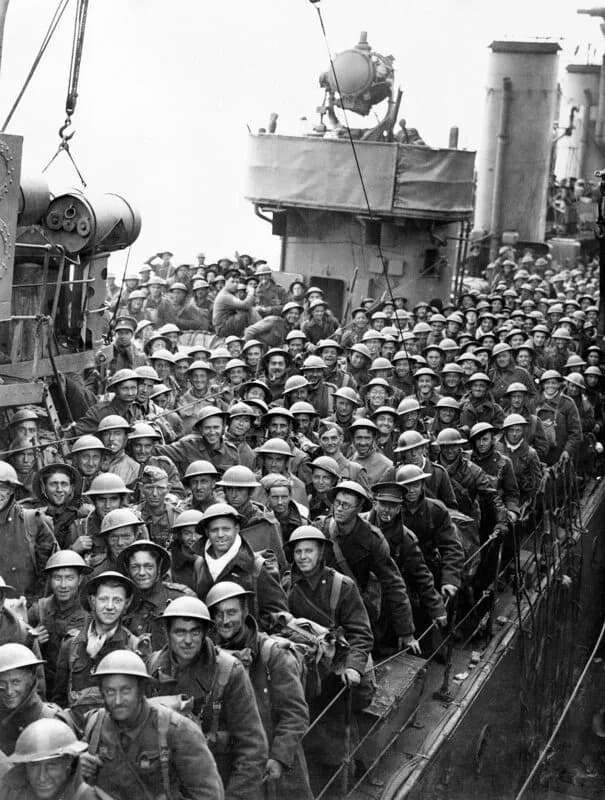
The Battle of Dunkirk and Operation Dynamo enabled the evacuation of 338,000 Allied soldiers encircled by German forces, saving the core of the British army and preserving hope for a future victory. Between 26 May and 4 June 1940, more than eight hundred vessels, including hundreds of requisitioned civilian craft, shuttled to England under bombardment.
In May 1940, Nazi Germany launched its great western offensive, Fall Gelb, which would trigger the most rapid and spectacular military collapse in modern history. The German plan, brilliantly conceived by General Erich von Manstein, called for a diversionary attack through Belgium and the Netherlands to draw the best Allied armies northward, while the Wehrmacht's armored spearhead would thrust through the Ardennes, deemed impassable by tanks. This breakthrough would cut the Allied armies off from their supply lines. On May 10, German forces simultaneously attacked Belgium, the Netherlands, and Luxembourg. As planned, the British Expeditionary Force and the best French divisions rushed into Belgium, falling into the trap. On May 13, Guderian's Panzers crossed the Meuse at Sedan and raced toward the English Channel, reaching Abbeville on May 20. Within ten days, the Allied forces in the north, comprising the bulk of the British army and several French armies, were encircled in a shrinking pocket around Dunkirk.
The forces trapped in the Dunkirk pocket comprised the bulk of the British Expeditionary Force, approximately 200,000 British soldiers, along with roughly 140,000 French and Belgian soldiers. The BEF was commanded by General Lord Gort, who made the crucial decision to retreat toward Dunkirk rather than attempt a breakout southward. French troops, under Admiral Jean Abrial's command for the defense of the Dunkirk perimeter, provided an essential part of the rearguard that enabled the evacuation. Operation Dynamo, directed by Vice Admiral Bertram Ramsay from tunnels beneath Dover Castle, mobilized an extraordinarily diverse fleet. In total, 861 vessels participated in the evacuation, from Royal Navy destroyers to pleasure boats, including trawlers, tugboats, and fishing boats. These 'little ships of Dunkirk,' approximately 700 requisitioned or volunteer civilian craft, became the symbol of the British spirit of resistance. On the German side, the forces encircling the pocket comprised several Panzer groups and dozens of infantry divisions, supported by Marshal Göring's Luftwaffe, which promised to destroy the Allied forces through airpower alone.
Operation Dynamo was launched on May 26, 1940, by Vice Admiral Ramsay, with the initial hope of saving perhaps 30,000 to 45,000 men. On the first day, only 7,669 soldiers were evacuated, primarily from the port of Dunkirk itself. A decisive factor was the controversial halt order given by Hitler on May 24, which stopped the Panzer advance for two crucial days, giving the Allies time to organize a defensive perimeter. The reasons for this order remain debated: some historians cite Göring's influence, wanting to reserve victory for the Luftwaffe, others Rundstedt's caution fearing a counterattack. The Luftwaffe mercilessly bombed the beaches and port, sinking several ships and inflicting heavy casualties, but the RAF committed its precious Spitfires to fierce aerial combat over Dunkirk, limiting the damage. Soldiers on the beaches, wading chest-deep in water, formed long orderly queues to board the small boats shuttling them to larger vessels offshore. On May 31, the most productive day, 68,014 men were evacuated. French troops heroically held the perimeter to the end, enabling the evacuation of the last units during the night of June 3-4.
The turning point at Dunkirk was unquestionably Hitler's halt order of May 24, 1940, one of the most controversial and consequential decisions of the entire Second World War. While Guderian's and Reinhardt's armored divisions were less than 20 kilometers from Dunkirk and could potentially have cut off the retreat of Allied armies, Hitler ordered the advance halted. This 48-hour pause gave the Allies an unexpected reprieve to organize the Dunkirk perimeter defenses and begin the evacuation. Several theories explain this fateful decision: the desire to preserve the armor for the second phase of the French campaign, Göring's assurance that the Luftwaffe alone could annihilate the encircled forces, or Hitler's belief that Britain would negotiate peace after France's fall. Whatever the motive, the halt order transformed what should have been a total capitulation into a successful evacuation. Another turning point was the spontaneous mobilization of British civilians with their private boats, transforming Dynamo from a conventional naval operation into an unprecedented national effort that enabled the evacuation of tens of thousands of men directly from the beaches.
The consequences of Dunkirk were immense and paradoxical. Materially, the defeat was undeniable: the Allies abandoned on the beaches and in the Dunkirk pocket a colossal amount of military equipment including 2,472 guns, 63,879 vehicles, 20,548 motorcycles, and over 500,000 tons of ammunition and supplies. The British army was temporarily stripped of virtually all its heavy weaponry. Approximately 40,000 French soldiers were captured defending the perimeter. However, strategically and psychologically, Dunkirk was an unexpected triumph. The 338,226 soldiers evacuated — including 198,229 British and 139,997 French and Belgian — constituted the core of an army that, reconstituted and re-equipped, would fight again. Winston Churchill, in his famous speech of June 4, 1940, masterfully transformed the evacuation into a symbol of national defiance with his immortal words: 'We shall fight on the beaches, we shall fight on the landing grounds, we shall never surrender.' The Dunkirk spirit became a pillar of wartime British national identity, symbolizing resilience in the face of adversity. Without Dunkirk, Britain would likely have had to negotiate peace, and the course of the war would have been radically different.
Operation Dynamo (May 26 - June 4, 1940) evacuated 338,226 Allied soldiers from Dunkirk: 198,229 British and 139,997 French and Belgian. Vice Admiral Ramsay's initial hope was to save 30,000 to 45,000 men. In total, 861 vessels participated, including approximately 700 small requisitioned civilian craft. The Allies abandoned on the spot 2,472 guns, 63,879 vehicles, and over 500,000 tons of equipment.
Hitler ordered the halt of armored forces on May 24, 1940, when they were within 20 km of Dunkirk. The reasons remain debated: Göring claimed the Luftwaffe could destroy the Allies alone, Rundstedt wanted to preserve the Panzers for the next phase, and Hitler hoped Britain would negotiate peace after France fell. This 48-hour pause allowed the Allies to organize their defensive perimeter and launch the evacuation.
On June 4, 1940, Winston Churchill delivered his 'We shall fight on the beaches' speech to Parliament, ending 'we shall never surrender.' This address transformed the Dunkirk evacuation — a military defeat — into a symbol of national resistance. It signaled to the United States and the world that Britain would continue fighting despite France's fall, keeping alive hope for a future victory against the Axis.
Information cross-checked against Wikipedia and reference historical works.
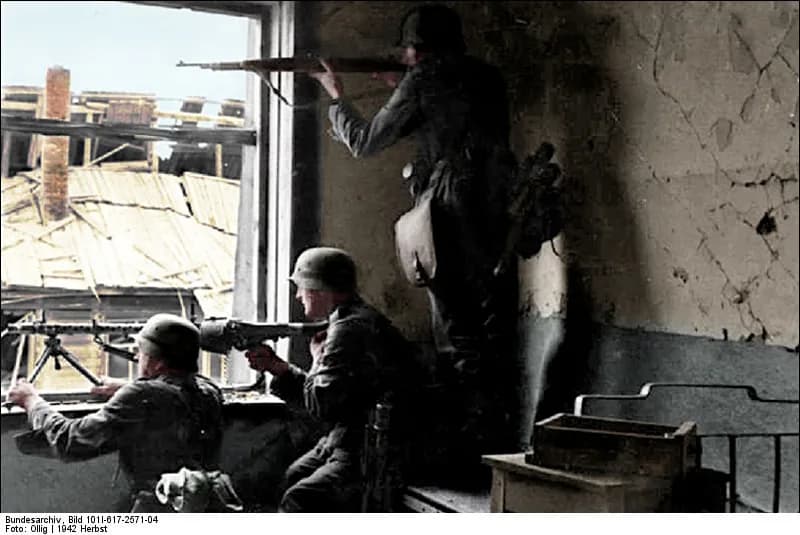
Battle of Stalingrad
The Battle of Stalingrad was among the deadliest clashes of World War II, pitting German and Soviet forces against each other in devastating urban combat that marked a decisive turning point on the Eastern Front. From 23 August 1942 to 2 February 1943, Operation Uranus encircled the German Sixth Army, whose roughly 91,000 survivors surrendered.
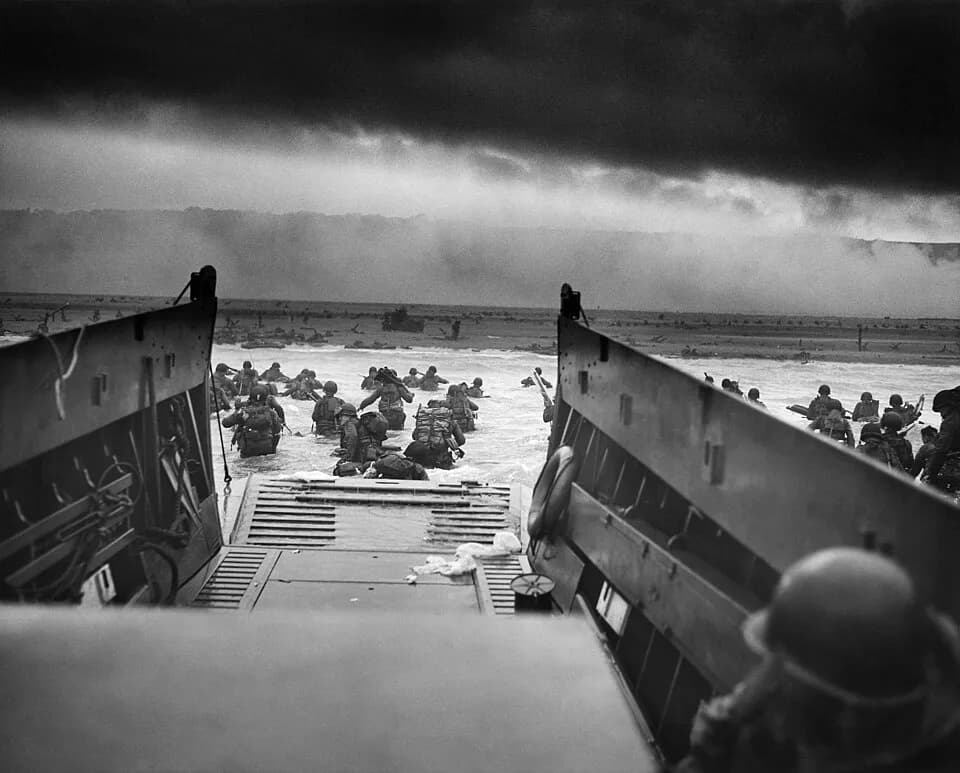
Normandy Landings
The Normandy landings, the largest amphibious operation in history, opened a second front in Western Europe on 6 June 1944, hastening the liberation of France and the defeat of Nazi Germany. Nearly 7,000 vessels put 156,000 men ashore on five beaches in a single day, under air cover and after months of deception meant to mislead the Wehrmacht.
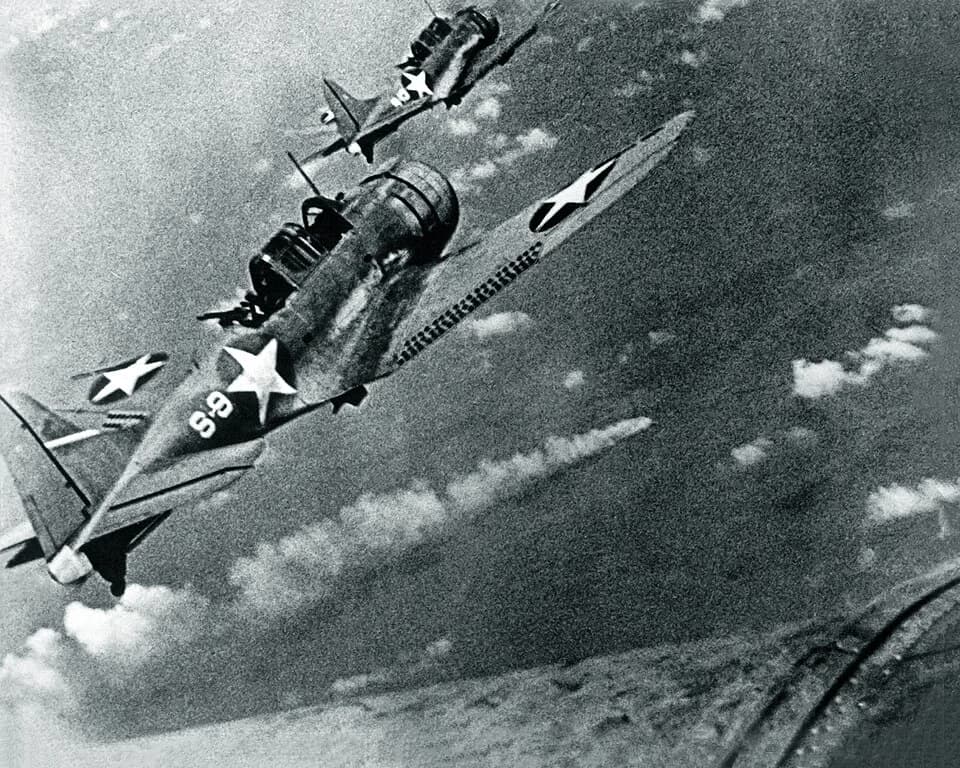
Battle of Midway
The Battle of Midway was the decisive turning point of the Pacific war, where the American navy inflicted a catastrophic defeat on the Japanese fleet by sinking four aircraft carriers, reversing the naval balance. From 4 to 7 June 1942, the decryption of Japanese communications allowed Admiral Nimitz to ambush a fleet that outnumbered his own.
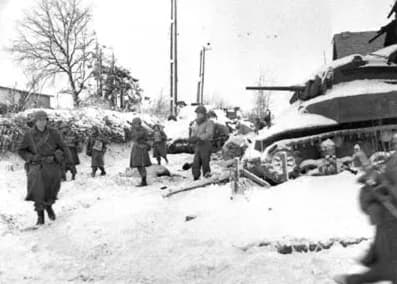
Battle of the Bulge
The Battle of the Bulge was the last major German offensive on the western front, a desperate attempt to break through Allied lines in the Belgian forests that failed against American resistance. Launched on 16 December 1944 under overcast skies that grounded Allied aircraft, it was broken by late January 1945.
