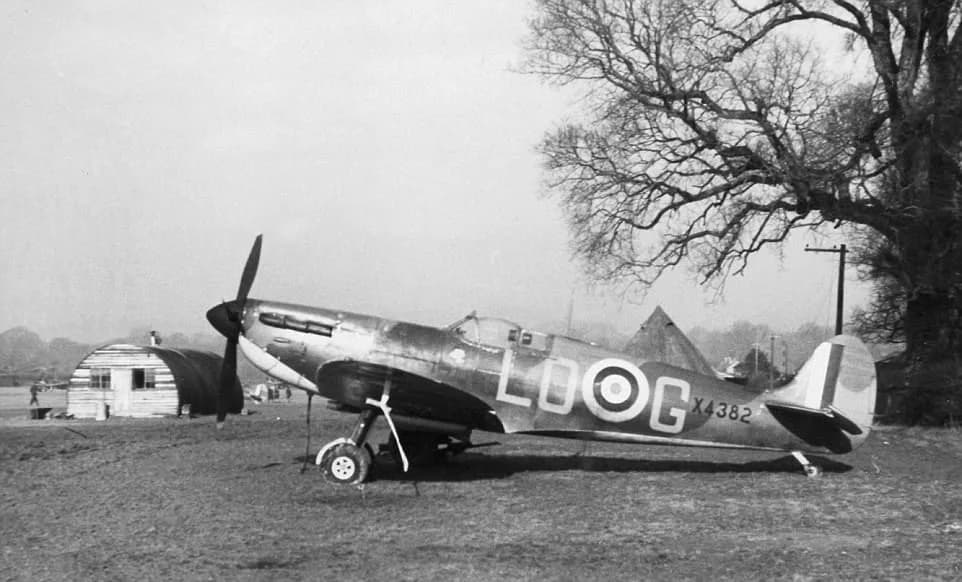
The Battle of Britain was the first major military campaign fought entirely by air forces, pitting the British RAF against the German Luftwaffe in a decisive aerial combat that prevented the invasion of Great Britain. From 10 July to 31 October 1940, the RAF held out thanks to radar and the Dowding system, forcing Hitler to postpone Operation Sea Lion.
After the fall of France in June 1940, Great Britain found itself alone against Nazi Germany. Adolf Hitler hoped the British would negotiate peace, but Prime Minister Winston Churchill categorically refused any negotiations. Hitler then ordered preparations for Operation Seelöwe (Sea Lion), a plan for an amphibious invasion of Great Britain. However, German admirals insisted on one absolute prerequisite: the Luftwaffe must first achieve air superiority over the English Channel and southern England to protect the invasion fleet from the powerful Royal Navy. Reichsmarschall Hermann Göring, commander of the Luftwaffe, assured Hitler he could destroy the RAF within weeks. The Luftwaffe fielded approximately 2,600 combat aircraft, including Heinkel He 111, Dornier Do 17, and Junkers Ju 88 bombers, escorted by the formidable Messerschmitt Bf 109 fighters and twin-engine Bf 110s. Facing this armada, RAF Fighter Command, led by Air Chief Marshal Hugh Dowding, had approximately 700 operational fighters, mainly Hurricanes and Spitfires.
The Battle of Britain pitted two air forces with very different doctrines and capabilities against each other. The Luftwaffe, commanded by Reichsmarschall Göring, had three air fleets (Luftflotten) deployed from Norway, Belgium, and France. Luftflotte 2, led by Field Marshal Albert Kesselring from Belgium, and Luftflotte 3, under Field Marshal Hugo Sperrle from France, constituted the main forces. In total, the Luftwaffe committed approximately 1,300 medium bombers, 300 Junkers Ju 87 Stuka dive bombers, 800 Messerschmitt Bf 109 fighters, and 200 Bf 110 heavy fighters. The Bf 109, an excellent fighter, suffered however from limited range that allowed only 20 minutes of combat over England. RAF Fighter Command, organized into four geographical groups, had approximately 700 to 900 operational fighters at any time, mainly Hawker Hurricanes and Supermarine Spitfires. The major asset of British defense was Dowding's integrated air defense system, combining Chain Home radar stations — which detected enemy formations at over 150 kilometers — the Royal Observer Corps ground observer network, and a centralized communication system that directed squadrons toward enemy formations with remarkable efficiency.
The Battle of Britain unfolded in several distinct phases. The first phase, from July 10 to August 11, consisted of attacks on maritime convoys in the Channel and coastal ports, testing British defenses. The second phase, from August 12 to September 6, was the most critical: the Luftwaffe launched Operation Adlerangriff (Eagle Attack) directly targeting Fighter Command's airfields and radar stations. These attacks were devastating; several key bases such as Biggin Hill, Kenley, and Manston were severely damaged, and the RAF was losing pilots faster than it could replace them. Dowding's system was pushed to its limits, and some historians believe that two more weeks of concentrated attacks on airfields could have broken British air defense. However, on September 7, the Luftwaffe made the strategic error that saved the RAF: in retaliation for an accidental British bombing of Berlin, Hitler ordered raids directed against London. This was the beginning of the Blitz. Although devastating for civilians — thousands of Londoners were killed — this change of target allowed Fighter Command's bases to repair and rebuild their forces. On September 15, during a massive raid on London, the RAF inflicted such heavy losses on the Luftwaffe that this date is commemorated as Battle of Britain Day.
The decisive turning point of the Battle of Britain came on September 7, 1940, when the Luftwaffe abandoned its attacks on Fighter Command's airfields to turn to bombing London. This decision, motivated by Hitler's anger after RAF Bomber Command's bombing of Berlin on the night of August 25, constituted one of the war's costliest strategic errors. At that precise moment, the RAF was on the verge of breaking: the 11 Group airfields in southeast England were severely damaged, pilot reserves were dangerously depleted, and morale was beginning to waver under constant pressure. Air Vice-Marshal Keith Park, commanding 11 Group which bore the brunt of the fighting, estimated his forces could only hold for a few more days at the rate of losses being suffered. The target change to London gave Fighter Command an unexpected reprieve to repair its bases, train new pilots, and rebuild its squadrons. September 15, 1940, confirmed the turning point: during two massive raids on London, the RAF shot down 56 German aircraft while losing only 26 fighters. That day demonstrated that the Luftwaffe could not achieve the air superiority necessary for invasion.
The consequences of the Battle of Britain were considerable and resonated well beyond 1940. Immediately, the Luftwaffe lost approximately 1,887 aircraft against 1,023 for the RAF, an unsustainable loss rate that forced Hitler to indefinitely postpone Operation Seelöwe on September 17, 1940. Great Britain remained undefeated, preserving an island base from which the Allies would later launch the liberation of Europe. The battle demonstrated that Hitler could be defeated, a powerful signal to occupied peoples and still-neutral nations. The RAF lost 544 pilots killed during the battle, including many Polish, Czech, Canadian, Australian, New Zealand, and other international volunteers who comprised approximately 20 percent of Fighter Command's pilots. Churchill paid tribute to them in his famous speech of August 20, 1940: 'Never in the field of human conflict was so much owed by so many to so few.' Strategically, the Luftwaffe's defeat forced Germany to turn eastward, launching Operation Barbarossa against the Soviet Union in June 1941, opening the front that would ultimately cause its downfall. The Battle of Britain also proved the value of radar and integrated air defense, revolutionizing military doctrine for decades to come.
This article draws on historical works, military archives and recognized academic publications.
The German Luftwaffe committed approximately 2,600 combat aircraft: 1,300 bombers, 800 Messerschmitt Bf 109 fighters, and 300 Stukas, deployed from France, Belgium, and Norway. RAF Fighter Command under Air Chief Marshal Dowding had approximately 700 to 900 Hurricanes and Spitfires operational at any time. The decisive British advantage was the Chain Home radar network (150 km detection) combined with a centralized command system.
The Luftwaffe lost approximately 1,887 aircraft against 1,023 for the RAF — an unsustainable loss rate. The decisive mistake came on September 7, 1940: Hitler ordered the bombing of London instead of Fighter Command's airfields, which were on the verge of collapse. This respite allowed the RAF to recover. On September 17, 1940, Hitler indefinitely postponed Operation Seelöwe. Great Britain remained undefeated.
On August 20, 1940, Winston Churchill told Parliament: 'Never in the field of human conflict was so much owed by so many to so few.' He was paying tribute to RAF pilots defending Great Britain against the Luftwaffe in the Battle of Britain. The RAF lost 544 pilots killed, approximately 20% of whom were foreign volunteers: Polish, Czech, Canadian, Australian, and others.
Information cross-checked against Wikipedia and reference historical works.
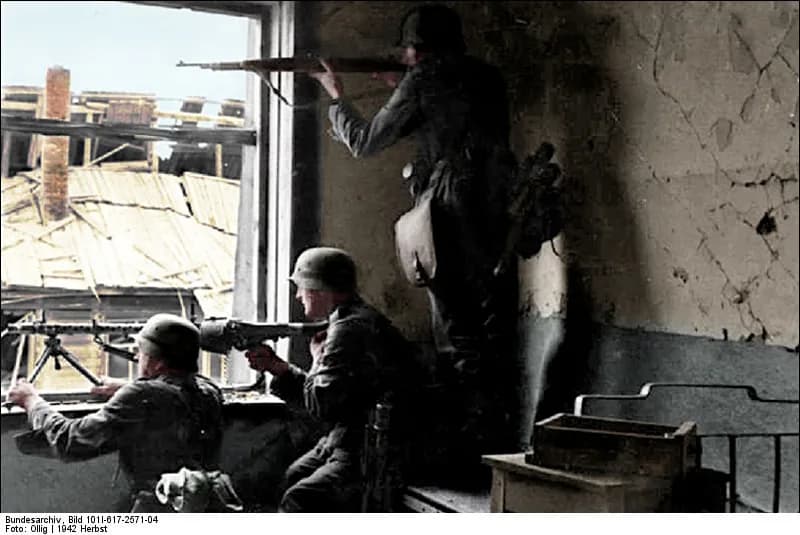
Battle of Stalingrad
The Battle of Stalingrad was among the deadliest clashes of World War II, pitting German and Soviet forces against each other in devastating urban combat that marked a decisive turning point on the Eastern Front. From 23 August 1942 to 2 February 1943, Operation Uranus encircled the German Sixth Army, whose roughly 91,000 survivors surrendered.
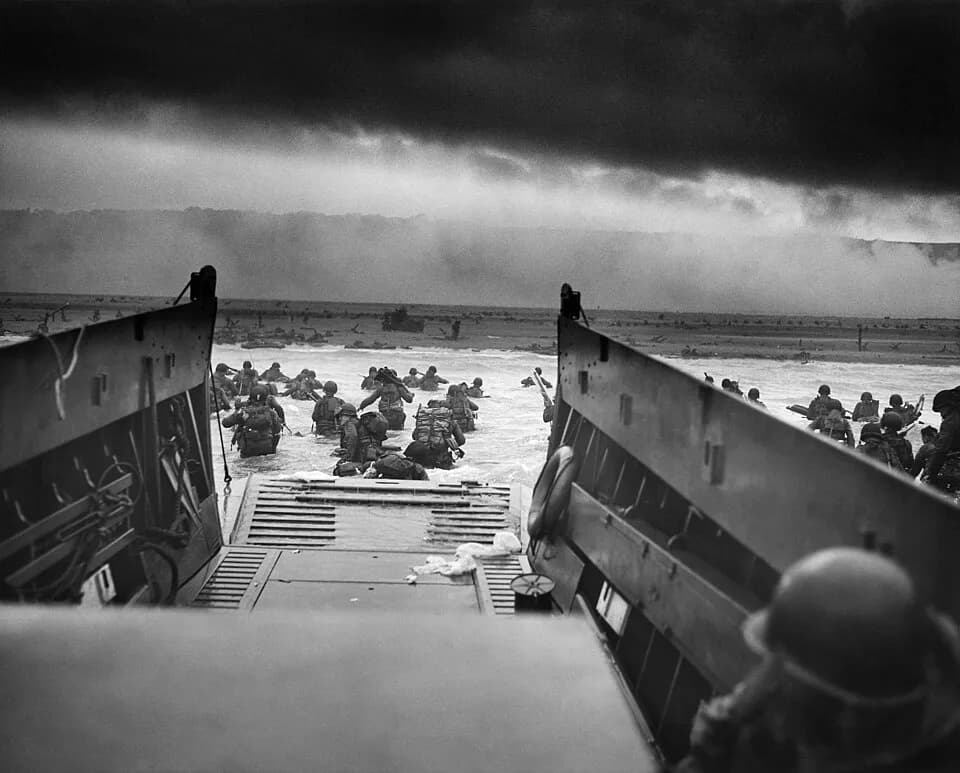
Normandy Landings
The Normandy landings, the largest amphibious operation in history, opened a second front in Western Europe on 6 June 1944, hastening the liberation of France and the defeat of Nazi Germany. Nearly 7,000 vessels put 156,000 men ashore on five beaches in a single day, under air cover and after months of deception meant to mislead the Wehrmacht.
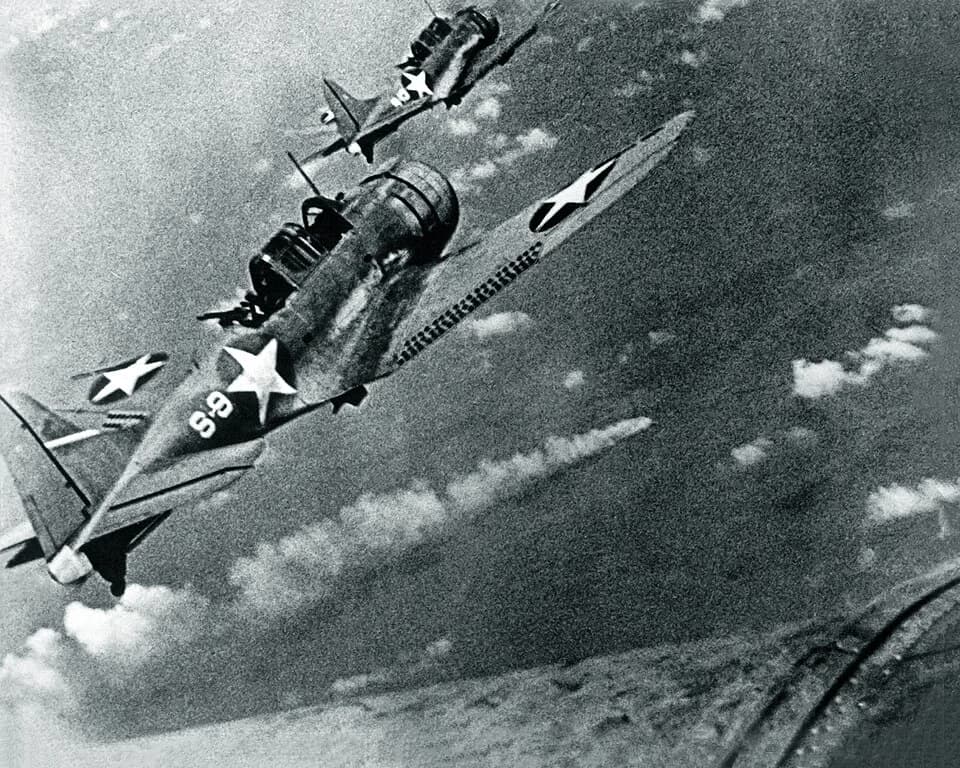
Battle of Midway
The Battle of Midway was the decisive turning point of the Pacific war, where the American navy inflicted a catastrophic defeat on the Japanese fleet by sinking four aircraft carriers, reversing the naval balance. From 4 to 7 June 1942, the decryption of Japanese communications allowed Admiral Nimitz to ambush a fleet that outnumbered his own.
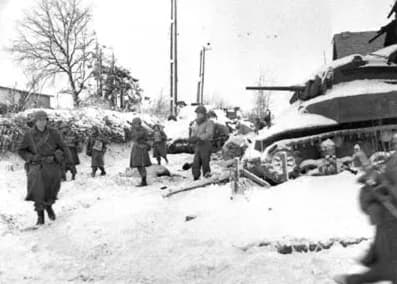
Battle of the Bulge
The Battle of the Bulge was the last major German offensive on the western front, a desperate attempt to break through Allied lines in the Belgian forests that failed against American resistance. Launched on 16 December 1944 under overcast skies that grounded Allied aircraft, it was broken by late January 1945.
