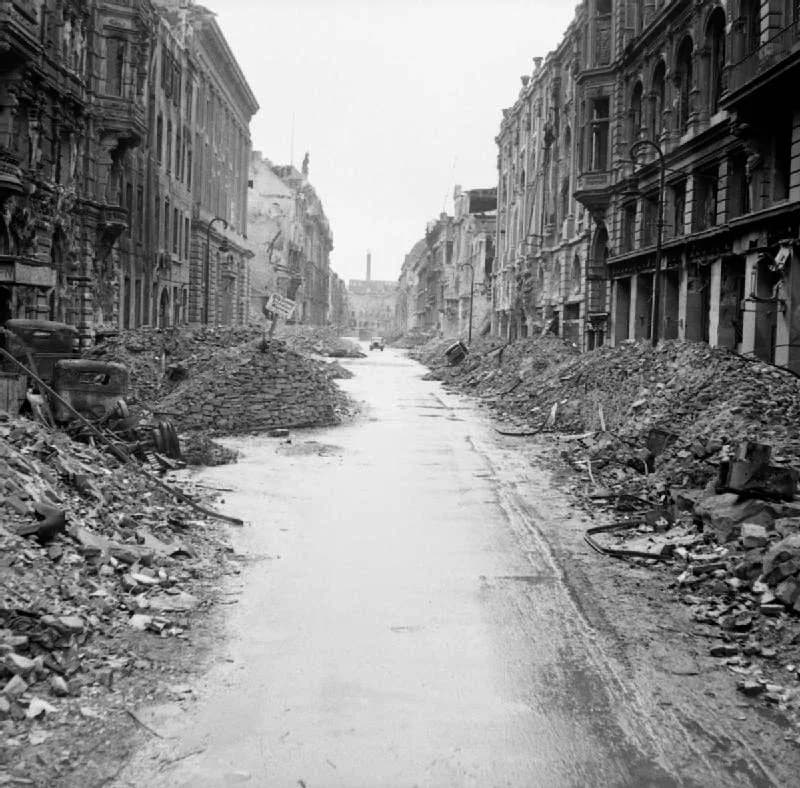
The Battle of Berlin was the final Soviet assault on the capital of the Third Reich, a massive operation involving over two million soldiers that ended the war in Europe with the fall of the Nazi regime. From 16 April to 2 May 1945, the Red Army encircled and then reduced the city street by street; Hitler took his own life in his bunker on 30 April.
The Battle of Berlin took place amid the final collapse of the Third Reich in spring 1945. Since the beginning of the year, Nazi Germany had been caught in a vise between Allied armies advancing from the west and Soviet forces progressing inexorably from the east. The Vistula-Oder Offensive, launched by the Red Army in January 1945, had allowed the Soviets to advance from central Poland to the Oder River, just 60 kilometers from Berlin. This spectacular advance of more than 500 kilometers in a few weeks had stunned the German high command and created a desperate strategic situation. Stalin was determined that Berlin would be taken by Soviet forces and not by the Western Allies, considering the capture of the German capital as a political and symbolic trophy of the highest importance. A fierce rivalry existed between Soviet Marshals Georgy Zhukov, commanding the 1st Belorussian Front directly facing Berlin, and Ivan Konev, commanding the 1st Ukrainian Front to the south. Stalin deliberately exploited this rivalry to stimulate competition between his generals, hoping to accelerate the city's capture. On the German side, Berlin's defense was organized around disparate and often improvised forces. General Gotthard Heinrici, commanding Army Group Vistula, was a recognized expert in defensive warfare and organized defense lines in depth along the Oder and the Seelow Heights, the last major natural position before Berlin. Hitler, entrenched in his bunker beneath the Chancellery since January, stubbornly refused to consider evacuation and continued ordering counteroffensives with divisions that existed only on paper. Berlin's garrison itself comprised a heterogeneous mix of regular troops, Volkssturm members, a popular militia composed of elderly men and teenagers, police, and foreign Waffen-SS volunteers. The morale of these defenders varied considerably, from the fanatical resistance of certain SS units to the resignation of ordinary citizens forced to take up arms. Berlin's civilian population, still numbering nearly three million despite evacuations and bombing, would find itself trapped at the heart of the most devastating combat of the war's end.
The Soviet offensive against Berlin began on April 16, 1945, with an artillery barrage of unprecedented intensity. On the sector of Zhukov's 1st Belorussian Front alone, more than 8,000 guns and Katyusha rocket launchers opened fire simultaneously, creating a wall of fire and steel. Zhukov also used 143 antiaircraft searchlights to blind German defenders, though this tactic had mixed results due to smoke and dust. However, the frontal assault on the Seelow Heights, a defensive position masterfully prepared by Heinrici, met fierce resistance. German forces had evacuated their front lines before the artillery barrage, following Heinrici's advice, and fought from positions in depth. For three days, Zhukov's forces were slowed in bloody fighting, suffering considerable losses in men and materiel. Stalin, frustrated by Zhukov's slowness, authorized Konev to direct his forces toward Berlin from the south, intensifying the rivalry between the two marshals. Konev's 1st Ukrainian Front achieved a faster breakthrough to the south and his armored units raced toward Berlin. On April 20, Hitler's birthday, the first Soviet artillery shells fell on central Berlin. The urban combat that followed was of extraordinary brutality. The Soviets advanced street by street, house by house, making massive use of direct-fire artillery against buildings transformed into fortresses. Soviet tanks, vulnerable in narrow streets to defenders' Panzerfaust weapons, advanced supported by infantry that systematically cleared each building. Berlin's subway tunnels became communication routes and fighting positions for both sides. On April 25, Soviet forces completely encircled Berlin, cutting the city off from all outside relief. The battle then concentrated on the government quarter, the Reichstag, and the Reich Chancellery. On April 30, while fighting raged a few hundred meters from his bunker, Adolf Hitler committed suicide with Eva Braun, whom he had married the previous day. On the same day, Soviet soldiers raised the red flag over the Reichstag, an image that became one of the most iconic symbols of Soviet victory. Berlin's garrison finally surrendered on May 2, 1945, under General Helmuth Weidling's orders, ending one of the most destructive urban battles in history.
The forces engaged in the Battle of Berlin were the most massive of the entire final offensive against the Third Reich. On the Soviet side, three fronts were mobilized for the final assault. Marshal Zhukov's 1st Belorussian Front, directly facing Berlin, had approximately 908,500 men, 3,155 tanks and self-propelled guns, and 14,628 artillery pieces and mortars. Marshal Konev's 1st Ukrainian Front numbered approximately 550,900 men, 1,388 tanks and self-propelled guns, and 7,517 artillery pieces. Marshal Rokossovsky's 2nd Belorussian Front, tasked with covering the northern flank, had approximately 441,600 men. In total, the three Soviet fronts assembled more than 2.5 million soldiers, approximately 6,250 tanks and self-propelled guns, more than 40,000 artillery pieces and mortars, and approximately 7,500 aircraft. It was the largest concentration of military power ever assembled for a single operation. On the German side, forces defending Berlin and its approaches were numerically far inferior and qualitatively degraded after nearly six years of war. Army Group Vistula under General Heinrici, later transferred to General Student's command in the final days, comprised the Ninth Army and the Third Panzer Army, totaling approximately 300,000 regular soldiers with approximately 750 tanks and assault guns and 8,000 artillery pieces. Berlin's garrison itself numbered approximately 45,000 regular soldiers, supplemented by approximately 40,000 Volkssturm members and thousands of Hitler Youth members, some as young as 14. The Waffen-SS also provided defenders, notably the SS Division Nordland composed of Scandinavian volunteers and the SS Brigade Charlemagne composed of French volunteers, who fought with desperate fanaticism knowing they had nothing to expect from capture. Luftwaffe forces were almost nonexistent at this stage, with only a few hundred operational aircraft against thousands of Soviet planes. Air defense relied primarily on 88mm Flak batteries, used in a dual role against Soviet tanks when they penetrated the city.
The consequences of the Battle of Berlin were proportional to the scale and violence of the confrontation. The fall of Berlin signified the end of the Third Reich and Allied victory in Europe. Adolf Hitler's suicide on April 30, 1945, followed by the Berlin garrison's surrender on May 2 and Germany's unconditional surrender on May 8, marked the end of the deadliest war in European history. The human losses of the Battle of Berlin were horrific. Soviet forces suffered approximately 81,000 killed and missing and approximately 280,000 wounded during the Berlin operation, a considerable price paid in part because of Stalin's haste to take the city before the Western Allies. German military losses are estimated at approximately 100,000 killed and approximately 480,000 prisoners. Civilian losses were also catastrophic, with estimates varying between 22,000 and 125,000 Berlin civilians killed in combat, bombing, and suicides. The taking of Berlin by the Red Army was accompanied by massive violence against the civilian population, including systematic sexual violence affecting hundreds of thousands of Berlin women, a trauma long hidden that was not fully recognized by historians until decades later. The physical destruction of Berlin was near total in the city center. The Reichstag, the Chancellery, government ministries, and entire neighborhoods were reduced to rubble. It is estimated that approximately one-third of Berlin's building stock was destroyed during the battle and preceding bombing. Politically, the fall of Berlin and Hitler's suicide paved the way for the division of Germany into four occupation zones and the partition of Berlin itself, which became the symbol of the Cold War for the following four decades. The race between the Allies to reach Berlin profoundly influenced the political geography of postwar Europe and the boundaries between the Western and Soviet blocs.
The legacy of the Battle of Berlin is deeply inscribed in the collective history and memory of multiple nations. For Russia, the taking of Berlin represents the apex of the Great Patriotic War and the ultimate triumph over fascism. Yevgeny Khaldei's iconic photograph showing a Soviet soldier raising the red flag over the Reichstag has become one of the most reproduced images of the twentieth century. Treptower Park in Berlin houses an imposing Soviet memorial featuring a statue of a Soviet soldier holding a German child and trampling a swastika, a monument visited annually by tens of thousands of people. May 9, Victory Day in Russia, sees ceremonies commemorating with great pomp the sacrifice of millions of Soviet soldiers who fell in combat. For Germany, the Battle of Berlin represents the cataclysmic end of the Third Reich and the beginning of confrontation with Nazi crimes. The site of Hitler's bunker beneath the Chancellery, long left anonymous to prevent it from becoming a neo-Nazi pilgrimage site, is subject to careful and thoughtful memorial treatment. The Reichstag, restored and topped with its glass dome designed by Norman Foster, has become the seat of the reunified German Bundestag, a symbol of Germany's democratic rebirth. Graffiti left by Soviet soldiers on the Reichstag's interior walls have been preserved as historical testimonies. The Topography of Terror and the German Resistance Memorial are among Berlin's many memorial sites that contextualize the battle within the broader history of Nazism and its crimes. In military history, the Battle of Berlin is studied as one of the most extreme examples of large-scale urban combat. The Soviet doctrine of massive artillery use in urban environments, systematic building-clearing tactics, and the logistical challenges of supplying millions of soldiers in a dense urban space are all subjects of study for contemporary military strategists. The battle also raises fundamental ethical questions about the human cost of strategic haste and commanders' responsibility toward soldiers and civilians.
This article draws on historical works, military archives and recognized academic publications.
The Battle of Berlin (April 16 - May 2, 1945) engaged over 2.5 million Soviet soldiers across three fronts, with approximately 6,250 tanks and 40,000 artillery pieces. The Germans defended the city with approximately 300,000 regular soldiers, 45,000 in Berlin's garrison, plus 40,000 Volkssturm militia — including teenagers as young as 14. The Soviets lost approximately 81,000 killed; the Germans approximately 100,000 killed and 480,000 prisoners.
Stalin considered the capture of Berlin a political and symbolic trophy of the highest importance — the final victory over Nazism had to belong to the Soviets. He deliberately exploited the rivalry between Marshals Zhukov (1st Belorussian Front) and Konev (1st Ukrainian Front) to accelerate the assault. This haste increased Soviet casualties but ensured it was the Red Army that raised its flag over the Reichstag on April 30, 1945.
Adolf Hitler committed suicide on April 30, 1945, in his bunker beneath the Berlin Chancellery while Soviet troops fought a few hundred meters away. He had married Eva Braun the previous day. On the same day, Soviet soldiers raised the red flag over the Reichstag. Berlin's garrison surrendered on May 2, 1945, under General Helmuth Weidling's orders. Germany signed its unconditional surrender on May 8, 1945.
Information cross-checked against Wikipedia and reference historical works.
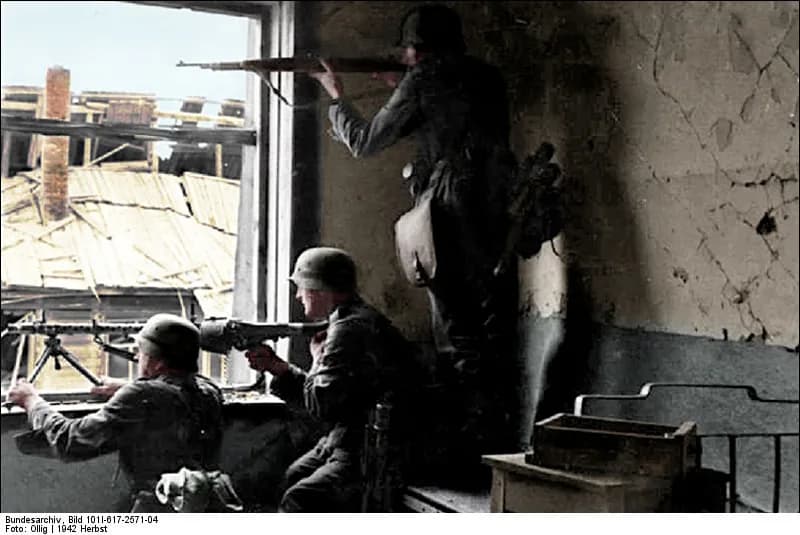
Battle of Stalingrad
The Battle of Stalingrad was among the deadliest clashes of World War II, pitting German and Soviet forces against each other in devastating urban combat that marked a decisive turning point on the Eastern Front. From 23 August 1942 to 2 February 1943, Operation Uranus encircled the German Sixth Army, whose roughly 91,000 survivors surrendered.
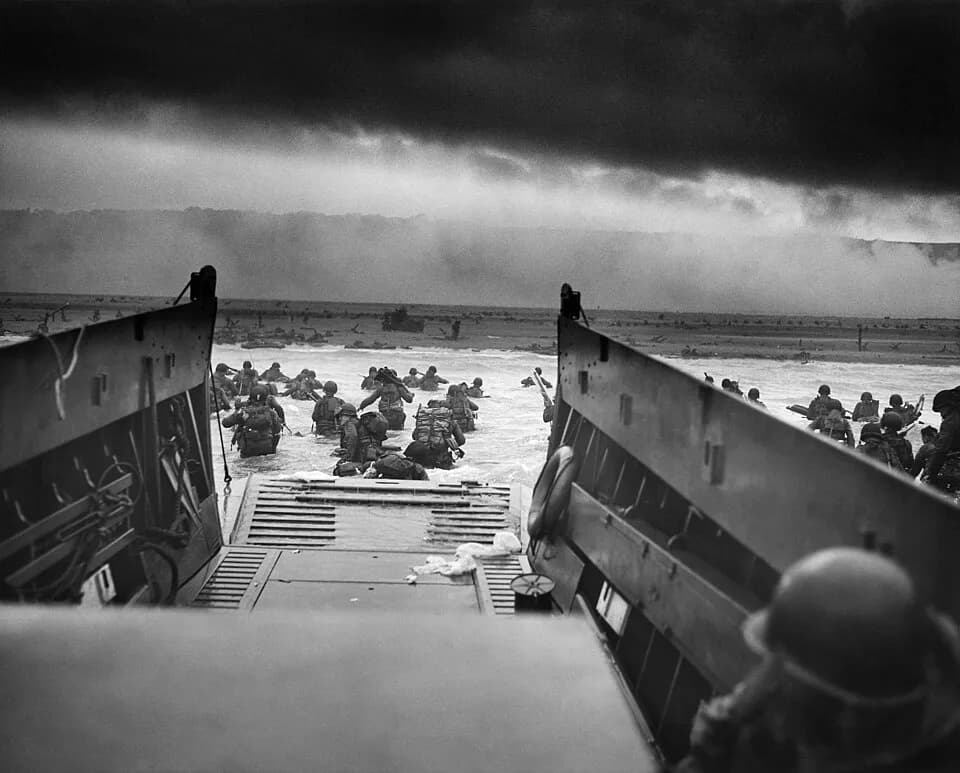
Normandy Landings
The Normandy landings, the largest amphibious operation in history, opened a second front in Western Europe on 6 June 1944, hastening the liberation of France and the defeat of Nazi Germany. Nearly 7,000 vessels put 156,000 men ashore on five beaches in a single day, under air cover and after months of deception meant to mislead the Wehrmacht.
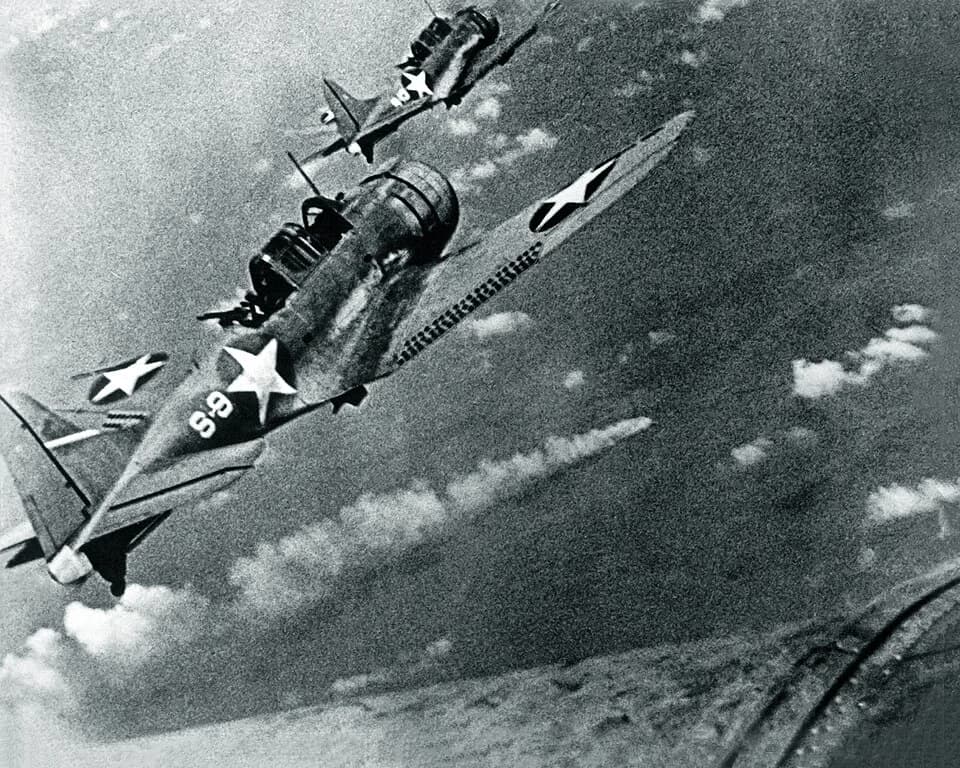
Battle of Midway
The Battle of Midway was the decisive turning point of the Pacific war, where the American navy inflicted a catastrophic defeat on the Japanese fleet by sinking four aircraft carriers, reversing the naval balance. From 4 to 7 June 1942, the decryption of Japanese communications allowed Admiral Nimitz to ambush a fleet that outnumbered his own.
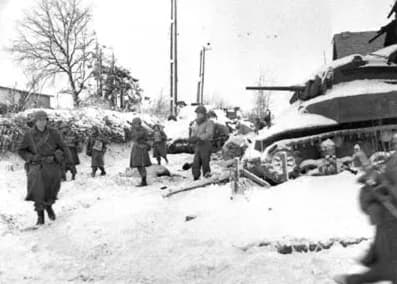
Battle of the Bulge
The Battle of the Bulge was the last major German offensive on the western front, a desperate attempt to break through Allied lines in the Belgian forests that failed against American resistance. Launched on 16 December 1944 under overcast skies that grounded Allied aircraft, it was broken by late January 1945.
