
RX 9070 XT Nitro+ vs RTX 5080 — which one to buy?
+$700 CAD for 10% more FPS: is the RTX 5080 really worth it?
A 2026 showdown between the Sapphire Nitro+ RX 9070 XT 16 GB and the RTX 5080. Specifications, prices recorded in Canadian dollars, benchmarks and an honest verdict for anyone building a PC on a tight budget.
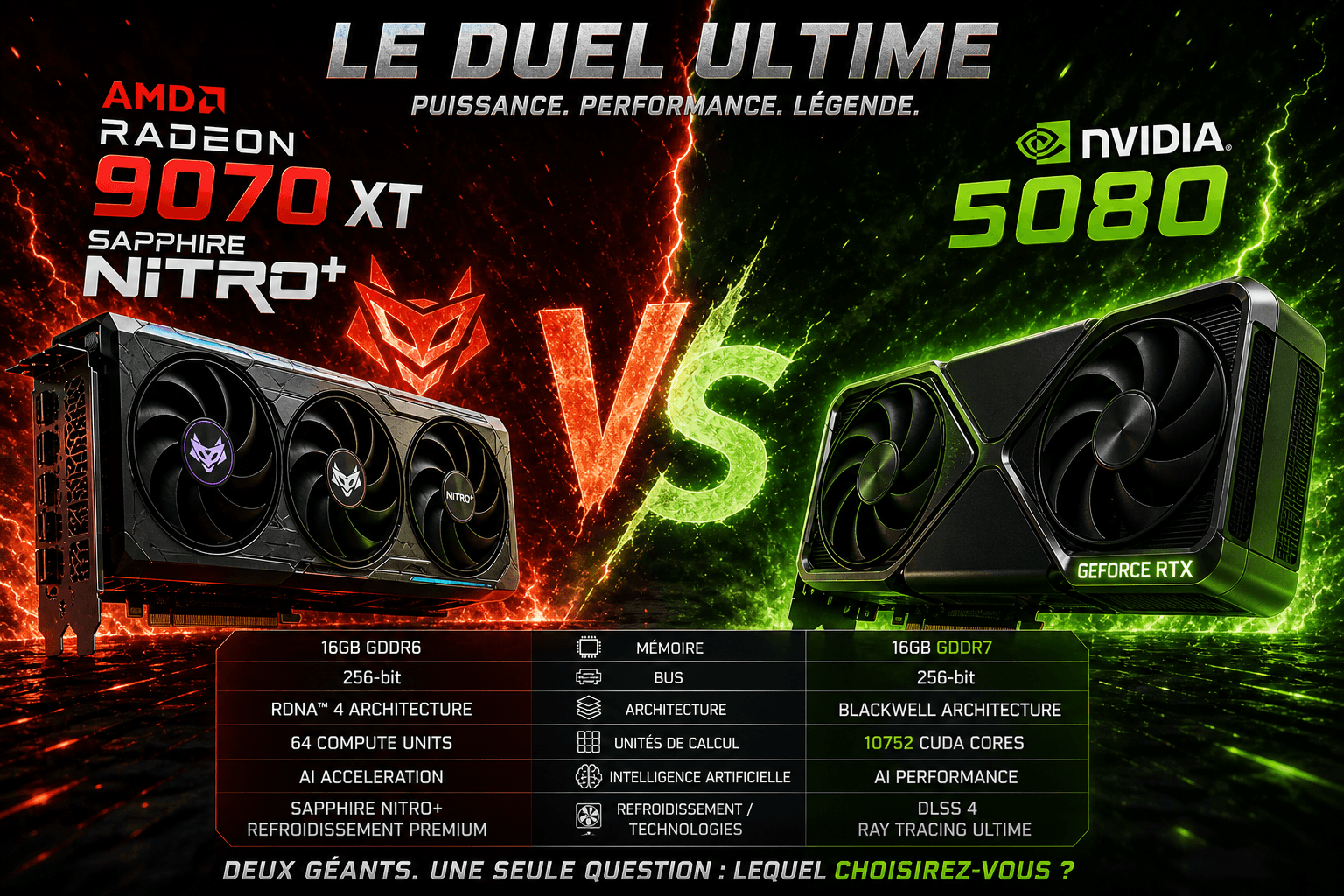
The fight of the year in 2026
It's April 29, 2026. If you want to build a gaming PC this year, you'll come across two graphics cards making waves: AMD's Sapphire Nitro+ RX 9070 XT 16 GB, and NVIDIA's RTX 5080. Both promise smooth 4K, ray tracing, and high FPS. But the price gap is huge — about $700 CAD difference before taxes.
The killer question: is the RTX 5080 really worth it, or is the 9070 XT Nitro+ the smart pick? We dug through benchmarks from TechPowerUp, GamersNexus and Tom's Hardware. We checked real CAD prices. We read Reddit feedback. Here's the truth, no marketing BS.
Quick glossary before diving in: "FPS" means frames per second on your screen (higher is smoother). "Ray tracing" makes light and reflections ultra-realistic but eats GPU power. "VRAM" is the graphics card's dedicated memory — think of it as the card's workbench. "MSRP" is the official price suggested by the maker (often impossible to find in real stores).
Specs side by side
Before looking at FPS, let's check the hardware. Both cards have the same memory amount (16 GB), but everything else differs.
| Spec | Sapphire Nitro+ RX 9070 XT | RTX 5080 |
|---|---|---|
| Architecture | RDNA 4 (AMD) | Blackwell (NVIDIA) |
| Date sortie / Release date | Mars 2025 / March 2025 | 30 janvier 2025 / Jan 30, 2025 |
| Cœurs / Cores | 4 096 stream processors | 10 752 CUDA cores |
| Boost clock officiel / official | 3 060 MHz | 2,62 GHz |
| Boost réel observé / actual OC observed | jusqu'à 3 400 MHz / up to 3,400 MHz | ~2,7 GHz |
| VRAM | 16 Go GDDR6 | 16 Go GDDR7 |
| Bus mémoire / Memory bus | 256-bit | 256-bit |
| Bande passante / Bandwidth | 645 Go/s | 736 Go/s |
| Consommation / TBP | 330 W (Nitro+) | 320 W |
| Connecteur alim / Power connector | 2× 8-pin | 1× 16-pin (12V-2x6) |
What jumps out: the RTX 5080 has almost three times more cores on paper. But careful — AMD and NVIDIA cores don't compare 1-to-1, they're built differently. It's like comparing musician counts in two orchestras: what matters is the result, not the headcount.
The Nitro+ has an interesting trait: its official boost is 3,060 MHz, but with its huge cooler it regularly hits 3,400 MHz in-game. That's free overclock with no tweaking. The RTX 5080 stays tighter around its specs.
On memory, both cards have 16 GB, which is comfortable for 4K in 2026. The RTX 5080 uses faster GDDR7 (736 GB/s vs 645 GB/s for the 9070 XT). In practice, this advantage mostly matters at heavy 4K — massive textures or heavy ray tracing.
Real price in Canadian dollars
Here's where it gets very interesting — and a bit depressing for NVIDIA buyers.
| Card | Official MSRP USD | Market price USD | CAD before tax | CAD with QC sales tax (~15%) |
|---|---|---|---|---|
| RX 9070 XT (référence) | 600 $ | ~700 $ | ~999 $ (Amazon CA) | ~1 149 $ |
| Sapphire Nitro+ RX 9070 XT | 729 $ | ~750–800 $ | 1 099–1 239 $ (selon retailer) | 1 264–1 425 $ |
| RTX 5080 MSRP | 999 $ | introuvable | — | — |
| RTX 5080 prix réel | — | 1 249 $ minimum | ~1 700 $ estimation | ~1 955 $ |
The RTX 5080 drama: official price is $999 USD, but it has NEVER been available at that price since its January 2025 launch. In April 2026, the floor price is around $1,249 USD, which is roughly $1,700 CAD before taxes — and close to $1,955 CAD once sales tax is added.
The Sapphire Nitro+ RX 9070 XT? Count roughly $1,100 to $1,239 CAD depending on retailer (Newegg, Memory Express, Canada Computers). With sales tax, that's $1,264 to $1,425. That's $530 to $690 CAD less than the RTX 5080. You could buy a nice 1440p 240 Hz monitor with that difference.
Performance: who wins, and by how much?
Good news: we have access to dozens of pro benchmarks (TechPowerUp, GamersNexus, Tom's Hardware) that tested both cards on the same games, same PC, same config. Here's the real story.
Without ray tracing (classic rasterization)
- 1440p Ultra: RTX 5080 leads by 7 to 15% on average.
- 4K Ultra: RTX 5080 leads by 7 to 10%. In real numbers, 80–100 FPS for the 5080 vs 75–95 FPS for the 9070 XT.
- Visual difference perceived: minimal. At these FPS levels, the human eye barely tells 85 from 95 FPS apart.
With ray tracing (RT on)
- Here, RTX 5080 takes the lead: +25 to +30% FPS over the 9070 XT.
- Extreme case Black Myth: Wukong 4K RT: NVIDIA completely crushes, gap over 70%.
- Light RT games (Resident Evil 4, Dragon's Dogma 2): 9070 XT stays competitive, gap under 10%.
The plot twist: undervolt changes everything
Tom's Hardware published a telling test: the RX 9070 XT, once undervolted (you lower voltage without losing performance), can BEAT the stock RTX 5080 in Cyberpunk 2077, with around 10% more FPS. It's free, takes 5 minutes in AMD's Adrenalin software. On the Nitro+ with its huge cooler, the undervolt is even more stable.
On upscaling, NVIDIA has DLSS 4 (Multi Frame Generation) which multiplies AI-generated frames. AMD replies with FSR 4, which made a huge quality leap from FSR 3. The DLSS 4 vs FSR 4 gap still exists, but became much more subtle in 2026.
What the community actually says
Benchmarks are one thing. Real user experience is another. We dug through Reddit, HardForum and Overclockers UK forums to collect real feedback after months of use.
« My RX 9070 XT was objectively the better card for my use. But AMD's driver track record pushed me back to the RTX 5080 anyway. I'd rather pay more for peace of mind. »
— u/[utilisateur XDA-Developers]
Recurring 9070 XT criticism
- AMD drivers: some users still report "driver timeouts" (screen freezes for 1-2 seconds then recovers). Not systematic, but documented.
- No CUDA: if you do Blender rendering, machine learning, or pro streaming with NVENC, NVIDIA keeps a clear edge.
- "Extreme" ray tracing: on path-traced games (Cyberpunk Overdrive, Alan Wake 2), AMD stays behind.
Recurring RTX 5080 criticism
- "Never at MSRP": 8 months after release, still impossible to find at $999 USD. Massive frustration.
- 12V-2x6 connector: cousin of the infamous 12VHPWR that had melting issues on RTX 4090. More reliable now, but the fear lingers.
- GamersNexus called the 5080 "a tool to sell 5090s" — disappointing generational gain (+7 to +20% vs RTX 4080 depending on game).
Praise is the opposite: the 9070 XT is hailed as "best value 4K 2026". The 5080 is loved for solid ray tracing, mature NVIDIA ecosystem (very stable drivers, NVENC for OBS, pro CUDA support), and DLSS 4 still ahead of FSR 4.
La Meute QC verdict — no BS
We'll be straight with you. If we had to build a gaming PC today, April 29, 2026, with a realistic budget, the answer is clear: the Sapphire Nitro+ RX 9070 XT 16 GB wins for 80% of gamers.
Why? Because paying $530-$690 CAD more for 7-10% extra rasterization FPS is a bad deal. With that difference, you can buy a better monitor, better keyboard, better SSD, or just keep your money. Ray tracing favors the RTX 5080, yes, but realistically: how many players actually play native 4K path tracing daily? A minority.
The Nitro+ has another hidden strength: build quality. It's a premium Sapphire card, with a massive cooler, ultra-quiet fans, and a solid warranty. It hits 3,400 MHz in-game without flinching, no coil whine, no thermal throttling. For the price of an entry-level RTX 5080, you get a high-end AMD card with nearly the same raster performance.
Who's it for? Who's it not?
Buy the Sapphire Nitro+ RX 9070 XT if you...
- play mainly at 1440p or 4K without extreme path tracing
- want the best FPS-per-dollar ratio of 2026
- play The Isle Evrima, HOI4, Space Engineers 2, Windrose, or competitive titles (CS2, Valorant, Apex)
- want a quiet, well-built card with a clean look
- are comfortable with a simple undervolt to grab 10% free perf
Buy the RTX 5080 if you...
- max out ray tracing or path tracing (Cyberpunk Overdrive, Alan Wake 2)
- do Blender 3D rendering, machine learning, or use CUDA for work
- stream seriously with OBS and want latest-gen NVENC
- have an unlimited budget and want max performance, period
Our final La Meute QC community recommendation: the Sapphire Nitro+ RX 9070 XT 16 GB is the best GPU buy of 2026 for the average gamer. Save $600, grab a nice 1440p 240 Hz monitor, and enjoy life. Your wallet will thank you.
📚 Verified sources
- TechPowerUp — Sapphire Radeon RX 9070 XT Nitro+ Review(verified 2026-04-29)
- GamersNexus — NVIDIA RTX 5080 Founders Edition Review(verified 2026-04-29)
- GamersNexus — AMD Radeon RX 9070 XT Review(verified 2026-04-29)
- Best Value GPU CA — RX 9070 XT Price Tracker(verified 2026-04-29)
- Best Value GPU — RTX 5080 Price Tracker(verified 2026-04-29)
- Tom's Hardware — Undervolted RX 9070 XT beats RTX 5080(verified 2026-04-29)
- XDA Developers — User testimony 9070 XT to RTX 5080(verified 2026-04-29)