
RAMpocalypse — DDR5, SSDs and GPUs spiral in 2026
A 32GB DDR5 kit at $400–500 in May 2026, versus $119 in October 2025 — AI is absorbing DRAM supply and gamers foot the bill
DRAM prices have climbed 497 % in a year, NAND SSDs 351 %. A 32 GB DDR5 kit sold at 119 € in October 2025 now trades at 400 to 500 € in May 2026. We explain why AI-driven demand is the main cause.
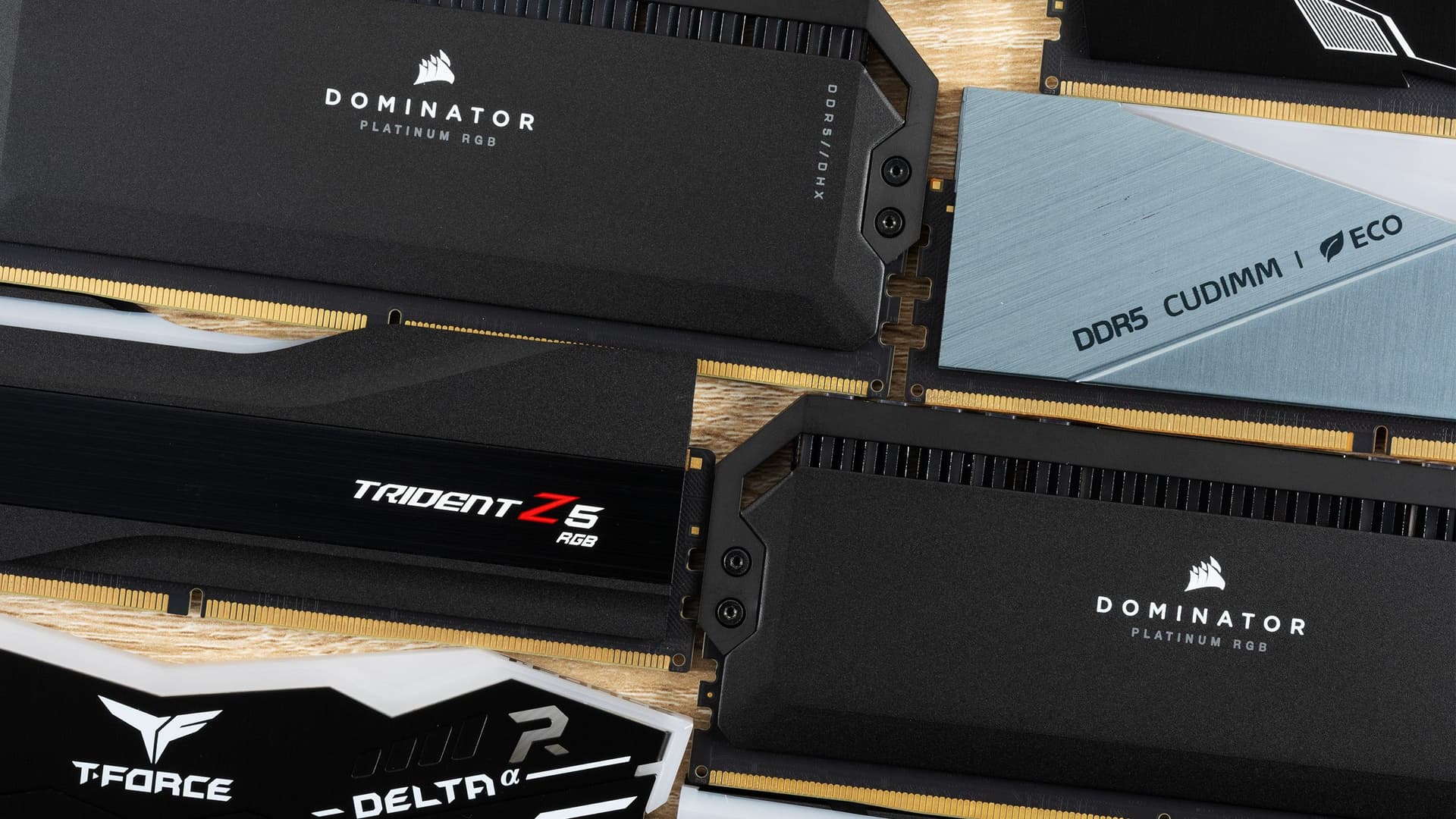
The numbers that hurt
If you've been watching RAM and SSD prices lately, you're not imagining things: they're climbing fast and hard. In May 2026, DRAM rose 20.9% in a single month, for a year-over-year increase hitting 497.4%. On the SSD side, NAND Flash jumped 63.1% between April and May 2026, with a 351.6% annual rise. These percentages translate very concretely: a 32GB DDR5-6000 kit you could buy for $119 in October 2025 now sits between $400–500 in France. In Canadian dollars, that's roughly $600–750 CAD for the same kit.
This isn't a normal market fluctuation. It's a structural market compression with an identifiable cause and a projected duration: according to industry analysts and manufacturer statements, the crisis isn't expected to ease until late 2027 at the earliest.
June 2026 update — the pressure isn't letting up
A month later, nothing has calmed down. In June 2026, DDR5 trades around $14.14 USD per gigabyte, still up 2.4% over the previous month. The cheapest 32GB kit available in the United States has climbed to roughly $375 USD — a year earlier, the same capacity ran $80 to $120. Over twelve months, that's beyond +400%. Gartner also warned in early June that memory costs could surge another 130% before stabilizing.
The driver is the same as in May: Samsung, SK Hynix and Micron keep redirecting their lines toward HBM for AI accelerators. As long as datacenters reserve production before it even leaves the factory, the consumer market absorbs the hit. For a PC build, that means waiting didn't pay off — those who bought in May came out ahead of those who held off.
Graphics cards caught in the same vise
The memory crisis spills onto GPUs, which also rely on chips (GDDR) from the same foundries. In June 2026, the high end spins out: the RTX 5090 sells up to 200% above its suggested price, between $2,000 and $4,100 USD depending on the model. The RTX 5080, 5070 Ti and 5060 Ti hover around 25 to 30% above MSRP. On AMD's side, the Radeon RX 9070 XT has eased back toward $650, one of the segment's rare reliefs.
Practical upshot: building a complete gaming machine in 2026 stacks two price spikes at once — memory and graphics card. For a player targeting 1440p, aiming for an RX 9070 XT rather than a high-end RTX remains the most sensible price compromise today.
AI is absorbing global DRAM production
The main cause is documented and direct: artificial intelligence. Demand for HBM (High Bandwidth Memory), used in AI training GPUs like NVIDIA H100 and H200, far exceeds what foundries can produce. Major memory manufacturers — Samsung, SK Hynix, Micron — have massively redirected production toward HBM at the expense of consumer DDR4 and DDR5 modules. The result: less supply available on the retail market, even when consumer demand remains stable.
Gerry Chen, CEO of Team Group — one of the major consumer memory module manufacturers — quantified the situation: AI-related demand now accounts for 40–50% of global memory supply. And that proportion is expected to keep growing. According to Chen, the majority of memory that will be produced between 2026 and 2027 is already reserved by AI sector players — datacenters, cloud providers, GPU manufacturers — before it's even manufactured. Server product prices are rising 30% per quarter.
What this means for gamers
Concretely, a gaming PC build in 2026 costs significantly more than in 2025 for equivalent specs. A system with 32GB DDR5 — which has become the recommended standard for recent AAA games — represents an added cost of $300–400 CAD compared to seven months ago. For anyone planning a memory upgrade or a new build, the impact is tangible.
NVMe SSDs are equally affected. A 2TB Gen4 SSD that sat around €80–100 at the start of 2026 now comfortably exceeds €200. 1TB SSDs have also reversed years of continuous price drops. For a complete gaming PC with 32GB DDR5 and a 1TB NVMe SSD, the price delta over a year sometimes equals the cost of an entry-level graphics card.
| Component | Oct. 2025 | May 2026 | Increase |
|---|---|---|---|
| DDR5 32 Go (2×16) | ~119 € | 400–500 € | +235–320 % |
| SSD NVMe 1 To Gen4 | ~55 € | ~130 € | +136 % |
| SSD NVMe 2 To Gen4 | ~90 € | ~210 € | +133 % |
"Buy now" — Team Group CEO's advice
In a statement reported by PC Gamer, Gerry Chen was direct: "If you need memory, we recommend purchasing it as soon as possible." This kind of statement from a manufacturer is unusual — memory company CEOs typically avoid advising on purchase timing to prevent speculation or panic buying. That Chen said it publicly suggests the situation is considered serious enough to warrant direct communication.
Take this with appropriate skepticism: a CEO who sells RAM has an objective interest in customers buying. But the structural context — documented AI overdemand, pre-reserved production capacity, consecutive monthly price increases — gives weight to his statement beyond a simple commercial pitch.
Cloud gaming as an alternative during the crisis
In this context, cloud gaming takes on a different practical value. NVIDIA announced this month the extension of RTX 5080 support to nearly the entire GeForce NOW library for Ultimate members — meaning thousands of games can be streamed on virtual rigs far more powerful than what a mid-range build would allow in 2026. For a player waiting to upgrade, GeForce NOW at ~$22 CAD/month can temporarily replace a hardware investment of $800 or more.
It's not a permanent solution — latency remains a factor for competitive games and internet connection needs to be solid. But for single-player games, RPGs, real-time strategy, or narrative games, the difference is imperceptible on a good connection. The memory crisis makes this option more relevant than it was when assembling an affordable gaming PC was more straightforward.
Verdict — wait or buy?
The honest answer: if you have a memory upgrade or new build planned in the next 6–12 months, buying now probably limits the damage compared to waiting. AI production demand won't slow in the short term, and foundry capacity won't increase fast enough to offset demand by late 2026. If your current build still runs fine, don't rush an unplanned purchase — but watch for flash sales, which are the only occasions when prices temporarily dip below the general trend.
📚 Verified sources
- Team Group CEO warns DRAM and SSD prices will still rise — PC Gamer(verified 2026-05-27)
- RAMpocalypse — prix DRAM et SSD explosent — Cowcotland(verified 2026-05-27)
- Pénurie mémoire 2026 — hausse RAM et SSD — DropReference(verified 2026-05-27)
- GeForce NOW RTX 5080 — bibliothèque complète mai 2026 — NVIDIA(verified 2026-05-27)
- RAM Prices 2026 — Gartner Forecasts 130% Memory Cost Surge — TechTimes(verified 2026-06-25)
- RAM price tracking 2026 (DDR5/DDR4) — Tom's Hardware(verified 2026-06-25)