
Switch 2 — success, but 3 real problems
17.37 million Switch 2 sold, but Joy-Con drift is still here.
Ten months after launch, the Switch 2 has passed 17.37 million units sold, yet Joy-Con drift, battery life and pricing remain sore points. Nintendo has still not publicly acknowledged the controller fault.
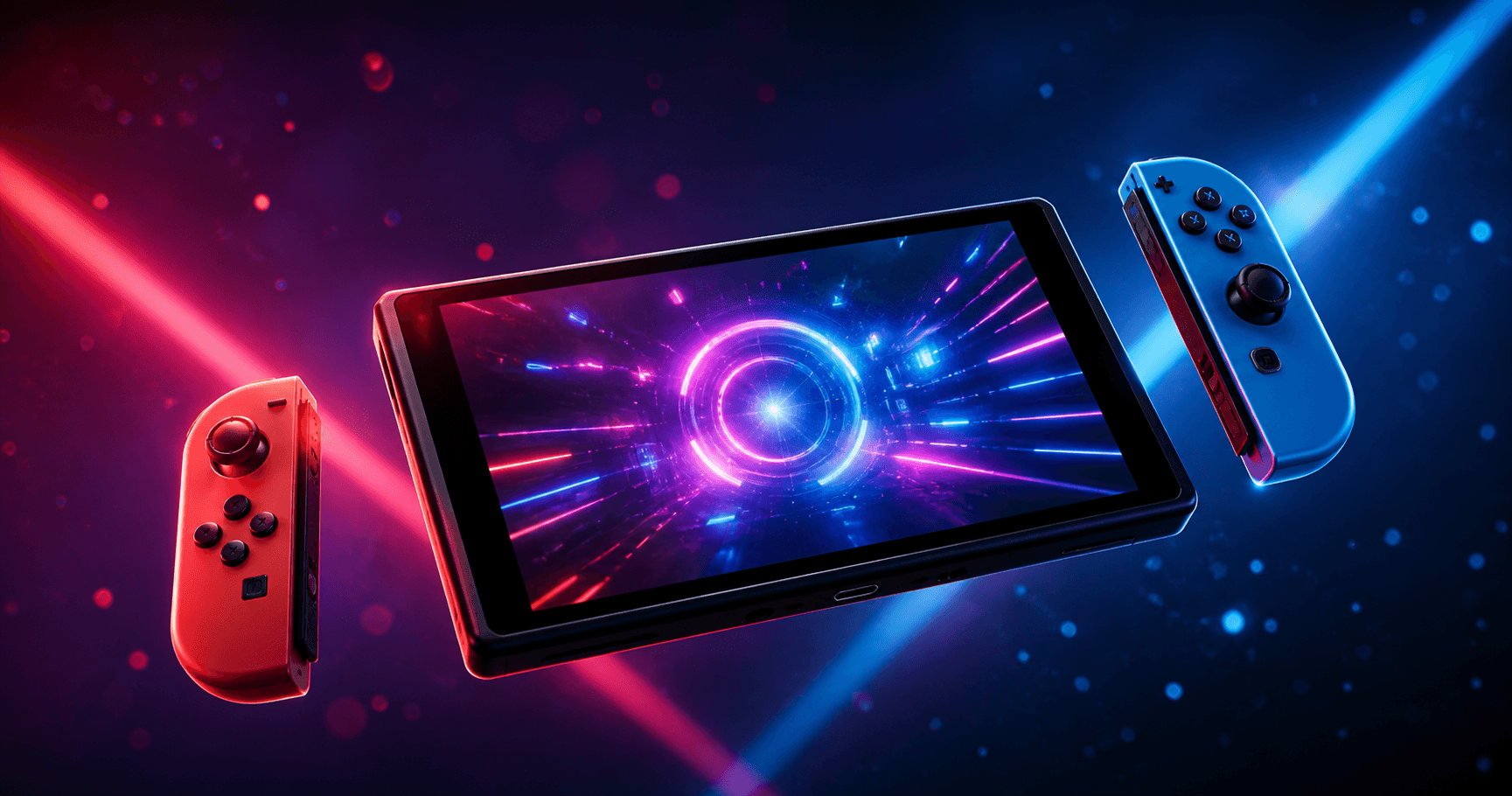
10 months and an awkward success
It is May 2, 2026. The Nintendo Switch 2 launched in Canada nearly eleven months ago, on June 5, 2025. The commercial verdict is clear: Nintendo has shipped 17.37 million consoles according to the Q3 FY2026 report published in February. That is roughly twice as fast as the original Switch over the same period in 2017.
Yet on forums and Reddit, the mood is not celebratory. Three complaints keep coming up: Joy-Con drift that was never fixed, battery life that has barely improved in eight years, and prices that hurt wallets. Here is an honest review of a console that dominates the market while frustrating its own buyers.
What you get for $630
The Switch 2 remains a hybrid console. It plugs into the TV through a dock like its predecessor, or runs portably with a 7.9-inch screen, larger than the Switch 1's 6.2-inch panel. HDMI output reaches 4K when docked on compatible games, and 1080p at 120 Hz handheld on select titles.
Under the hood: a custom NVIDIA chip with hardware ray tracing and DLSS, 12 GB of RAM and 256 GB of internal storage. The expansion slot only accepts microSD Express cards — the old microSD cards from the Switch 1 no longer work. Joy-Cons are magnetic and feel sturdier than the first generation, but the stick remains mechanical and soldered according to the iFixit teardown.
| Spec | Value |
|---|---|
| CPU/GPU | NVIDIA custom (ray tracing, DLSS) |
| RAM | 12 Go |
| Stockage | 256 Go interne, microSD Express |
| Écran | 7,9 pouces, 1080p 120 Hz |
| Sortie TV | Jusqu'à 4K via dock |
| Autonomie | 2 à 6,5 heures selon le jeu |
| Joy-Con | Magnétiques, stick mécanique soudé |
The first-party lineup delivers. In ten months, Nintendo has released roughly 22 in-house games including Mario Kart World at launch (already 14.03 million copies), Donkey Kong Bananza, Metroid Prime 4: Beyond, Pokémon Legends Z-A and Kirby Air Riders. The Duskbloods by FromSoftware and Fire Emblem: Fortune's Weave are announced for this year.
On backwards compatibility, the console accepts most Switch 1 games on cartridge or download, often with a performance boost through a free or paid update. Several major titles such as Zelda: Breath of the Wild, Tears of the Kingdom, Super Mario Bros. Wonder and Xenoblade Chronicles X received a dedicated Switch 2 edition. Original Joy-Cons still pair via Bluetooth but no longer attach magnetically to the console.
The dock is slightly larger than the Switch 1's and now includes an active fan to sustain 4K mode. The USB-C port is faster, but Nintendo still blocks uncertified third-party accessories with a software check, which frustrates accessory makers. Wi-Fi is now Wi-Fi 6 and online connectivity is overall more reliable.
The real cost to get started, in Canadian dollars
The official price on Nintendo.ca is $629.99 CAD for the console alone. The Mario Kart World bundle is $699.99 CAD, saving roughly $30 on the game. That is a 58% increase compared to the $379.99 CAD asked for the Switch 1 in 2017. Inflation explains part of the gap, but not all of it.
The real shock is game pricing. Mario Kart World, Metroid Prime 4 and most Nintendo new releases sell for $89.99 CAD physical or digital. For comparison, first-party PS5 games run between $69.99 and $79.99 CAD. Add a 256 GB microSD Express card at $89.99 CAD because internal storage fills up fast, and the bill keeps climbing.
All told, a family wanting a Switch 2 with one game and a memory card spends about $810 CAD before tax. With two games, the bill passes $900. After GST and QST at 14.975%, it crosses $1,000. That is a clear generational leap for the wallet.
Switch 2 vs PS5 vs Xbox in 2026
For March 2026, VGChartz reports 1.765 million Switch 2 sold worldwide versus 1.043 million PS5 and just 140,000 Xbox Series X|S. Year-to-date through March 2026, Switch 2 totals 3.34 million units, ahead of PS5 at 2.64 million. The new Nintendo is the best-selling console of the year so far.
Even so, PS5 keeps a massive lead on lifetime sales: 92.08 million units since 2020, compared to 18.93 million Switch 2 in April. Sony is responding to Nintendo's pressure by cutting PS5 Pro bundle prices by up to $200. Microsoft is not reacting. The gap is widening for Xbox.
Real competition for the Switch 2 is still Valve's Steam Deck OLED, especially for players who prioritize handheld and indie catalogs. But Valve does not play in the same league: no first-party exclusives, no Mario, no Zelda. Nintendo still has the one catalog you cannot find anywhere else.
On raw power, the PS5 Pro is still ahead on pixels and stable framerate. But Sony has no answer on handheld: its PlayStation Portal still requires a PS5 at home and a solid connection. Microsoft has hinted at an Xbox handheld for late 2026, without firm details. For now, Nintendo owns the hybrid market alone, and that is likely the main reason for the commercial blowout.
What the community holds against it
On Reddit, GamesRadar and specialized forums, three criticisms come up everywhere. First: Joy-Con drift is back. iFixit teardowns confirm Nintendo still uses soldered mechanical sticks, in principle identical to the Switch 1's. Users report drift starting a few months in. Nintendo has hinted at a future move to Hall Effect sensors, with no timeline.
« I paid 630 bucks for a 2026 console and my left Joy-Con drifts after six months. Same as it ever was. »
— u/SwitchOwnerCA, r/NintendoSwitch2
Second complaint: battery life. Nintendo claims 2 to 6.5 hours depending on game and brightness. In practice, user tests give 4 to 6 hours on light games like Animal Crossing, but 2 to 3 hours on Metroid Prime 4 or Pokémon Z-A. That is almost identical to the original 2017 Switch 1. For a console launched nine years later, that is hard to defend.
Third complaint: $89.99 CAD game prices. On jeuxvideo.com and Clubic, comments are harsh. Nintendo justifies the increase with higher component costs — DRAM rose by up to 75% between December 2025 and January 2026, because Samsung and SK Hynix are redirecting production lines to HBM chips for AI. The shortage slowing Switch 2 production stems from the same problem.
La Meute QC verdict
The Switch 2 is a deserved commercial success. The first-party lineup is strong, Mario Kart World delivers, and the console has been outselling PS5 and Xbox monthly since launch. As a pure gaming machine, it is a good one.
But Nintendo is getting away with three things that would not fly at a competitor. Keeping a stick design known for drifting, after a class action and eight years of complaints, is a choice. Selling a 2026 handheld with 2017-era battery life is another choice. Charging $90 for a Mario Tennis game when first-party PS5 titles run around $80 is a third. Three choices, three signs of disrespect for buyers.
Our advice: if you haven't bought yet, wait. Bundles will keep appearing, the DRAM shortage will eventually ease, and there is a good chance a Joy-Con hardware revision lands before end of 2026. If you already own the console, enjoy it — the catalog more than justifies its price.
One last thing to keep in mind: Nintendo has never had so much room to maneuver. The PS5 Pro is slowing down, Xbox has essentially abandoned the console segment, and casual players have no credible hybrid alternative. That means things will not improve on their own. If we want better Joy-Cons or $80 games like Sony's, we have to make it known, either by waiting before buying or by going second-hand.
Who's it for? Who's not?
It's for you if: you mostly play Nintendo exclusives, you do local multiplayer with family, you want a real handheld with a catalog that exists nowhere else, and you can absorb the $800-$1,000 bill for a complete starter setup.
It's not for you if: you want raw performance (PS5 Pro still leads), you mostly play competitive online (the PlayStation and PC ecosystems are stronger), you refuse to pay $90 per game, or you find Joy-Con drift after six months unacceptable. In all those cases, keep your $630 for something else and wait for a possible Switch 2 OLED or a Joy-Con revision.
📚 Verified sources
- Nintendo Switch 2 — page officielle Canada(verified 2026-05-02)
- Nintendo — Résultats financiers Q3 FY2026 (FactorNews)(verified 2026-05-02)
- iGeneration — Switch 2 vs Switch 1 sur le premier mois(verified 2026-05-02)
- GamesRadar — Joy-Con stick drift teardown(verified 2026-05-02)
- iFixit — Switch 2 teardown complet(verified 2026-05-02)
- VGChartz — Ventes hardware mondiales mars 2026(verified 2026-05-02)
- Jeuxvideo.com — Controverse prix jeux 90 $(verified 2026-05-02)
- La Presse — Pénurie de puces mémoire mondiale(verified 2026-05-02)